
IKA MultiDrive MI 250.3 beater, tungsten carbide, 0020023168


€274.50
% Manufacturer's RRP: €372.00 26% below manufacturer's RRP
- Beater made from solid tungsten carbide
- For extremely hard, brittle matrices
- Reduces iron and chromium contamination
- High abrasion resistance
- Crushing through high impact energy
- Precisely fitted for the MI 250 grinding chamber
ⓘ This product description has been translated from German using AI. Despite careful review, we do not guarantee that the translation is error-free; in case of doubt, the German version shall prevail.
Product information "IKA MultiDrive MI 250.3 beater, tungsten carbide, 0020023168"
Solid-state physics and tribological resistance
In geochemical analysis, metallurgy and materials testing, the comminution of extremely hard, mineral or ceramic sample matrices reaches fundamental physical limits. Standard stainless steel grinding tools suffer severe tribological deformation and extreme material wear when used on matrices with a Mohs hardness of over 6. The IKA MultiDrive MI 250.3 beater is made entirely of tungsten carbide (WC). This hard material is characterised by extreme structural density and a hardness reaching values of up to 9.5 on the Mohs scale (just below diamond). This material superiority makes the tool resistant to plastic deformation caused by abrasive micro-collisions with hard ores, quartzites, glasses or slags.
Kinetics of extreme impact crushing
The physical principle of comminution remains identical to that of the standard beater: driven at up to 30,000 revolutions per minute by the MultiDrive system, the MI 250.3 transforms rotational energy into massive kinetic impact energy. Due to the extreme hardness and very high specific gravity of tungsten carbide, the mechanical impulse transferred to the sample material upon impact is significantly more rigid and results in less energy loss than with more elastic steel alloys. The lattice structures of even extremely brittle, crystalline solids are shattered by the incoming shock waves in fractions of a millisecond and converted into a highly fine, analytically usable powder matrix.
Analytical purity during grinding
A key problem in trace element analysis (for example, using ICP-OES or XRF) is sample contamination caused by abrasion of the grinding tool (carry-over). Grinding hard rocks with stainless steel tools can lead to an introduction of iron, chromium and nickel ions, which can distort the quantitative elemental analysis of these metals in the sample. The use of the MI 250.3 tungsten carbide beater reduces this specific heavy-metal contamination caused by stainless steel abrasion.
Technical details
- Product type: Beater for extreme impact crushing (interchangeable tool)
- Material: Tungsten carbide (hard metal)
- Processing principle: Impact and percussion comminution (impact milling)
- Physical scope of application: Extremely hard and brittle matrices (ores, glass, ceramics)
- Hardness of the material: approx. 9 to 9.5 on the Mohs scale
- Analytical advantage: Reduction of iron, chromium and nickel contamination
- Compatibility (vessel): Exclusively suitable for the IKA MultiDrive MI 250 grinding chamber
- Compatibility (drive): IKA MultiDrive basic and MultiDrive control
- Fitting: Tool-free, form-fit replacement in the grinding vessel
Scope of delivery
-
1 x IKA MultiDrive MI 250.3 beater (tungsten carbide)
(Important note: The MultiDrive drive unit and the MI 250 grinding chamber are not included in the scope of delivery!)
Individual requirements & accessories
The MI 250.3 beater is designed for very hard materials. To consistently maintain the analytical integrity of the system during grinding, it is essential that not only the beater but also the grinding chamber itself does not cause any iron contamination. Although tungsten carbide is extremely hard, its crystalline structure makes it more susceptible to bending or lever forces than ductile stainless steel. The tool must never be forced into the vessel at an angle. Please contact our procurement service at any time for the metrologically correct configuration of your milling systems.
Fits

IKA MultiDrive control: drive unit for grinding, mixing and dispersing The IKA MultiDrive control (MPN 0025002643) is a drive for grinding and mixing tasks. Whether you need to crush hard samples, cut fibrous material or homogenise soft substances, this device can be adapted to the task at hand thanks to its interchangeable vessel system. The “control” version offers an integrated scale, RFID recognition and a TFT display. Versatility thanks to the “MultiDrive” concept The name says it all: one drive (“Drive”) for many applications (“Multi”). The separately available vessels transform the unit depending on the task: Grinding chamber (MI 250 / MI 400): For classic dry grinding of hard and brittle materials. Grinding cup (MT 150): Autoclavable plastic grinding cup, 150 ml. Mixing cup (BT 250): Autoclavable plastic mixing cup, 250 ml. Mixing vessel (BL): For wet grinding. Dispersing vessel (DI): With rotor-stator system for dispersing. Tube Mill cup: Thanks to an adapter, even the tried-and-tested disposable cups of the Tube Mill can be used. Integrated weighing function: Precision without detours The MultiDrive control has an integrated scale. In conventional workflows, samples must be weighed, transferred and then ground separately. This often results in material loss or contamination. With the MultiDrive control, you weigh directly into the fitted grinding cup. The display shows the weight. Thanks to the tare function, you can also prepare complex mixtures directly in the beaker without having to remove the vessel. This can save time and cleaning effort and reduces transfer losses of expensive substances. Process control with RFID and TFT In modern laboratories, error prevention is crucial. Thanks to the integrated RFID technology, the base unit automatically recognises which vessel has been fitted. The system then adjusts the parameters accordingly: Speed limit: A dispersion vessel must not rotate as fast as a grinding cup. The device regulates this automatically. Safety functions: Specific settings are enabled. The large, easy-to-read TFT display allows for intuitive navigation. Here, you can not only set the speed and time, but also activate interval operation (for better mixing) or set temperature limits (when used with temperature-sensitive vessels). Temperature measurement and cooling The MultiDrive control, when used in combination with the appropriate vessels (e.g. MI 250-T-S), offers integrated temperature measurement. The sensor in the cup transmits the actual temperature wirelessly to the display. You can define a safety shut-off: ‘Stop the process when 40 °C is reached’. This helps to limit the degradation of heat-sensitive constituents. For even more demanding tasks, the system supports actively coolable grinding cups (double-walled for water cooling) or the use of dry ice for embrittlement directly in the grinding chamber. Motor: 1,000 watts The motor is brushless. With a power consumption of 1,000 watts and speeds ranging from 3,000 to 20,000 rpm, it can also process hard materials. Despite this power, the unit starts up smoothly thanks to frequency converter technology. Easy cleaning and safety Cleaning is simple, as the unit itself (‘Easy Clean Design’) has virtually no nooks where dirt can accumulate, and the grinding cups (available separately) can usually be completely dismantled and are either dishwasher-safe or autoclavable. In terms of safety, the unit is fitted with an electronic brake that stops the tool when the housing is opened. Operation is only possible when the protective housing is closed. Connectivity and documentation The device can be integrated into the laboratory IT system via the USB and Bluetooth interfaces. With the labworldsoft® software (optional), you can create grinding programs, control the device remotely and document all process data (speed, time, temperature, weight). Technical data Device type: Universal mill (drive unit) Motor power input/output: 1,000 W / 800 W Speed range: 3,000 – 20,000 rpm Speed deviation: ± 5 % Weighing function: Yes (integrated) Weighing range: 5 to 4,000 g Temperature measurement: Yes (with RFID vessels) Vessel recognition: Yes (RFID) Display: TFT Interfaces: USB, Bluetooth Dimensions (W x H x D): 300 x 350 x 250 mm Weight: 8.5 kg Degree of protection: IP 31 Scope of delivery 1 x IKA MultiDrive control (base unit) 1 x socket wrench 2 x disassembly tool 1 x cleaning brush 1 x USB cable, USB A to Micro-B, 2 m 1 x operating instructions Grinding chambers and grinding cups are not included and must be ordered separately. WarrantyManufacturer’s warranty from IKA: 2 years, extended to 3 years upon registration at ika.com/register within 90 days of purchase.Regulatory informationThis device is an electrical appliance within the meaning of the German Electrical and Electronic Equipment Act (ElektroG). The WEEE registration number of the manufacturer, IKA, is DE 66784213. Information on the return of old appliances can be found on our page Environment and disposal.Individual requirements & accessories As this unit is modular, you will need accessories to get started. Do you want to grind (MI 250), wet-grind (BL) or disperse (DI)? We can help you put together the right vessels. Please contact our procurement service.

For many years, the IKA M 20 batch mill was the standard piece of equipment for the dry grinding of hard and brittle samples, featuring a fixed grinding chamber and a constant speed of 20,000 rpm. The IKA MultiDrive basic M20 Successor Package replaces it and separates the drive from the grinding chamber: The MultiDrive basic drive operates at a variable speed of up to 20,000 rpm, whilst the supplied MI 250-S grinding chamber, with a 250 ml capacity and a stainless steel beater, can be swapped for other chambers from the MultiDrive range if required. IKA explicitly positions the package as the successor product to the M 20.Successor to the M 20, now with an interchangeable chamberWhereas the M 20 was limited to a permanently integrated grinding chamber, the MultiDrive drive system makes the vessel an interchangeable component. The supplied MI 250-S processes hard and brittle substances up to 250 ml dry; an integrated cooling system in the grinding beaker enables indirect heat dissipation during the grinding process, and dry ice can also be used for cooling if the sample is particularly heat-sensitive. For other sample volumes or types, further grinding chambers, mixing and dispersing vessels are available from the MultiDrive range; these are not included in the scope of delivery for this package and must be ordered separately.Basic configuration without TFT and weighing functionUnlike the ‘control’ version of the MultiDrive platform, this package features a 7-segment LED display instead of a TFT display, and does not include an integrated weighing function, temperature measurement or a WPAN interface. Vessel recognition is included, and a micro-USB interface connects the unit to a computer for documentation purposes. With a power consumption of 1,000 watts and a speed range of 3,000 to 20,000 rpm, the grinding performance remains identical to that of the control range; an intermittent operation mode for pre-grinding hard samples or particularly thorough mixing is also available. For laboratories that rely primarily on grinding performance rather than weighing or temperature data, the ‘basic’ configuration streamlines operation to the essentials.Typical applicationsThis package is aimed at laboratories seeking a robust, variably adjustable batch mill for routine analysis, without requiring the additional functions of the control range.Dry grinding of hard and brittle substances up to 250 mlReplacement for the IKA M 20 batch millGrinding of soft or fibrous samples in day-to-day laboratory workApplications involving varying sample volumes thanks to the interchangeable grinding chamberConversion to wet or fine grinding by changing the vesselsTechnical detailsMotor power input / output1,000 W / 800 WSpeed range3,000 to 20,000 rpm, deviation ±5 %Display7-segment LEDVessel detectionYesOn/off cycle time5 min / 10 minInterfaceMicro-USBPermissible ambient conditions5 to 40 °C, max. 80 % relative humidityConnected load specifications220 to 240 V, 50/60 Hz, 1,000 W (230 V / 100 to 120 V / 100 V variants available)Degree of protectionIP 31 (DIN EN 60529)Dimensions W x H x D300 x 350 x 250 mmWeight8.5 kgScope of delivery1 x IKA MultiDrive basic drive unit1 x MultiDrive MI 250-S grinding chamber, 250 ml, with standard stainless steel beaterAt the end of its useful life, this electrical appliance belongs in the separate collection scheme for waste electrical and electronic equipment (WEEE) and not in household waste.Regulatory informationThis device is an electrical appliance within the meaning of the German Electrical and Electronic Equipment Act (ElektroG). The WEEE registration number of the manufacturer, IKA, is DE 66784213. Information on the return of old appliances can be found on our page Environment and disposal.Individual requirements and procurement serviceIf a suitable grinding chamber is already available, the IKA MultiDrive basic drive unit alone (without a vessel) is also sufficient. Those who also require an integrated weighing function, temperature measurement and a TFT display will find these features in the control packages: the MultiDrive control BT Package for wet samples and the MultiDrive control MT Package for dry samples. The previous model, the IKA M 20, is also available. Further grinding chambers and accessories for IKA mills can be requested via our procurement service. IKA provides a 2-year manufacturer’s warranty on the drive unit, which is extended to 3 years upon registration at ika.com/register within 90 days of purchase.Frequently asked questionsIs this package identical in design to the M 20?No, the M 20 has a permanently fitted grinding chamber; here, the MI-250-S chamber is an interchangeable part mounted on a separate MultiDrive drive.Does the drive have a weighing function?No, this ‘basic’ version has neither a weighing function nor a TFT display; the ‘control’ packages are available for these features.Can the ground material be cooled?Yes, the MI 250-S grinding chamber has an integrated cooling system and can also be cooled with dry ice.How long is the warranty valid for?IKA provides a 2-year manufacturer’s warranty on the drive; this is extended to 3 years if the unit is registered at ika.com/register within 90 days of purchase.What is the drive power of this package compared to the M 20?The MultiDrive drive has a power consumption of 1,000 watts and a speed range of 3,000 to 20,000 rpm, thereby fully covering the previous fixed speed of the M 20, whilst also being variably adjustable.

To grind wet, moist or pasty samples with less carry-over of residues in the grinding tool from one batch to the next: this is what the IKA MultiDrive control BT Package is designed for. The package combines the MultiDrive control drive, featuring a TFT display and integrated weighing function, with the autoclavable single-use BT 250 vessel, which is fitted with a four-blade cross-beater and flow breaker. An RFID chip in the base of the vessel automatically records and limits its service life, ensuring that each grinding run is confined to a fresh vessel; this prevents any subsequent reuse beyond the intended service life.BT 250: Disposable vessel for wet samplesThe BT 250.5 mixing beaker is made of autoclavable plastic and is operated exclusively in conjunction with the supplied TC 1 protective housing, which serves safety during grinding. Five replacement seals are included to ensure that a vessel remains leak-proof over several uses before a new one needs to be ordered. The standardised mounting allows additional vessels from the MultiDrive range to be used, such as grinding chambers for dry material or dispersion vessels with temperature measurement; however, these are not included in the Scope of delivery of this package.Weighing function, TFT display and temperature measurementThe mixing beaker can be weighed directly on the drive; a weighing range of 5 to 4,000 g with a resolution of 1 g covers most laboratory balances without the need to transfer the sample. Temperature measurement from -50 to 120 °C with an accuracy of ±1 K monitors the material being ground during operation. The TFT display clearly shows all values; a WPAN interface and a micro-USB socket connect the unit to a computer for documentation and remote control. With a power consumption of 1,000 watts and a speed range of 3,000 to 20,000 rpm, the drive is designed for coarse to fine grinding; intermittent operation can be activated via a button.Typical applicationsThe BT Package is suitable for laboratories that regularly process different moist sample matrices and want to avoid carry-over between batches.Grinding of moist, wet or pasty samples with reduced cross-contaminationWeighing and grinding in the same vessel, without the need for decantingTemperature-monitored homogenisation of sensitive samplesCoarse to fine grinding with variable speed up to 20,000 rpmTechnical detailsMotor power input / output1,000 W / 800 WSpeed range3,000 to 20,000 rpm, deviation ±5 %DisplayTFT, with RFID read/write unitWeighing range5 to 4,000 g, resolution 1 g, accuracy ±(0.3 % + 2) gTemperature measurement-50 to 120 °C, resolution 0.1 K, accuracy ±1 KDuty cycle ON / OFF5 min / 10 minInterfacesMicro-USB, WPANPermissible ambient conditions5 to 40 °C, max. 80 % relative humidityConnected load220 to 240 V, 50/60 Hz, 1,000 W (100 to 120 V / 100 to 115 V variants available)IP ratingIP 31 (DIN EN 60529)Dimensions W x H x D300 x 350 x 250 mmWeight8.5 kgScope of delivery1 x IKA MultiDrive control drive unit1 x MultiDrive TC 1 protective housing for MT 150 and BT 2501 x MultiDrive BT 250.5 mixing beaker, autoclavable5 x replacement seals for the mixing beakerAt the end of its service life, this electrical appliance must be disposed of via the separate collection scheme for waste electrical and electronic equipment (WEEE) and must not be placed in household waste.Regulatory informationThis device is an electrical appliance within the meaning of the German Electrical and Electronic Equipment Act (ElektroG). The WEEE registration number of the manufacturer, IKA, is DE 66784213. Information on the return of old appliances can be found on our page Environment and disposal.Individual requirements and procurement serviceFor dry samples, the IKA MultiDrive control MT Package with the MT 150 grinding vessel is the more suitable choice; technically, the drive is identical. Those who do not require a weighing function or TFT display and are instead looking for a classic batch mill will find the IKA MultiDrive basic M20 Successor Package to be a simpler alternative based on the same MultiDrive platform. If you already have a vessel from the MultiDrive range, the IKA MultiDrive basic drive unit alone, with no vessel included in the scope of delivery, will suffice. Further grinding and mixing vessels for IKA mills can be requested via our procurement service. IKA provides a 2-year manufacturer’s warranty on the drive unit; this is extended to 3 years if registered at ika.com/register within 90 days of purchase.Frequently Asked QuestionsWhat type of sample is the BT Package designed for?For moist, wet or pasty samples; the BT 250 disposable vessel features a four-blade cross-beater and flow breaker for this purpose.Can the vessel be reused?The integrated RFID chip automatically tracks and limits the vessel’s service life; a new vessel is available as an accessory.What distinguishes the BT Package from the MT Package?The BT Package includes the BT 250 vessel for wet samples, whilst the MT Package includes the MT 150 with a classic stainless steel beater for dry samples. The drive unit is identical in both cases.How long is the warranty valid for?IKA provides a 2-year manufacturer’s warranty on the drive; this is extended to 3 years if the product is registered at ika.com/register within 90 days of purchase.

A single fixed-speed batch mill rarely covers all the grinding tasks required in a laboratory. The IKA MultiDrive basic therefore separates the drive unit from the vessel: a 1,000-watt drive unit with a variable speed range of 3,000 to 20,000 rpm, to which different grinding chambers or mixing vessels can be connected depending on the task.Variable speed from 3,000 to 20,000 rpmThe brushless DC motor draws 1,000 W and delivers 800 W, with a speed deviation of ±5 %. An intermittent operation mode, which can be activated at the touch of a button, allows hard samples to be pre-ground or mixed particularly thoroughly. The operating principle encompasses cutting, impact crushing, mixing and dispersing; an automatic vessel detection system adjusts the drive to suit the connected vessel.Vessels can be selected separatelyThe drive unit itself does not include a grinding chamber or mixing vessel. The sealed MI 250-S and MI 400-S grinding chambers are available for dry grinding, whilst the BL 2000 mixing vessel is available for wet grinding and mixing. The MI grinding chambers can be cooled indirectly using the CS 1 cooling system, whilst keeping the material being ground and the coolant separate. The combination of vessel and beater best suited to a particular sample depends on the hardness of the material and the desired final particle size.Connection and environmental conditionsOperation is indicated via a 7-segment LED display, whilst a micro-USB interface is used to connect to PC software. The permissible ambient temperature range is 5 to 40 °C, and the permissible relative humidity is 80 %. Measuring 300 x 350 x 250 mm and weighing 8.5 kg, the MultiDrive basic is slightly larger and heavier than the M 20, but offers significantly greater flexibility in terms of speed. The unit’s power consumption is 1,000 W at 220 to 240 V, and it has an IP 31 protection rating in accordance with DIN EN 60529.Beaters, blades and qualificationThe MI 250-S and MI 400-S grinding chambers each come with their own beaters and blades made of stainless steel or tungsten carbide (MI 250.1/.2/.3 and MI 400.1/.2/.3), whilst the BL 2000 mixing vessel comes with the standard BL 2000.1 mixing blade. Tungsten carbide is recommended for particularly abrasive or hard samples, where a stainless steel beater would wear out more quickly. For regulated environments, IKA provides factory calibration certificates and IQ/OQ documents for the MultiDrive basic.One drive for multiple batch sizesAs the MI 250-S, MI 400-S and BL 2000 are connected to the same drive, a single MultiDrive basic can be used to process both a small 250-ml batch and a larger 400-ml or 2000-ml batch without the need to purchase a second unit. Automatic vessel recognition ensures that the drive detects which vessel is connected and adjusts the parameters accordingly. For vessels with their own temperature sensor (MI 250-T-S, MI 400-T-S, DI 2000-T), the drive also displays the medium temperature, which is helpful for temperature-sensitive samples.Certificates for regulated establishmentsIn addition to the IQ/OQ documents, IKA also provides general certificates 2.2 and 3.1 for the MultiDrive basic, as well as guidance on carrying out the qualification process. For organisations with documented equipment qualifications, for example, in pharmaceutical development, these documents can be incorporated directly into their own quality management documentation, together with the factory calibration certificate.Typical applicationsGrinding of hard, soft or fibrous samples using a single driveTasks that involve both grinding and mixing or dispersingPreliminary comminution in intermittent operation for particularly tough samplesLaboratories that wish to accommodate different batch sizes by using different vesselsTechnical detailsProcess typeBatchOperating principleCutting / Impact crushing / Mixing / DispersingMotor power input / output1,000 W / 800 WSpeed range3,000 to 20,000 rpmSpeed deviation±5 %Motor principlebrushless, direct currentVessel detectionyesPermissible ambient temperature / relative humidity5 to 40 °C / 80 %USB interfaceMicro-USBDimensions (W x H x D)300 × 350 × 250 mmWeight8.5 kgConnected load220 to 240 V, 50/60 Hz, 1,000 W (other voltage options available)Degree of protectionIP 31 (DIN EN 60529)Scope of delivery1 x IKA MultiDrive basic (drive unit)1 x socket spanner2 x disassembly tools1 x cleaning brush1 x USB cable, USB A to Micro-B, 2 mGrinding chambers and mixing vessels are separate accessories and are not included in the scope of delivery for the drive.Regulatory informationThis device is an electrical appliance within the meaning of the German Electrical and Electronic Equipment Act (ElektroG). The WEEE registration number of the manufacturer, IKA, is DE 66784213. Information on the return of old appliances can be found on our page Environment and disposal.Selection guide and serviceAs a replacement for the classic IKA M 20 Universal Mill, IKA offers the package MultiDrive basic M20 Successor Package with the same drive unit as described here, supplemented by the MI 250-S grinding chamber. If you already own the drive unit or specifically require a different chamber, order the drive unit separately, as described here. For a more advanced configuration featuring a TFT display, RFID and weighing function, the control variants MultiDrive control MT and MultiDrive control BT are available. As an electrical appliance, the MultiDrive basic is covered by the WEEE Directive. IKA offers a 2-year manufacturer’s warranty, which is extended to 3 years if you register at ika.com/register within 90 days of purchase. Through our procurement service, we can help you choose the right grinding chamber, mixing vessel and beater.
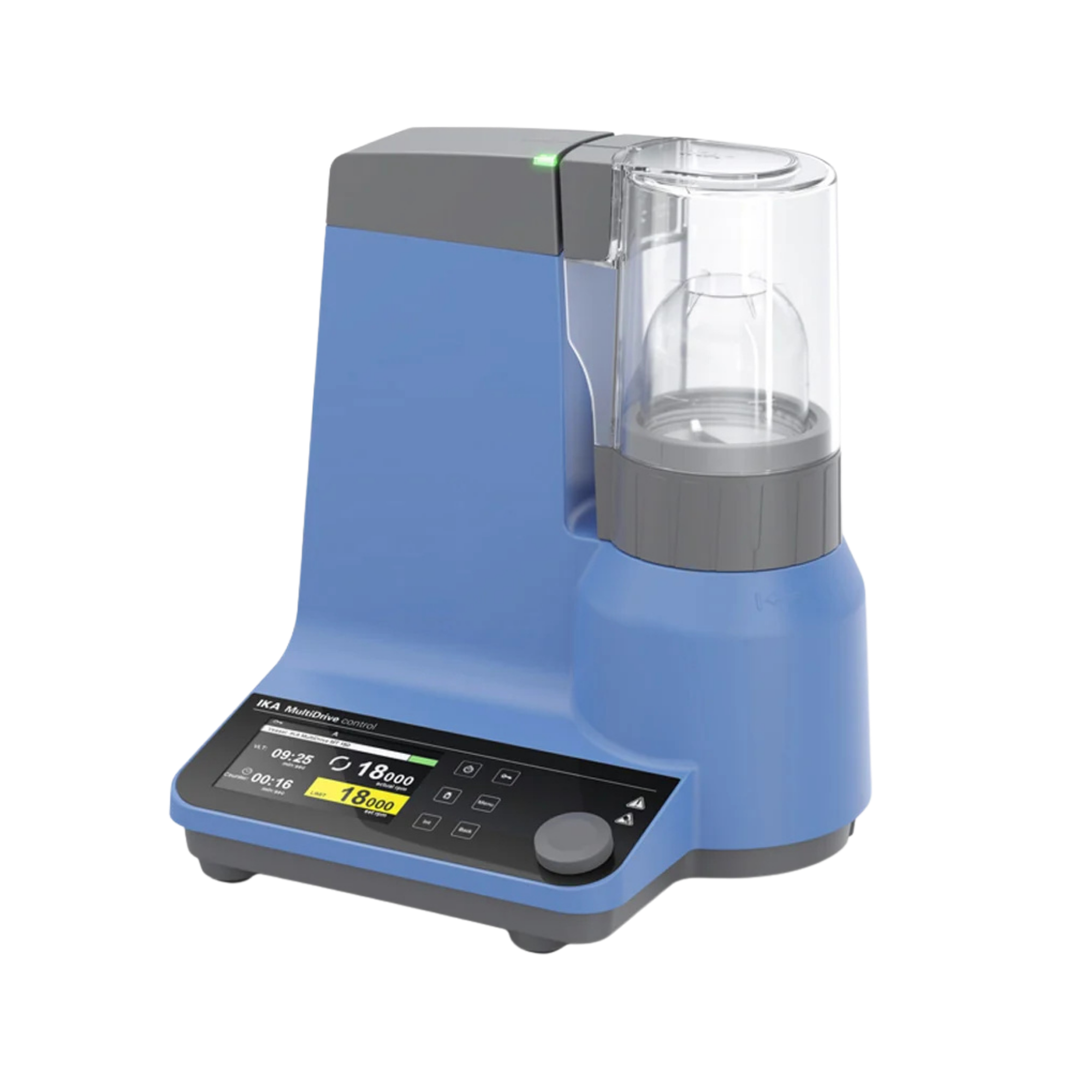
Grinding dry samples whilst directly determining the initial weight using the same vessel: this is what the IKA MultiDrive control MT Package is designed for. The package combines the MultiDrive control drive, featuring a TFT display and integrated weighing function, with the autoclavable disposable MT 150 vessel, which comes with a classic stainless steel beater for dry materials. An RFID chip in the base of the vessel automatically records and limits its service life.MT 150: Disposable vessel for dry samplesThe MT 150.5 grinding vessel is made of autoclavable plastic and is operated exclusively in conjunction with the supplied TC 1 protective housing, which serves safety during grinding. Five replacement seals are included to ensure that a vessel remains leak-proof over several uses before a new one needs to be ordered. The standardised mounting allows additional vessels from the MultiDrive range to be used, such as grinding chambers for other sample volumes or the autoclavable BT 250 for wet samples; however, these are not included in the Scope of delivery of this package.Weighing function, TFT display and temperature measurementThe grinding vessel can be weighed directly on the drive; a weighing range of 5 to 4,000 g with a resolution of 1 g covers most laboratory weighing requirements without the need to transfer the sample. Temperature measurement from -50 to 120 °C, with an accuracy of ±1 K, monitors the ground material during operation. The TFT display clearly shows all values; a WPAN interface and a micro-USB socket connect the device to a computer for documentation and remote control. With a power consumption of 1,000 watts and a speed range of 3,000 to 20,000 rpm, the drive is designed for coarse to fine grinding; intermittent operation can be activated via a button.Typical applicationsThe MT Package is suitable for laboratories that regularly grind dry or fibrous sample material and wish to carry out both weighing and grinding in the same vessel.Grinding of dry and fibrous samples with reduced cross-contaminationWeighing and grinding in the same vessel, without the need for transferTemperature-controlled grinding of sensitive dry samplesCoarse to fine grinding with variable speed up to 20,000 rpmTechnical detailsMotor power input / output1,000 W / 800 WSpeed range3,000 to 20,000 rpm, deviation ±5 %DisplayTFT, with RFID read/write unitWeighing range5 to 4,000 g, resolution 1 g, accuracy ±(0.3 % + 2) gTemperature measurement-50 to 120 °C, resolution 0.1 K, accuracy ±1 KDuty cycle ON / OFF5 min / 10 minInterfacesMicro-USB, WPANPermissible ambient conditions5 to 40 °C, max. 80 % relative humidityConnected load220 to 240 V, 50/60 Hz, 1,000 W (100 to 120 V / 100 to 115 V variants available)IP ratingIP 31 (DIN EN 60529)Dimensions W x H x D300 x 350 x 250 mmWeight8.5 kgScope of delivery1 x IKA MultiDrive control drive unit1 x MultiDrive TC 1 protective housing for MT 150 and BT 2501 x MultiDrive MT 150.5 grinding vessel, autoclavable5 x replacement seals for the grinding vesselAt the end of its service life, this electrical appliance must be disposed of via the separate collection scheme for waste electrical and electronic equipment and must not be placed in household waste.Regulatory informationThis device is an electrical appliance within the meaning of the German Electrical and Electronic Equipment Act (ElektroG). The WEEE registration number of the manufacturer, IKA, is DE 66784213. Information on the return of old appliances can be found on our page Environment and disposal.Individual requirements and procurement serviceFor wet or pasty samples, the IKA MultiDrive control BT Package with the BT 250 vessel is the more suitable choice; technically, the drive is identical. Those who do not require a weighing function or TFT display and are instead looking for a classic batch mill will find the IKA MultiDrive basic M20 Successor Package to be a simpler alternative based on the same MultiDrive platform. If you already have a vessel from the MultiDrive range, the IKA MultiDrive basic drive unit alone, with no vessel included in the scope of delivery, will suffice. Further grinding and mixing vessels for IKA mills can be requested via our procurement service. IKA provides a 2-year manufacturer’s warranty on the drive unit; this is extended to 3 years if registered at ika.com/register within 90 days of purchase.Frequently asked questionsWhat type of sample is the MT Package designed for?For dry and fibrous samples; the MT 150 disposable vessel features a standard stainless steel beater for this purpose.Can the vessel be reused?According to IKA, the vessel is a disposable vessel that can also be used several times, and replacing the seal extends its service life (five spare seals are included). The integrated RFID chip automatically tracks and limits the vessel’s service life; a new vessel is available as an accessory.What distinguishes the MT Package from the BT Package?The MT Package includes the MT 150 vessel for dry samples, whilst the BT Package includes the BT 250 vessel with a cross-beater for wet samples. The drive unit is identical in both cases.How long is the warranty valid for?IKA provides a 2-year manufacturer’s warranty on the drive; this is extended to 3 years if the product is registered at ika.com/register within 90 days of purchase.