
Laboratory supplies
In the general laboratory supplies section, LT Laborhandel offers practical products for everyday use in laboratories, research and production. As well as standard accessories, we stock consumables and protective equipment such as disposable gloves, Paper towels, Laboratory bottles and pipettes. All products are characterised by high-quality workmanship, safe handling and reliability in everyday laboratory use. Whether for sample preparation, cleaning or storing materials: at LT Laborhandel you will find the right laboratory supplies to meet your requirements.
 save up to 10 %
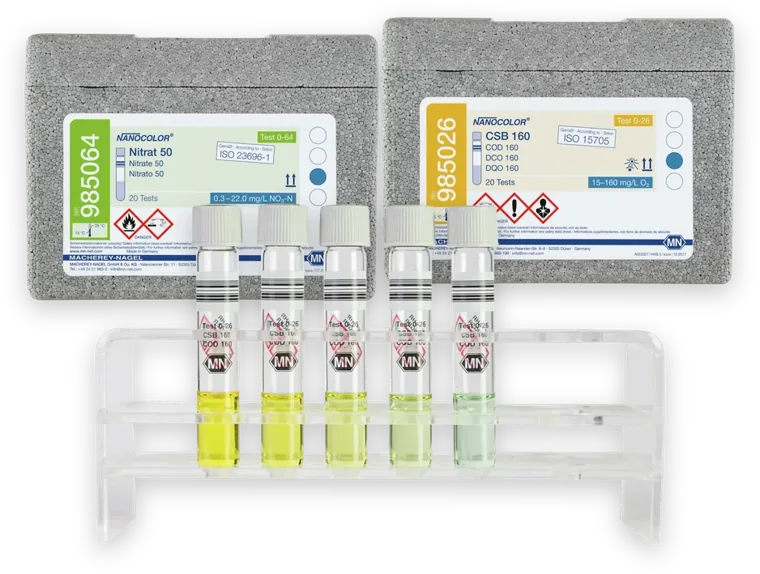
NANOCOLOR tube tests
Round cuvettes with pre-dosed reagents for COD, nitrate, total nitrogen, sulphate, chloride and more.
Compared with the Macherey-Nagel RRP.

Meditrade Nitrile Black Examination Gloves, Black, Powder-free, Pack of 100 (Sizes S to XL), 1284
Black nitrile gloves have now become almost standard in the tattoo and beauty industries, as the dark colour gives a professional appearance and any ink or pigment residue is not immediately noticeable. Meditrade Nitril Black examination gloves are powder-free, latex-free, disposable nitrile gloves with a micro-textured, elastic and tear-resistant surface, available in sizes S, M, L and XL, each in packs of 100. Latex-free for sensitive skin The gloves are completely latex-free and are therefore a suitable choice for staff with a diagnosed type 1 latex allergy, regardless of the area of application. The tear strength is 6 N, tested to an AQL value of 1.5, the standard sampling inspection level for the integrity of disposable gloves. Thickness varies by zone The Nitril Black gloves feature varying thicknesses across different zones: the thickness on the palm is 0.07 mm (± 0.02 mm), on the fingertips 0.10 mm (± 0.02 mm) for added grip on the fingertips, and 0.05 mm (± 0.02 mm) at the cuff for easier donning. This variation in thickness is common in nitrile gloves, as the fingertips are subject to the highest mechanical stress, whilst the wrist primarily requires elasticity. Nitrile as the material of choice Nitrile is a synthetic rubber which, unlike natural latex, does not contain the allergy-triggering latex proteins, whilst offering greater puncture and chemical resistance than latex. For businesses that avoid natural latex entirely for hygiene or compliance reasons, nitrile is therefore the obvious alternative to traditional latex gloves. Furthermore, nitrile retains its shape well even after prolonged wear, which noticeably enhances comfort throughout the entire shift in professions where gloves are changed frequently throughout the day. Tested to EN 455 and EN 374 Nitril Black complies with EN 455 (Parts 1 to 4) for medical disposable gloves, as well as the test standards of the EN 374 series (Parts 1 to 5) for protective gloves against microorganisms and chemicals. In addition, they are tested in accordance with EN ISO 21420:2020, the basic standard for protective gloves in general, and with EN 16523-1 for determining resistance to chemical permeation. The manufacturer also classifies them as food-safe, which is relevant, for example, for inspection tasks in food processing or the catering industry. EN 16523-1 specifies how long it takes and to what extent a chemical penetrates the glove material, providing an additional indicator alongside the pure microorganism barrier as defined by EN 374. Selection guide: choosing the right size The size range starts at S and goes through M and L to XL; an XS size is not available for this model. We can provide width and length measurements on request; when selecting a size, we also recommend comparing it with the size of a disposable glove you already own that fits well. SizeManufacturer’s item no.EAN S1284S4250016405078 M1284M4250016405085 L1284L4250016405092 XL1284XL4250016405108 Differentiation within the nitrile range At LT Laborhandel, the Nitril Black is available alongside several other Meditrade nitrile gloves with the same thickness gradation on the palm, fingertips and cuff. For those looking for a light-coloured glove for food processing rather than the dark contrasting colour, the Meditrade Nitrile 3000 in white offers an alternative with identical wall thickness and additionally documented carton and pallet dimensions. For businesses using colour-coding by station or shift, the Meditrade Nitrile Viola in purple is also available. Anyone requiring a variant tested against blood-borne pathogens with a wider size range up to XXL will find this in the Meditrade Nitrile NextGen. Use and disposal We can provide details of storage conditions and shelf life on request. According to the manufacturer, the glove is non-sterile and intended for single use; it can be worn on either hand. After use, disposable gloves are usually disposed of as clinical waste; contaminated gloves are disposed of separately in accordance with internal hazardous substances regulations. Typical applications The black colour of these nitrile gloves makes them suitable for a variety of sectors and applications: Tattoo and beauty salons, where black is an established, professional-looking colour Catering and event venues, to ensure a uniform, smart appearance for staff Laboratory and examination work, where light-coloured powders, tablets or crystals are more visible on dark gloves than on light-coloured ones General examination and routine tasks where a latex-free, food-safe disposable glove is required For example, when portioning powders or granules in the laboratory, it is immediately apparent whether any residue has become trapped on the dark glove, a contrast that a natural-coloured glove does not provide. Assessing your needs correctly: the pack of 100 for everyday use Nitril Black is sold in packs of 100 per size. A simple rough calculation can help with demand planning: at a rate of 10 gloves per workstation per day, one pack covers around two working weeks; at 30 gloves per day, it lasts for three to four working days. For businesses with higher consumption of several sizes simultaneously, it is advisable to stock several packs of the relevant sizes straight away, so that no workstation runs out of a particular size. The AQL value of 1.5 indicates the maximum number of defective gloves per batch that are tolerated within the framework of statistical sampling; a lower value indicates a stricter inspection. If you stock several sizes at the same time, you can distinguish between the packs of 100 at a glance using the manufacturer’s item number, without having to open the individual packs first. Frequently asked questions about Nitril Black Is Nitril Black latex-free?Yes, the glove is made entirely from nitrile and is therefore latex-free. Is Nitril Black sterile?No, according to the manufacturer, it is a non-sterile, single-use glove. How thick is the glove?The thickness is 0.07 mm on the palm, 0.10 mm at the fingertips and 0.05 mm at the cuff, each with a tolerance of ± 0.02 mm. What sizes are available?S, M, L and XL. An XS size is not available for this model. Is the glove food-safe?Yes, the manufacturer classifies it as food-safe. What is the medical device class and PPE category of the glove?We can provide details of the medical device class and PPE category on request. Technical details MaterialNitrile ColourBlack SurfaceMicro-textured, elastic, tear-resistant Thickness (palm)0.07 mm ± 0.02 mm Thickness at fingertips0.10 mm ± 0.02 mm Cuff thickness0.05 mm ± 0.02 mm Tensile strength6 N AQL1.5 PropertiesPowder-free, latex-free, food-safe, non-sterile, ambidextrous StandardsEN 455-1/-2/-3/-4, EN 374-1/-2/-3/-4/-5, EN ISO 21420:2020, EN 16523-1 Scope of delivery 1 pack = 100 Meditrade Nitrile Black examination gloves (size as per variant selection) Individual requirements and procurement service Do you require larger quantities or a different colour from the Meditrade nitrile range? Our procurement service will be happy to assist you in making the right choice.

Meditrade NextGen Nitrile Examination Gloves, blue, 100 pcs., sizes XS–XXL, 1283X
In day-to-day laboratory work, a nitrile glove must do two things at once: provide reliable protection whilst being so unobtrusive that you forget you’re wearing it whilst working. The Meditrade Nitrile NextGen is designed precisely for this purpose. It is blue, powder-free, latex-free and holds dual certification: as a Class I medical device and as Category III personal protective equipment. This means that a single pack covers what would otherwise require two different types of gloves in the cupboard. Blue nitrile gloves: why the colour matters In laboratory and medical settings, blue is the established signal colour for disposable gloves. It stands out clearly against most work materials, which has two practical advantages. Firstly, a tear or hole is spotted more quickly because of the high contrast with the skin. Secondly, a torn piece of glove is easier to spot in a production process or in a sample than one that is a natural colour. In food processing, this is precisely why blue gloves have been the standard there for years: the colour is virtually never found naturally in food. Thickness, tear resistance and grip The glove is deliberately designed to be thin so that tactile sensitivity is maintained. The thickness is 0.07 mm on the palm, 0.10 mm on the fingertips and 0.07 mm on the back of the hand, in each case with a tolerance of 0.02 mm. The slightly greater thickness on the fingers is no coincidence; this is the area subject to the greatest mechanical stress. Despite the thin material, the median tear strength is at least 6.0 N, both when new and after artificial ageing. This is the more relevant of the two values, as gloves are rarely found on the shelf straight from production. The surface is micro-textured. This ensures a good grip when vessels, pipettes or instruments are damp, without the need to grip any tighter than necessary. The rolled cuff stabilises the glove whilst putting it on and prevents it from rolling down whilst working. With a length of at least 240 mm, it extends securely over the wrist. Latex-free, powder-free, protein-free The Nitrile NextGen is manufactured without natural rubber latex and is therefore suitable for people with a diagnosed type 1 latex allergy. As it is also powder-free, it does not contain maize starch dust, which acts as an allergen carrier in powdered gloves and is a source of particles that can cause disruption in cleanrooms or during sensitive analyses. The glove is also free from mercaptobenzothiazoles and thiurams, two groups of accelerators that are frequently responsible for type 4 contact allergies. However, it does contain dithiocarbamates, which is why it should not be used by anyone with a known hypersensitivity to this group of substances. Dual certification: medical device and PPE Category III As an examination glove, the Nitrile NextGen complies with the EN 455-1 to EN 455-4 series and is classified as a Class I medical device under Regulation (EU) 2017/745. At the same time, it is Category III personal protective equipment (PPE) under Regulation (EU) 2016/425, i.e. the highest category intended to protect against irreversible damage to health. This is demonstrated by testing in accordance with EN 374-1, -2, -4 and -5, as well as EN 16523 for permeation and ASTM F 1671 for the penetration of blood-borne pathogens. The general requirements for protective gloves set out in EN 21420:2020 are also met. The gloves are tested for freedom from holes with an AQL of 1.5. They are manufactured under a quality management system in accordance with EN ISO 13485:2016. The gloves are expressly suitable for contact with food. Typical areas of use Laboratory: sample preparation, handling reagents and disinfectants, work at the workbench, cleaning glassware Medicine and care: examinations, taking samples, changing dressings, patient contact Food processing: Portioning, packaging, order picking, work relating to production hygiene Industry and cleaning: handling cleaning and disinfectant chemicals, assembly and testing work requiring a delicate touch A typical real-world scenario: In a routine laboratory, samples are prepared in the morning, analytical work is carried out at midday, and disinfection takes place in the afternoon. Anyone who has to keep three different types of gloves on hand for this has three stocks to manage and three potential sources of error when reaching into the box. A glove that complies with both EN 455 and PPE Category III, and is also food-safe, reduces this to a single item. Storage and shelf life Store in a cool, dry place and protect from direct sunlight. The shelf life is 3 or 5 years depending on the batch; the exact date is stated on the packaging. The glove is non-sterile and intended for single use only; reuse is not permitted, even after cleaning, as changes in the material cannot be reliably detected. Technical details MaterialNitrile butadiene rubber (NBR) ColourBlue DesignPowder-free, latex-free, protein-free, non-sterile, textured, rolled cuff, ambidextrous SurfaceMicro-textured, elastic and tear-resistant Thickness (palm)0.07 mm ± 0.02 mm Finger thickness0.10 mm ± 0.02 mm Thickness of the shaft0.07 mm ± 0.02 mm LengthMin. 240 mm Width by sizeXS 75 ± 5 mm, S 80 ± 10 mm, M 95 ± 10 mm, L 110 ± 10 mm, XL ≥ 110 mm, XXL ≥ 115 mm Tensile strengthMedian ≥ 6.0 N, before and after ageing Absence of holesAQL 1.5 CategoryClass I medical device in accordance with (EU) 2017/745, Class III PPE in accordance with (EU) 2016/425 StandardsEN 455-1/-2/-3/-4, EN 374-1/-2/-4/-5, EN 21420:2020, EN 16523, ASTM F 1671, DIN EN 374-5 Quality managementEN ISO 13485:2016 Food contactSuitable IngredientsNitrile butadiene rubber, antioxidant, sulphur, zinc oxide, zinc diethyldithiocarbamate, titanium dioxide, zinc dibutyldithiocarbamate, colour pigment Free frommercaptobenzothiazoles, thiurams, natural rubber latex Shelf life3 or 5 years; store in a cool, dry place; protect from direct sunlight Packaging dimensions240 x 125 x 55 mm per pack, 295 x 260 x 250 mm per carton Contents 1 pack = 100 Meditrade Nitrile NextGen gloves, blue (see variant selection for size) Not included: glove dispenser and wall bracket. Larger packs are available as cartons containing 10 packs. Safety instructions For single use only; do not reuse Contains dithiocarbamates; do not use if you have a known hypersensitivity to this group of substances Further information on use can be found in the instructions for use Customised requirements & procurement service Do you require larger quantities, a different container size or a different colour for area segregation? Our procurement service can assist you with product selection, framework agreements and regular deliveries. You can find further models in our Nitrile Gloves category.

Meditrade Nitrile 3000 Examination Gloves, White, Powder-free, 100 Pieces (sizes S to XL), 1280X
You don’t always need specialist equipment for your daily use of nitrile gloves. Meditrade Nitrile 3000 examination gloves are the standard white nitrile gloves in the Meditrade range available from LT Laborhandel; they are powder-free, latex-free and come with fully documented packaging and pallet dimensions for logistics planning. Available in sizes S to XL, each in packs of 100. Latex-free with a tried-and-tested basic formulation The glove is made from nitrile butadiene rubber (NBR) containing the following ingredients: antioxidant, sulphur, zinc oxide, zinc diethyldithiocarbamate, zinc dibutyl dithiocarbamate, titanium dioxide and potassium hydroxide; it is free from mercaptobenzothiazole and thiurams and, according to the manufacturer, is not manufactured using natural rubber latex. The textured surface with a rolled cuff ensures a secure fit and makes the gloves easier to put on and take off. Thickness from the cuff to the fingertips According to the data sheet, the thickness at the shaft is 0.05 mm (± 0.02 mm), at the palm 0.07 mm (± 0.02 mm) and at the fingertip 0.10 mm (± 0.02 mm), ensuring that the greatest mechanical stress is absorbed at the fingertips. The tear strength is at least 6 N both before and after artificial ageing, tested with an AQL value of 1.5. White as a neutral base colour Unlike the coloured variants of the Meditrade nitrile range, Nitrile 3000 is available in a neutral white colour, which is regarded as the standard colour for examination gloves in many organisations and is compatible with almost any corporate design or hygiene concept. For organisations with no specific need for colour-coding or additional testing, it is therefore often the obvious first choice before a more specialised variant, such as a contrasting colour or an additionally tested version, is considered. Class I medical device and Category III PPE The Nitril 3000 is classified as a Class I medical device in accordance with Regulation (EU) 2017/745 and as Category III personal protective equipment in accordance with Regulation (EU) 2016/425. It complies with EN 455 (Parts 1 to 4), EN 374-1, -2, -4 and -5, EN 16523-1 for chemical permeation, EN 420:2003+A1:2009 and EN 21420:2020, and is manufactured under a quality management system certified to EN ISO 13485:2016. According to the data sheet, it is also suitable for contact with food. Selection guide: choosing the right size At LT Laborhandel, the Nitril 3000 is available in sizes S to XL, with widths ranging from 80 mm (± 10 mm) for size S to over 110 mm for size XL. SizeManufacturer’s item no.WidthLength S1280S80 mm (± 10 mm)min. 240 mm M1280M95 mm (± 10 mm)min. 240 mm L1280L110 mm (± 10 mm)min. 240 mm XL1280XL> 110 mmmin. 240 mm Distinctions within the nitrile range Within the Meditrade nitrile range at LT Laborhandel, the Nitril 3000 is the standard white version with fully documented packaging and pallet dimensions. Anyone looking for the same glove in a dark contrasting colour for tattooing, cosmetic or laboratory work involving light-coloured powders will find the Meditrade Nitrile Black, which offers the same range of thicknesses. For businesses using colour-coding, the Meditrade Nitrile Viola in purple is also available. If you require a variant that has been additionally tested against blood-borne pathogens and is available in sizes up to XXL, look for the Meditrade Nitril NextGen. Use, storage, shelf life and disposal According to the data sheet, the shelf life is 3 or 5 years, provided the gloves are stored in a cool, dry place and protected from direct sunlight. The gloves are non-sterile, ambidextrous and intended for single use. According to the information in the data sheet, they contain dithiocarbamates, which should not be used by anyone with a known hypersensitivity to these substances. After use, the gloves are disposed of as clinical waste or via the internal hazardous waste disposal system, depending on the degree of contamination. Typical applications As the basic variant of the nitrile range, the Nitril 3000 is suitable for a wide range of applications: General examination and routine tasks in medical practices, laboratories and care settings Food processing and catering, for which the glove is suitable according to the data sheet Businesses that require a light-coloured, neutral glove without the need for additional testing Logistics-intensive businesses that can plan precisely thanks to documented carton and pallet dimensions For example, during incoming goods inspection in food processing, the same type of glove can be used consistently, from sampling right through to packaging checks. A neutral, widely used basic variant is also practical in training and educational contexts, as it is not tied to a specific workstation or colour-coding scheme. Assessing requirements correctly: from the pack to the box The Nitril 3000 is sold in packs of 100 pieces per size. According to the manufacturer, one carton holds 10 packs, i.e. 1,000 gloves, with a pallet containing 72 cartons (carton dimensions 29.5 x 26.0 x 25.0 cm). A simple rough calculation helps with demand planning: at a consumption rate of 10 gloves per workstation per day, one pack covers around two working weeks; at 30 gloves per day, it lasts for three to four working days. For larger businesses with multiple workstations, the carton dimensions can also be used to plan storage logistics directly, for example, how many cartons will fit on a pallet or on a warehouse shelf. This makes capacity planning easier, particularly for larger businesses with their own warehousing, without having to first request the dimensions separately from the manufacturer. Why a basic version can be a sensible choice Not every business requires the additional ASTM F-1671 testing offered by NextGen or colour-coding by workstation. Where the nitrile glove is primarily intended to provide reliable basic protection in accordance with EN 455 and EN 374, with traceable logistics, the Nitrile 3000 is a cost-effective choice without compromising on tear strength, AQL value or certification compared to the other variants in the range. Frequently asked questions about the Nitril 3000 Is the Nitrile 3000 latex-free?Yes, according to the manufacturer, it is produced without natural rubber latex. Is the glove sterile?No, according to the data sheet, the Nitril 3000 is a non-sterile, single-use glove. How thick is the glove?According to the data sheet, 0.05 mm on the shaft, 0.07 mm on the palm and 0.10 mm at the fingertips, with a tolerance of ± 0.02 mm in each case. How big is a carton and how many fit on a pallet?A carton holds 1,000 gloves (10 packs of 100 each) and measures 29.5 x 26.0 x 25.0 cm; a pallet holds 72 cartons. Are the gloves suitable for food contact?Yes, according to the data sheet, they are suitable for contact with food. Can I order individual gloves instead of the whole pack?No, the pack of 100 pieces per size is the smallest unit sold. How does the Nitril 3000 differ from the coloured variants in the range?It shares the same material and thickness grades as Nitril Black and Nitril Viola, but is the only variant in neutral white without an additional colour-coding function. Technical details MaterialNitrile butadiene rubber (NBR) ColourWhite SurfaceTextured, rolled edge, suitable for both hands Lengthmin. 240 mm Thickness (palm)0.07 mm ± 0.02 mm Fingertip thickness0.10 mm ± 0.02 mm Thickness of shaft0.05 mm ± 0.02 mm Tensile strength (before/after ageing)min. 6 N AQL1.5 Packaging100 pieces per pack, 10 packs per carton (1,000 pieces), 72 cartons per pallet FeaturesPowder-free, latex-free, non-sterile, ambidextrous, food-grade Medical device classI (Regulation (EU) 2017/745) PPE categoryIII (Regulation (EU) 2016/425) Shelf life3 or 5 years; store in a cool, dry place; protect from direct sunlight StandardsEN 455-1/-2/-3/-4, EN 374-1/-2/-4/-5, EN 16523-1, EN 420:2003+A1:2009, EN 21420:2020, EN ISO 13485:2016 Scope of delivery 1 pack = 100 Meditrade Nitrile 3000 examination gloves (size as per variant selection) Individual requirements and procurement service Do you require larger purchase quantities, a different colour from the Meditrade nitrile range, or assistance with warehouse logistics? Our procurement service will be happy to help you make the right choice.

Meditrade Gentle Skin Grip, latex examination gloves, powder-free, 100 pieces – M, 1221GRIP-M
Wet instruments, oily tools or slippery packaging put many disposable gloves to the test: as soon as the surface becomes damp or greasy, the grip decreases noticeably. According to the manufacturer, Meditrade Gentle Skin Grip latex examination gloves are the most grippy latex gloves in the Meditrade range. An acrylic polymer coating on a textured surface provides extra grip where smooth gloves reach their limits. Available in sizes XS to XL, each in packs of 100. Acrylic polymer coating for extra grip In addition to the ingredients typically found in latex gloves, natural rubber latex, sulphur, zinc oxide, zinc diethyldithiocarbamate, zinc dibutyl dithiocarbamate, titanium dioxide and antioxidants, the Grip range also features an acrylic polymer coating on the textured surface. This coating is the key difference compared to traditional latex gloves without any special grip optimisation and, according to the manufacturer, improves grip, particularly when handling damp, oily or powdery surfaces. The glove is free from mercaptobenzothiazole and thiurams. Thickness from the cuff to the fingertips According to the manufacturer’s data sheet, the thickness at the cuff is at least 0.08 mm, at the palm at least 0.11 mm and at the fingertips at least 0.12 mm, ensuring that the greatest material thickness is available at the point subject to the most stress. The tear strength is at least 6 N both before and after artificial ageing, tested with an AQL value of 1.5 for the absence of holes in the batch. The rolled hem also makes it easier to put on and take off the gloves, even when the hands themselves are already damp. Class I medical device and PPE Category III The glove complies with EN 455 (Parts 1 to 4) for single-use medical gloves, as well as EN 374-1, -2, -4 and -5 for protection against microorganisms, supplemented by EN 16523-1 for chemical permeation and EN 420:2003+A1:2009 as the general standard for protective gloves. It is classified as a Class I medical device in accordance with Regulation (EU) 2017/745 and as Category III personal protective equipment under Regulation (EU) 2016/425, and is manufactured under a quality management system certified to EN ISO 13485:2016. Why smooth gloves reach their limits in wet conditions A purely textured glove without an additional coating loses some of its grip when it comes into contact with water, oil or cleaning agents, because a thin film of liquid forms between the glove and the workpiece. This is precisely where the acrylic polymer coating of the Gentle Skin Grip comes into its own: According to the manufacturer, it increases friction even in damp conditions without compromising the elasticity of the natural latex. For standard dry tasks without any particular risk of slipping, however, a simpler latex glove from our range is often sufficient. Selection guide: choosing the right size As with the other Gentle Skin gloves, the size range from XS to XL is based on the width of the hand, measured at the widest point excluding the thumb. SizeManufacturer’s item no.WidthLength XS1221GRIP-XS< 80 mmmin. 240 mm S1221GRIP-S80 mm (± 10 mm)min. 240 mm M1221GRIP-M95 mm (± 10 mm)min. 240 mm L1221GRIP-L110 mm (± 10 mm)min. 240 mm XL1221GRIP-XL> 110 mmmin. 240 mm Distinction within the Gentle-Skin latex range Within the Meditrade latex range available from LT Laborhandel, the Grip differs from the other two variants primarily due to its coating. Those who, on the other hand, require a particularly fine sense of touch for pipetting and laboratory work are better served by the low-protein Meditrade Gentle Skin Sensitive, which has a slightly thinner wall thickness of 0.13 mm at the fingertip. For general routine use without any specific grip or protein requirements, the Meditrade Gentle Skin compact+ is available, with a comparable basic wall thickness. All three are certified to EN 455 and EN 374 and are classified as a Class I medical device and PPE Category III. Those wishing to avoid natural latex entirely will find latex-free alternatives in our range of nitrile gloves, although these do not feature the grip coating described here. Use, storage, shelf life and disposal According to the data sheet, the shelf life is 3 or 5 years, provided the gloves are stored in a cool, dry place and protected from direct sunlight. The gloves are non-sterile, ambidextrous and intended for single use only. As the gloves are made from natural rubber latex, the manufacturer expressly warns of the risk of allergic or even anaphylactic reactions. After use, the gloves are disposed of as operational waste or via the internal hazardous waste disposal system, depending on the level of contamination. Typical applications The non-slip coating makes the Gentle Skin Grip ideal for use wherever moisture or grease would otherwise make a firm grip difficult: Cleaning and processing of laboratory glassware and instruments, often in contact with water or cleaning agents Handling oily or greasy components in workshops and industry Packaging and order-picking tasks involving frequent changes of material Examination and care tasks where a secure grip on damp surfaces is required For example, when rinsing and sorting laboratory glassware under running water, the grip is maintained, whereas an uncoated glove would slip more easily in the same situation. The difference compared to a smooth glove surface is also clearly evident when handling greasy seals or lubricants in the workshop. Assessing your requirements correctly: from the pack to the box Gentle Skin Grip is sold in packs of 100 per size; according to the manufacturer’s data sheet, a box contains 10 packs, i.e. 1,000 gloves. A simple rough calculation can help with demand planning: at a rate of 10 gloves per workstation per day, one pack covers around two working weeks; at 30 gloves per day, it lasts for three to four working days. Businesses with multiple workstations or frequent glove usage should ideally stock several packs of the appropriate size to ensure that no workstation runs out of a particular size. Frequently asked questions about Gentle Skin Grip What sets the Grip apart from other latex gloves?The textured surface is additionally coated with an acrylic polymer, which, according to the manufacturer, improves grip on damp or oily surfaces. Is the glove sterile?No, according to the data sheet, it is a non-sterile, single-use glove. How thick is the glove?The thickness is at least 0.08 mm on the cuff, 0.11 mm on the palm and 0.12 mm at the fingertips. Is the Grip suitable for people with a latex allergy?No, the glove is made of natural rubber latex and, according to the manufacturer, may trigger allergic or even anaphylactic reactions. What is the shelf life of the glove?According to the data sheet, 3 or 5 years when stored in a cool, dry place, protected from direct sunlight. Is the Grip coating also available on a latex-free glove?For this data sheet, the coating is only documented for the latex version. For a latex-free alternative offering comparable grip performance, our procurement service will be happy to assist you with your selection. What sizes are available?XS, S, M, L and XL, each with its own width specification as per the data sheet, ranging from under 80 mm to over 110 mm. Can I order individual gloves instead of the whole pack?No, the product is sold exclusively in packs of 100 per size. Technical details MaterialNatural rubber latex with an acrylic polymer coating SurfaceTextured, rolled cuff, ambidextrous Lengthmin. 240 mm Thickness (shaft)min. 0.08 mm Palm thicknessmin. 0.11 mm Fingertip thicknessmin. 0.12 mm Tensile strength / breaking strength (before/after ageing)min. 6 N AQL1.5 Packaging100 pieces per pack, 10 packs per carton (1,000 pieces) CharacteristicsPowder-free, non-sterile, textured, rolled cuff, ambidextrous, free from mercaptobenzothiazole and thiurams Medical device classI (Regulation (EU) 2017/745) PPE categoryIII (Regulation (EU) 2016/425) Shelf life3 or 5 years; store in a cool, dry place; protect from direct sunlight StandardsEN 455-1/-2/-3/-4, EN 374-1/-2/-4/-5, EN 16523-1, EN 420:2003+A1:2009, EN ISO 13485:2016 Scope of delivery 1 pack = 100 Meditrade Gentle Skin Grip latex examination gloves (size as per variant selection) Individual requirements and procurement service Do you require a different size, a latex-free alternative with similar grip, or larger purchase quantities for your business? Our procurement service will be happy to assist you in making the right choice.

Meditrade Gentle Skin Sensitive Latex Gloves, natural colour, powder-free, 100 pieces, size L, 1221RLT
Anyone who spends many hours in a laboratory or in a care setting pipetting, decanting samples or handling delicate instruments will quickly realise whether a glove is helpful or more of a hindrance. Meditrade Gentle Skin Sensitive latex gloves are low-protein natural latex gloves designed specifically for this kind of fine motor work: powder-free, thin-walled and with a stretch that moulds closely to the hand without causing fatigue even when worn for hours on end. Available in sizes XS to XL, each pack containing 100 gloves. Low-protein thanks to a multi-stage processing method Natural latex naturally contains water-soluble proteins which can trigger skin reactions in sensitised individuals. The Sensitive range is therefore processed using a multi-stage washing process and additionally undergoes double chlorination, which reduces the protein content whilst also allowing the gloves to be put on easily without powder. This does not make the glove completely latex-free; it remains a natural rubber product containing natural rubber latex, sulphur, dithiocarbamate, zinc oxide, titanium dioxide, potassium hydroxide, calcium carbonate, polyacrylate and colour pigments. If you have a known Type 1 latex allergy, a nitrile glove from our range is therefore the safer choice. Gradual thickness variation from the palm to the fingertips According to the manufacturer’s data sheet, the thickness at the palm is at least 0.11 mm, and at the fingertips 0.13 mm (± 0.02 mm), slightly thicker to provide additional tactile sensitivity and mechanical strength precisely where the greatest stress occurs during gripping and pipetting. The tear strength is at least 6 N both before and after artificial ageing, tested with an AQL value of 1.5 for the absence of holes in the batch. The textured, micro-roughened surface with a rolled hem also ensures a secure grip, whether used dry or in contact with aqueous solutions. Class I medical device and PPE Category III The glove complies with EN 455 (Parts 1 to 4) for single-use medical gloves, as well as EN ISO 374-1, -2, -4 and -5 for protection against microorganisms, supplemented by EN 16523-1 for chemical permeation and EN ISO 21420:2020 as the basic standard for protective gloves in general. It is classified as a Class I medical device under Regulation (EU) 2017/745 and as Category III personal protective equipment under Regulation (EU) 2016/425, and is manufactured under a quality management system certified to EN ISO 13485:2016. According to the data sheet, it is also suitable for contact with food, which is relevant, for example, for sample preparation in food analysis. Latex or nitrile: when it’s worth switching Natural latex offers high elasticity with low mechanical stress, which means the Gentle Skin Sensitive fits snugly to the hand and provides a particularly fine sense of touch. However, natural latex is less suitable for tasks involving non-polar solvents such as oils or fats, as the material can swell. In such cases, or where there is a known latex allergy, a nitrile glove from our range is the more appropriate choice, offering a comparable fit but greater chemical resistance. Selection guide: choosing the right size The size range extends from XS to XL and is based on the width of the hand, measured at the widest point excluding the thumb. A glove that is too tight causes the hand to tire more quickly when worn for long periods, whilst a glove that is too loose reduces both tactile sensitivity and a secure grip. SizeManufacturer’s item no.WidthLength XS1221RXST< 80 mmmin. 240 mm S1221RST80 mm (± 10 mm)min. 240 mm M1221RMT95 mm (± 10 mm)min. 240 mm L1221RLT110 mm (± 10 mm)min. 240 mm XL1221RXLT> 110 mmmin. 240 mm Differentiation within the Gentle Skin latex range At LT Laborhandel, the Gentle Skin Sensitive is available alongside two other latex gloves from the same Meditrade range. Anyone who, in addition to a fine sense of touch, requires greater grip on damp or oily surfaces will find this in the textured Meditrade Gentle Skin Grip with its acrylic polymer coating. For day-to-day routine use without the protein-reduced processing of the Sensitive range, the Meditrade Gentle Skin compact+, with a comparable wall thickness, is an obvious alternative from the same product family. All three share the same basic construction made from natural latex with a rolled cuff and certification to EN 455 and EN ISO 374-1, but differ in wall thickness, surface treatment and protein content. Those who wish to avoid natural latex altogether will find a latex-free alternative in our range of nitrile gloves. Use, storage, shelf life and disposal According to the manufacturer, the gloves are suitable for all areas where there is a risk of contamination, ranging from highly infectious situations in hospitals and doctors’ surgeries, through the care sector and laboratories, to the pharmaceutical industry, cleaning and industrial applications. According to the data sheet, the shelf life is 3 or 5 years, provided they are stored in a cool, dry place and protected from direct sunlight. The gloves are non-sterile and intended for single use only; used gloves are disposed of as clinical waste or via the internal hazardous waste disposal system, depending on the level of contamination. It is recommended that the gloves be changed at the latest upon the first visible sign of damage or soiling, even if the specified shelf life of 3 or 5 years has not yet been reached. Typical applications The low-protein formulation makes the Gentle Skin Sensitive particularly suitable for situations where tactile sensitivity and skin compatibility are both essential: Sample preparation and pipetting tasks in the laboratory where dexterity is required Care and examination tasks involving frequent glove changes throughout a shift Food analysis and quality control, where the glove is suitable for food contact according to the data sheet Cleaning and routine tasks in the pharmaceutical industry and industrial settings For example, when pipetting a series of samples over several hours, the thin-walled material on the palm and fingertips can be utilised without the hand tiring prematurely, an advantage over thicker standard gloves. Assessing requirements correctly: from the pack to the carton Gentle Skin Sensitive is sold in packs of 100 per size. According to the manufacturer’s specifications, one carton contains 10 packs, i.e. 1,000 gloves, with a pallet comprising 56 cartons. A simple rough calculation can help with demand planning: at a rate of 10 gloves per workstation per day, a pack of 100 will last for around two working weeks; at 30 gloves per day, it will last for three to four working days. For businesses with multiple workstations or varying sizes, it is advisable to stock several packs of the appropriate size straight away, to ensure that no workstation runs out of a particular size. Frequently asked questions about Gentle Skin Sensitive Is the Gentle Skin Sensitive suitable for people with a latex allergy?No. The glove is low in protein but is still made from natural rubber latex. For those with a known Type 1 latex allergy, we recommend a nitrile glove from our range. Are the gloves sterile?No; according to the data sheet, they are non-sterile, single-use gloves. How thick is the glove on the palm and fingertips?The thickness is at least 0.11 mm on the palm and 0.13 mm (± 0.02 mm) on the fingertips. Is the glove suitable for contact with food?Yes, according to the data sheet, it is suitable for contact with food. What is the shelf life of the glove?3 or 5 years according to the data sheet, provided it is stored in a cool, dry place and protected from direct sunlight. Can I order individual gloves instead of the whole pack?No, the sales unit is a pack of 100 per size. Technical details MaterialNatural latex ColourNatural white SurfaceTextured, chlorinated, rolled edge Lengthmin. 240 mm Thickness (palm)min. 0.11 mm Fingertip thickness0.13 mm ± 0.02 mm Tensile strength (before/after ageing)min. 6 N AQL1.5 Packaging100 pieces per pack, 10 packs per carton (1,000 pieces), 56 cartons per pallet FeaturesPowder-free, non-sterile, textured, rolled cuff, ambidextrous, food-grade Medical device classI (Regulation (EU) 2017/745) PPE categoryIII (Regulation (EU) 2016/425) Shelf life3 or 5 years; store in a cool, dry place; protect from direct sunlight StandardsEN 455-1/-2/-3/-4, EN ISO 374-1/-2/-4/-5, EN 16523-1, EN ISO 21420:2020, EN ISO 13485:2016 Scope of delivery 1 pack = 100 Meditrade Gentle Skin Sensitive latex gloves (size as per variant selection) Individual requirements and procurement service Do you require a different size, a sterile version or larger purchase quantities for your laboratory or practice? Our procurement service will be happy to assist you in making the right choice.

DURAN ® Laboratory flask, clear, graduated, GL 45, without screw cap and pouring ring, 3500 ml, #218016908
DURAN ® Laboratory flask, clear, graduated, GL 45, without screw cap and pouring ring, 3500 ml, with DIN 168-1 thread, graduated, #218016908

Meditrade Gentle Skin Compact+ Latex Gloves, Natural White, Pack (100 Pieces), 1221I
Even where natural rubber latex is not required, its elasticity and comfort make it the first choice amongst disposable gloves for many users. Meditrade Gentle Skin compact+ latex gloves are powder-free, natural white, online-chlorinated for easy donning and doffing, and available in packs of 100 in sizes XS to XL. Natural rubber latex for high elasticity The glove is made from natural rubber latex with a textured surface and a rolled cuff. The online chlorination process reduces the material’s natural stickiness, making the glove easier to put on and take off than an untreated latex variant, even with slightly damp hands. The high inherent elasticity of natural rubber ensures a snug, second-skin fit, which many users prefer to nitrile for tasks requiring fine motor skills, as the glove adapts more directly to the shape of the hand. Thickness for delicate tasks According to the data sheet, the median thickness at the palm and fingertips is at least 0.11 mm in each case, with a median length of at least 240 mm. The width varies according to size: under 80 mm for XS, 80 mm (± 10 mm) for S, 95 mm (± 10 mm) for M, 110 mm (± 10 mm) for L and over 110 mm for XL. The tear strength is at least 6 N on average, both before and after artificial ageing, tested with an AQL value of 1.5. Class I medical device and Category III PPE The Gentle Skin compact+ is classified as a Class I medical device in accordance with Regulation (EU) 2017/745 and as Category III personal protective equipment in accordance with Regulation (EU) 2016/425. It complies with EN 455 (Parts 1 to 4), EN ISO 374-1/-2/-4/-5 and EN ISO 21420:2020, and is manufactured under a quality management system certified to EN ISO 13485:2016. Important note for those with a latex allergy As a natural rubber product, the glove contains dithiocarbamates (ZDC, ZDBC) according to the data sheet, for which there is a warning regarding possible allergic reactions. However, it is free from mercaptobenzothiazole and thiurams, two other common contact allergens used in rubber processing. Organisations with staff or customers known to have a latex allergy should switch to a nitrile-based alternative. Compact pack of 100 as a sales unit Unlike some nitrile variants in the range, which are sold in large cartons containing several thousand pieces, Gentle Skin compact+ is deliberately available in a handy pack of 100. This is ideal for businesses that regularly reorder smaller quantities without having to stock a whole box of 1,000 pieces, such as smaller medical practices or departments with lower throughput. Typical applications As a powder-free, highly elastic latex examination glove, the Gentle Skin compact+ is suitable for, amongst other things: Examination and care activities requiring a high degree of tactile sensitivity and dexterity Medical practices and clinics where there are no known cases of latex allergy amongst staff or patients Routine laboratory work where the high elasticity of natural rubber latex is preferred over nitrile Short-term tasks involving frequent glove changes, thanks to the compact pack of 100 For example, during examinations requiring fine motor skills, such as palpating small structures, the snug fit of natural rubber latex can be utilised to great effect, whilst the compact pack size ensures that a fresh pack is always to hand, even for less frequent tasks, rather than having to keep a large carton in stock. In training situations too, where groups of trainees rotate, the 100-pack makes it easier to track consumption per group than with a large carton. Packaging: from individual pack to carton Gentle Skin compact+ is sold in packs of 100 pieces per size. According to the manufacturer, one carton holds 10 packs (1,000 pieces), with a pallet containing 54 cartons. The individual pack measures 120 x 215 x 70 mm, whilst the carton measures 245 x 360 x 225 mm, dimensions that aid storage planning in first-aid cupboards or stock rooms. Anyone looking for a powder-free latex alternative with a different grip surface will find it in the Gentle Skin Grip from the same product range. The entire latex range can be found under ‘Latex gloves’. Technical details MaterialNatural rubber latex ColourNatural white SurfaceTextured, rolled cuff, ambidextrous, online chlorinated PowderingPowder-free Lengthmin. 240 mm (median) Width by sizeXS < 80 mm, S 80 ± 10 mm, M 95 ± 10 mm, L 110 ± 10 mm, XL > 110 mm Thickness (palm/fingertip)min. 0.11 mm (median) Tensile strength (before/after ageing)min. 6 N (median) AQL1.5 Packaging100 pieces per pack (120 x 215 x 70 mm), 10 packs per carton (245 x 360 x 225 mm), 54 cartons per pallet Medical device classClass I (Regulation (EU) 2017/745) PPE categoryIII (Regulation (EU) 2016/425) StandardsEN 455-1/-2/-3/-4, EN ISO 374-1/-2/-4/-5, EN ISO 21420:2020, EN ISO 13485:2016 Scope of delivery 1 pack = 100 Meditrade Gentle Skin compact+ latex gloves (size as per variant selection) Individual requirements and procurement service Do you require larger purchase quantities, a different variant from the Gentle Skin range, or advice on latex tolerance within your team? Our procurement service will be happy to assist you in making the right choice.

Eppendorf Research plus single-channel pipette, variable, 100–1000 µL, blue, 3123000063
Varying sample volumes within the same volume range require a pipette that can be adjusted quickly and without the need for tools. The Eppendorf Research plus single-channel pipette, in its variable 100–1000 µL blue version, meets precisely this requirement, with 1 µL increments and a spring-loaded tip cone that reduces the force required for tip loading. It is designed for workstations where dilution series or different sample volumes are used within the same batch.Typical applicationsThe Eppendorf Research plus 100–1,000 µL is suitable for, amongst other things:Media changes in cell cultureBuffer preparations and reagent dispensing in the medium-volume rangeSample aliquoting and sample preparationFilling reaction vessels and cuvettesFeatures and handlingAll Research-plus pipettes up to 1 mL are fitted with a spring-loaded tip cone, which reduces the force required for tip changes. Within the Eppendorf pipette range, Research-plus is one of the lightest models, an advantage during many consecutive pipetting steps. For cleaning and maintenance, the lower section with the Fortron PerfectPiston can be quickly disassembled without tools.Eppendorf provides a user-adjustment feature for the Research-plus range, known as secondary adjustment, which allows the pipette to be set for a liquid other than water without permanently altering the factory setting.Selection guide within the Research plus rangeThe volume ranges vary significantly across the variable Research-plus models. The following overview shows neighbouring variable models from the same range:VolumeColour codeMPN1–10 mLturquoise31230000802–20 µLlight grey31230000982–20 µLyellow312300003930–300 µLorange3123000101The appropriate volume in each individual case depends on the actual sample quantities and reagent volumes involved in the respective step. Selecting a volume that is too large reduces relative accuracy at the lower end of the scale, whilst selecting a volume that is too small necessitates several pipetting steps instead of a single one.Comparing Research plus, Reference 2 and XplorerAnyone choosing between the three Eppendorf manual pipette ranges should first consider the operation. The Research plus is adjusted via a mechanical adjustment wheel, with no electronics and no display, making it robust and low-maintenance. The Reference 2 replaces the adjustment wheel with a single-button operation featuring a digital display, which is practical for laboratories with frequently changing volumes and multiple users sharing the same device. The Xplorer and Xplorer Plus go one step further, pipetting electronically programmed sequences, with password protection included in the Plus version. For a clearly defined volume range in routine work, the mechanical Research Plus range remains the simplest choice.Differentiation within the Research plus rangeIf the volume range of this pipette does not fully meet your requirements, it is worth considering neighbouring Research plus models, for example the Eppendorf Research plus single-channel pipette, variable (1–10 mL), 3123000080 Eppendorf Research plus G pipette, single-channel, variable, 2–20 µL, light grey, epT.I.P.S. box, 3123000098. This allows you to put together a suitable combination of several volume ranges without having to switch to a different product line.Use, storage and maintenanceThe upper and lower sections can be autoclaved together at 121 °C and 1 bar overpressure for 20 minutes; it is not necessary to dismantle the lower section for this. The filter sleeve and protective filter are autoclaved separately. No re-lubrication is required after autoclaving; a gravimetric accuracy check is recommended afterwards. The pipette is stored without transport packaging at temperatures between –5 and 45 degrees Celsius and relative humidity of 10 to 95 per cent; during operation, the temperature range is 5 to 40 degrees Celsius within the same humidity range. Warranty claims are handled via the relevant Eppendorf authorised partner; claims are excluded for damage resulting from misuse, unauthorised opening of the upper section, and wear and tear on typical wear parts.Fixed volume or variable settingA variable-volume pipette is worthwhile whenever different volumes within the same range are required during a workflow, for example when carrying out dilution series or handling varying sample volumes. The adjustment wheel allows for adjustment without tools and without changing equipment. If, on the other hand, only a single volume is pipetted on a permanent basis, a fixed-volume pipette from the same range eliminates the risk of accidental misadjustment.Frequently asked questionsCan the 100–1000 µL version be sterilised in an autoclave?Yes, the upper and lower sections can both withstand 121 degrees Celsius, 1 bar overpressure and a dwell time of 20 minutes; it is not necessary to dismantle the lower section for this. The filter sleeve and protective filter are autoclaved separately.How is accuracy checked after autoclaving?Re-greasing is not required; however, Eppendorf still recommends a gravimetric check after autoclaving to confirm accuracy.How is the volume set on the variable model?Via the mechanical adjustment wheel on the pipette head, without a display or electronics. The set value is retained until the next adjustment.Which pipette tips are compatible with the Eppendorf Research plus 100–1000 µL?According to the operating instructions: epT.I.P.S. blue 71 mm (50–1000 µL).Is the pipette an in vitro diagnostic device?According to the operating instructions, the Research plus range is designed for the low-contamination transfer of liquids, including samples from the human body and reagents within the context of an in vitro diagnostic application as defined by Directive 98/79/EC.To whom should warranty claims be addressed?To the relevant Eppendorf authorised dealer. Excluded are damages resulting from misuse, unauthorised opening of the upper part, and wear and tear of typical wear parts.Can the pipette be readjusted if it deviates from the factory setting?According to the manufacturer, secondary calibration is provided for the Research-plus range. Details are set out in a separate Eppendorf calibration document, the full text of which was not available at the time of writing.What does the IVD marking on the Research-plus range signify?The user manual generically refers to the pipette as an in vitro diagnostic device within the meaning of Directive 98/79/EC, for the entire Research-plus range. No product-specific confirmation was available at the time of writing.Technical detailsRangeEppendorf Research plusModelvariableVolume100–1000 µLIncrement1 µLColour codeblueCompatible pipette tipepT.I.P.S. blue 71 mm (50–1000 µL)Test volume 100 µLSystematic measurement error 3.0%/3.0 µLRandom measurement error 0.6%/0.6 µLTest volume 500 µLSystematic measurement error: 1.0%/5.0 µLRandom measurement error 0.2%/1.0 µLTest volume 1000 µLSystematic measurement error 0.6%/6.0 µLRandom measurement error 0.2%/2.0 µLStandardTest in accordance with ISO 8655Contents1 Eppendorf Research plus single-channel pipette (100–1000 µL, blue)Individual requirements & procurement serviceFor suitable pipette tips, spare parts or additional volume ranges from the Research plus range, LT Laborhandel provides support via its own procurement service at lt-laborhandel.de/service.

Brand Transferpette S Starter Kit Standard, 3 Pipettes 0.5-10 / 10-100 / 100-1000 µl, DE-M, 705893
Anyone who wants to equip a laboratory with several volume ranges in one go rarely needs just a single pipette. The Brand Transferpette S Starter Kit Standard bundles 3 variable single-channel pipettes of 0.5-10 / 10-100 / 100-1000 µl in one set and thus covers in one go what would otherwise require several individual orders, ready for use directly in the stand and typically suitable for initial laboratory equipment with the three most frequently used volume ranges in everyday microbiological and molecular biological work. This makes the commonly used combination of small, medium and large volume available immediately. All the pipettes included can be operated one after another without getting used to a different handling.3 pipettes for the complete rangeThe Starter Kit Standard combines 3 Transferpette S single-channel pipettes with variable volume: the D-10 for 0.5-10 µl with an increment of 0.01 µl, the D-100 for 10-100 µl with an increment of 0.1 µl and the D-1000 for 100-1000 µl with an increment of 1 µl. Together the devices cover the range 0.5-10 / 10-100 / 100-1000 µl. A matching pipette tip size is defined for each pipette, included in the set as 1x TipBox 0.5-20 µl, 1x TipBox 2-200 µl, 1x TipBox 50-1000 µl.Precision under German legal metrologyAll pipettes in the set carry the DE-M marking under German legal metrology, and the accuracy testing is based on DIN EN ISO 8655 with three test points per volume range (100, 50 and 10 percent of the nominal volume). At the respective nominal volume, the accuracy A lies, depending on the model, between ±1 % and ±0.6 %, a level of accuracy that matters in dilution series and quantitative analyses. The accuracy A describes the deviation of the mean dispensed volume from the nominal value, the coefficient of variation CV the scatter of several repetitions at the same volume, both values increase towards the lower end of a volume range.One-handed operation and tool-free adjustmentFor series work, each pipette in the set is designed for one-handed operation, including a lock (UNLOCK/LOCK) against accidental adjustment. A deviation from the factory setting can be corrected directly and without tools using the Easy Calibration function.Autoclavable fully assembledSterile working is possible with every pipette in the set: it can be autoclaved completely, at 121 degrees Celsius and 2 bar, with a holding time of at least 15 minutes according to DIN EN 285, without having to be dismantled beforehand.Quality certificate and warranty includedA quality certificate (Performance Certificate) documents the testing of the pipettes in the Starter Kit Standard. A three-year warranty applies to the single-channel pipettes of the entire Transferpette S series.Which laboratory this combination suitsFor a newly equipped laboratory without a known focus, a broad basic equipment makes more sense than specialising in one volume window. With a small, a medium and a large range, the Starter Kit Standard covers the combination most frequently requested in practice, before the actual requirements become apparent in operation.Advantage of the set over individual procurementChoosing the Starter Kit Standard replaces 3 individual orders and the different delivery times that come with them. Since all pipettes come from the same series, operation is identical on every device, which helps especially at workstations with changing staff. The 3 shelf holders supplied hold all 3 pipettes within easy reach between two applications, instead of leaving them lying loose on the laboratory bench.Typical applicationsInitial laboratory equipment with the three most frequently used volume ranges in everyday microbiological and molecular biological work. This makes the commonly used combination of small, medium and large volume available immediately.Dilution series and reagent addition across several volume rangesInitial equipment for newly set up workstations as well as training and further educationReplacement equipment for a second workstation with the same volume spectrumTechnical detailsCompositionTransferpette S variable, single-channel, 3-piece Starter KitVolume range D-100.5-10 µl, increment 0.01 µlVolume range D-10010-100 µl, increment 0.1 µlVolume range D-1000100-1000 µl, increment 1 µlOperationOne-handed operation, volume lock UNLOCK/LOCKAdjustmentEasy Calibration, tool-free, adjustment slider under the label windowSterilisationAutoclavable fully assembled at 121 °C, 2 bar, at least 15 minutes according to DIN EN 285MarkingDE-MScope of delivery1x Transferpette S variable, D-10 (0.5-10 µl)1x Transferpette S variable, D-100 (10-100 µl)1x Transferpette S variable, D-1000 (100-1000 µl)1x TipBox 0.5-20 µl, 1x TipBox 2-200 µl, 1x TipBox 50-1000 µl, filled3 shelf holders1x quality certificate1x silicone greaseIndividual requirements & procurement serviceFor deviating requirements, LT Laborhandel carries both the individual models of the Transferpette S series and further sets with a different volume combination. The procurement service supports with accessories, spare parts and individual calibration.

Eppendorf Multipette M4 Hand-operated Dispenser with Bracket, Mechanical, 4982000012
This version of the Multipette M4 comes with a mount that can be fitted either on the wall or in the pipette carousel. If you wish to keep the dispenser within easy reach at a fixed workstation, there is no need to purchase the mount separately, as it is already included with this item. Same dispensing technology as the basic model Like the standard M4, this variant also operates on the direct displacement principle: the piston of the Combitip advanced is moved directly by the device, so there is no need for a separate piston in the dispenser. A code on the Combitip and a sensor ring in the device automatically recognise the tip size being used. Mounting bracket for wall or carousel The supplied mount is suitable for either wall mounting or installation in a pipette carousel. For workstations with multiple dispensing devices, this reduces the need to search for the right unit, and ensures the M4 does not sit loose on the bench between two runs. For viscous and aqueous media A ViscoTip with a 10 mL volume is also available for viscous samples; for standard aqueous applications, the Combitip advanced range covers the entire volume range from 1 µL to 50 mL, with volumes from 0.1 mL to 50 mL. Selection guide: M4, E3 or E3x If you need a Multipette without ever having to worry about a battery, the M4 is the right choice for you. It requires no charging cycles; according to the manufacturer, a single button cell lasts around two years and powers only the automatic volume detection. On the other hand, if you work in a setting where volumes vary within the same Combitip size, or if you wish to programme a series with different increments, the motorised E3 or E3x is a better choice: both can be operated via the display and rocker switch, whilst the M4 is adjusted purely mechanically using a scale. According to the user manual, the E3 and E3x have the same specifications for volume range, battery and test conditions. Both are based on the same device platform. Product family overview: Multipette, Research plus and Xplorer A Multipette is a repeat dispenser: it draws a larger volume of liquid from the Combitip advanced in a single aspiration and then dispenses it in several equal portions without having to aspirate again in between. This is worthwhile whenever the same volume needs to be dispensed repeatedly into many vessels, such as when filling a microtitre plate. A Research plus or Xplorer pipette, on the other hand, is a piston-stroke pipette based on the air-cushion principle: It draws up a single volume at a time using an epT.I.P.S. tip and dispenses it once before drawing up again; this is the right choice for single volumes or small series with varying quantities. Because, with the Multipette’s direct displacement principle, the liquid flows exclusively through the Combitip and does not come into contact with the device, the Multipette is also suitable for viscous, foaming or volatile media, where an air cushion in the pipette tip would lead to inaccuracies. For viscous samples, the M4 also offers a ViscoTip with a 10 mL volume. Typical applications Permanent workstation set-ups where the dispenser is to be mounted within easy reach at all times Batch filling of test tubes or microtitre plates Addition of reagents in sample preparation and quality control Combination with a pipette carousel when several dispensers are stored together Use and maintenance When a new Combitip advanced is attached, the M4 automatically reads the coding on the tip body via a sensor ring in the device and adjusts itself to the appropriate volume range; there is no need for manual switching. After use, the Combitip is disposed of together with its integrated piston; the device itself does not come into contact with the dispensed liquid. Information regarding the autoclavability of the dispenser housing itself is available on request; only the Combitips advanced and the ViscoTip, as single-use items, are affected by the sterilisation requirements. Technical details Dispensing principleDirect displacement via Combitips advanced Total volume range1 µL to 50 mL, depending on the Combitip advanced used Example increment, smallest tipCombitip 0.1 mL: 1 to 100 µL, increment 1 µL Example increment, largest tipCombitip 50 mL: 0.5 to 50 mL, increment 0.5 mL For viscous mediaViscoTip, 10 mL Volume detectionAutomatic via coding on the Combitip and a sensor ring in the unit Weight of dispenser without Combitipapprox. 105 g BatteryButton cell, 3 V, operating life approx. 2 years Operating conditions5 to 40 °C, 10 to 95 per cent relative humidity, non-condensing, 795 to 1060 hPa Scope of delivery Multipette M4 hand-held dispenser Bracket for wall and/or carousel mounting Combitips advanced and ViscoTip are not included in the Scope of delivery and must be ordered separately. Regulatory information The Multipette M4 features battery-powered volume detection and is therefore subject to WEEE registration requirements. We will provide the WEEE registration number on request. Frequently Asked Questions Do I need to reset the volume when changing the Combitip size? No, a code on the Combitip and a sensor ring in the device automatically detect the tip size. Is the Multipette M4 suitable for viscous liquids? Yes, a ViscoTip with a 10 mL volume is also available for this purpose. How long does the M4’s battery last? According to the manufacturer, a 3 V button cell powers the volume detection for around two years. What is the total volume range covered by the M4? 1 µL to 50 mL; depending on the Combitip Advanced size used, the range is between 0.1 mL and 50 mL. Can I also dispense single volumes with the M4, as with a piston-type pipette? No, the M4 is a repeat dispenser for repeated, equal-sized portions from a single sample; for single volumes, a Research-plus or Xplorer pipette is the more suitable choice. Individual requirements and procurement service You can enquire about suitable Combitip Advanced sizes, an additional pipette carousel or spare parts for the M4 via LT Laborhandel’s procurement service. Please contact us at lt-laborhandel.com/service.

Macherey-Nagel NANOCOLOR CSB 160 round cuvette test, 985026
Chemical oxygen demand (COD) is one of the most important parameters for the assessment of industrial and municipal effluents. The NANOCOLOR COD 160 round-cell test from Macherey-Nagel delivers precise, time-saving results in accordance with ISO 15705 when used in conjunction with the appropriate NANOCOLOR photometers. Low measurement range for samples with low organic load The test covers a measurement range of 15–160 mg/L O₂ and is therefore suitable for samples with a lower organic load than the NANOCOLOR COD 4000 (Item No. 985011). The method is based on the potassium dichromate procedure and complies with DIN ISO 15705 – H45, whilst also being based on EPA 410.4, APHA 5220 D and DIN 38409 – H41-1. Compatible with standard NANOCOLOR photometers The test can be analysed on the following instruments: 500 D, Advance, MT Easy UV, MT Easy VIS, PF-3 COD, PF-12Plus, UV/VIS II and VIS II – including the NANOCOLOR VIS II (item no. 919650.1) and NANOCOLOR Advance (item no. 919750) spectrophotometers already featured in the LT range. Scope of application The test is designed for wastewater, sewage sludge and water samples. A sturdy box containing 20 round cuvettes is sufficient for 20 determinations. When stored at 15–25 °C, the shelf life is 1 year from the date of manufacture. Technical details Parameters COD Method COD – Potassium dichromate Measuring range COD – 15–160 mg/L O₂ Note Measurement range on the NANOCOLOR VIS II Test range Low Test method Photometric Underlying standard In accordance with DIN ISO 15705 – H45, analogous to EPA 410.4, APHA 5220 D, DIN 38409 – H41-1 Test No. 0–26 Platform NANOCOLOR round cuvette tests Compatible with 500 D, Advance, MT Easy UV, MT Easy VIS, PF-3 COD, PF-12Plus, UV/VIS II, VIS II Application Wastewater, sewage sludge, water Seawater analysis No Digestion kit No Sewage sludge digestion No NanOx Metal No NanOx N No Packaging unit 20 test(s) Contents Sturdy box containing 20 round cuvettes. Sufficient for 20 analyses. Shelf life (from date of manufacture) 1 year(s) Storage temperature 15–25 °C Gross weight (including packaging) 376 g Packaging dimensions 160 x 111 x 122 mm Hazardous substances Yes Trademarks NANOCOLOR

Eppendorf Research plus single-channel pipette set, pack of 3, 0.5–10 µL / 10–100 µL / 100–1000 µL, 3123000900
Those who switch between several volume ranges in their day-to-day laboratory work often find themselves using three separate pipettes rather than just one. The Research-plus Set 3123000900 brings together precisely this combination: one pipette for 0.5–10 µL, one for 10–100 µL and one for 100–1000 µL, each colour-coded and supplied with matching epT.I.P.S. tips. The set is suitable for workstations where different volume ranges are regularly used in the same experiment, for example in molecular biology or when preparing dilution series.Typical applicationsThe Eppendorf Research plus 0.5–10 µL / 10–100 µL / 100–1000 µL is suitable, amongst other things, for:Filling reaction vessels and cuvettesMedia changes in cell culturePCR reactions and dilution seriesPipetting small volumes into microtitre platesSample aliquoting and sample preparationEquipment and handlingFor volumes up to 1 mL, Eppendorf’s Research-plus range features a spring-loaded tip cone, which makes attaching and ejecting the pipette tip noticeably easier. The pipette is one of the lightest in the Eppendorf range, which makes a noticeable difference to user comfort during long pipetting runs. The Fortron PerfectPiston is housed in a base that can be dismantled without tools, making it practical for cleaning and maintenance.If the pipetting result deviates from the expected accuracy – for example, when using a liquid other than water – the pipette can be readjusted via a user-defined setting without losing the original factory setting.A comparison of Research plus, Reference 2 and XplorerResearch plus, Reference 2 and Xplorer together form the Eppendorf manual pipette family, but differ significantly in terms of operation. Research plus adjusts the volume mechanically via a setting wheel, without any electronics at all. Reference 2, on the other hand, uses a digital display with one-button operation and is particularly suitable for workstations where volumes change frequently. Xplorer and Xplorer plus feature electronic, programmable pipetting, are battery-operated and, in the Plus version, offer additional functions such as dilution or sequential dispensing. Research plus, on the other hand, stands out as the lightest of the three ranges and is the easiest to handle during continuous use.Differentiation within the Research plus rangeIf this pipette’s volume range does not fully meet your requirements, it is worth considering neighbouring Research plus models, for example the Eppendorf Pipette Research plus G, 3-pack, Option 3, 100–1000 µL / 0.5–5 mL / 1–10 mL, incl. epT.I.P.S. boxes, 3123000926 Eppendorf Pipette Research plus G, single-channel, fixed, 200 µL blue, 3124000091. This allows you to put together a suitable combination of several volume ranges without having to switch to a different product line.Use, storage and maintenanceThe upper and lower sections can be autoclaved together at 121 °C and 1 bar overpressure for 20 minutes; it is not necessary to dismantle the lower section for this. The filter sleeve and protective filter are autoclaved separately. No re-lubrication is required after autoclaving; a gravimetric accuracy check is recommended afterwards. The pipette is stored without transport packaging at temperatures between –5 and 45 degrees Celsius and relative humidity of 10 to 95 per cent; during operation, the temperature range is 5 to 40 degrees Celsius within the same humidity range. Warranty claims are handled via the relevant Eppendorf authorised partner; damage resulting from misuse, unauthorised opening of the upper section and wear and tear on typical wear parts are excluded.Set or single pipetteA set of three covers a wider volume range than a single pipette and is intended for workstations where users regularly switch between the three volume ranges included. If only one specific volume range is required on a permanent basis, the corresponding individual pipette from the Research-plus range may be sufficient.Frequently asked questionsIs the Eppendorf Research plus 0.5–10 µL / 10–100 µL / 100–1000 µL autoclavable?Yes. The upper and lower sections can be autoclaved together at 121 degrees Celsius and 1 bar gauge pressure for 20 minutes without the lower section needing to be dismantled. The filter sleeve and protective filter are autoclaved separately.Does the pipette need to be recalibrated after autoclaving?It is not necessary to re-lubricate the pistons after autoclaving. However, a gravimetric accuracy check is still recommended afterwards.Can the three pipettes in the set be reordered individually?The pipettes included in the set correspond to the respective individual models from the Research plus range and can also be ordered individually from LT Laborhandel if required.Which pipette tips are compatible with the Eppendorf Research plus 0.5–10 µL / 10–100 µL / 100–1000 µL?As specified in the epT.I.P.S. operating instructions for each pipette.Is the pipette an in vitro diagnostic?According to the operating instructions, the Research plus range is designed for the low-contamination transfer of liquids, including samples from the human body and reagents within the context of an in vitro diagnostic application as defined by Directive 98/79/EC.To whom should warranty claims be addressed?To the relevant Eppendorf authorised dealer. Excluded are damages resulting from misuse, unauthorised opening of the upper part, and wear and tear on typical wear parts.Can the pipette be readjusted if it deviates from the factory setting?According to the manufacturer, secondary calibration is provided for the Research-plus range. Details are set out in a separate Eppendorf calibration document, the full text of which was not available at the time of writing.What does the IVD marking on the Research-plus range signify?The user manual generically refers to the pipette as an in vitro diagnostic device within the meaning of Directive 98/79/EC, for the entire Research-plus range. No product-specific confirmation was available at the time of writing.Technical detailsRangeEppendorf Research plusVersion3-pack, three individual pipettesPipette 10.5–10 µL, medium greyDosing pipette 210–100 µL, yellowDosing pipette 3100–1,000 µL, blueStandardTest in accordance with ISO 8655Contents3 Eppendorf Research plus single-channel pipettes (0.5–10 µL / 10–100 µL / 100–1000 µL)Matching epT.I.P.S. boxes for each volume rangeIndividual requirements & procurement serviceFor suitable pipette tips, spare parts or additional volume ranges from the Research plus range, LT Laborhandel provides support via its own procurement service at lt-laborhandel.de/service.

Eppendorf Research plus single-channel pipette, variable, 10–100 µL, yellow, 3123000047
Varying sample volumes within the same volume range require a pipette that can be adjusted quickly and without the need for tools. The Eppendorf Research plus single-channel pipette, in its variable 10–100 µL version (yellow), meets precisely this requirement, with 0.1 µL increments and a spring-loaded tip cone that reduces the effort required to attach tips. It is designed for workstations where dilution series or different sample volumes are used in the same batch.Typical applicationsThe Eppendorf Research plus 10–100 µL is suitable for, amongst other things:Standard procedures in molecular biologyDilution series and reagent dispensing in routine laboratoriesSample aliquoting into reaction vesselsPreparing reaction mixtures in cell cultureFeatures and handlingAll Research-plus pipettes up to 1 mL are fitted with a spring-loaded tip cone, which reduces the force required when changing tips. The pipette is one of the lightest in the Eppendorf range, which makes a noticeable difference to user comfort during long pipetting runs. The Fortron PerfectPiston sits in a base section that can be dismantled without tools, making it practical for cleaning and maintenance.For secondary adjustment – i.e. calibration to a liquid other than water or to a custom factory setting – the manufacturer states that Research-plus pipettes feature a user adjustment function that does not overwrite the original factory setting.Selection guide within the Research-plus rangeThe volume ranges vary significantly across the variable Research-plus models. The following overview shows neighbouring variable models from the same range:VolumeColour codeMPN1–10 mLturquoise31230000802–20 µLlight grey31230000982–20 µLyellow312300003930–300 µLorange3123000101The appropriate volume in each individual case depends on the actual sample quantities and reagent volumes involved in the respective step. Selecting a volume that is too large reduces relative accuracy at the lower end of the scale, whilst selecting a volume that is too small necessitates several pipetting steps instead of a single one.A comparison of Research plus, Reference 2 and XplorerResearch plus, Reference 2 and Xplorer together form the Eppendorf manual pipette family, but differ significantly in terms of operation. Research plus adjusts the volume mechanically via a setting wheel, without any electronics at all. Reference 2 uses a digital display with one-button operation and is particularly suitable for workstations where volumes change frequently. Xplorer and Xplorer plus pipette electronically and are programmable, with battery operation and, in the Plus version, additional functions such as dilution or sequential dispensing. Research plus, on the other hand, stands out as the lightest of the three ranges and the easiest to handle during continuous use.Differentiation within the Research plus rangeIf this pipette’s volume range does not fully meet your requirements, it is worth considering neighbouring Research plus models, for example the Eppendorf Research plus single-channel pipette, variable (1–10 mL), 3123000080 Eppendorf Research plus G pipette, single-channel, variable, 2–20 µL, light grey, epT.I.P.S. box, 3123000098. This allows you to put together a suitable combination of several volume ranges without having to switch to a different product line.Use, storage and maintenanceThe upper and lower sections can be autoclaved together at 121 °C and 1 bar overpressure for 20 minutes; it is not necessary to dismantle the lower section for this. The filter sleeve and protective filter are autoclaved separately. No re-lubrication is required after autoclaving; a gravimetric accuracy check is recommended afterwards. The pipette is stored without transport packaging at temperatures between –5 and 45 degrees Celsius and relative humidity of 10 to 95 per cent; during operation, the temperature range is 5 to 40 degrees Celsius within the same humidity range. Warranty claims are handled via the relevant Eppendorf authorised partner; claims are excluded for damage resulting from misuse, unauthorised opening of the upper section, and wear and tear on typical wear parts.Fixed volume or variable settingAnyone who switches between several volumes within the same range in their day-to-day work – for example, when carrying out dilution series or handling different sample volumes per batch – will find a variable-volume pipette more flexible than using several fixed-volume devices. For a single, recurring value, however, a fixed-volume pipette from the Research-plus range is the better choice, as it prevents the adjustment wheel from being turned in the first place.Frequently asked questionsCan the pipette withstand steam sterilisation?Yes, at 121 degrees Celsius and 1 bar overpressure for 20 minutes, whilst assembled and without first dismantling the lower section. The filter sleeve and protective filter must be placed separately in the autoclave.How is accuracy checked after autoclaving?Re-lubrication is not required; however, Eppendorf still recommends a gravimetric check after autoclaving to confirm accuracy.How is the volume set on the variable model?Via the mechanical adjustment wheel on the pipette head, without a display or electronics. The set value is retained until the next adjustment.Which pipette tips are compatible with the Eppendorf Research plus 10–100 µL?According to the epT.I.P.S. operating instructions: yellow 53 mm (2–200 µL).Is the pipette an in vitro diagnostic?According to the operating instructions, the Research plus range is designed for the low-contamination transfer of liquids, including samples from the human body and reagents within the context of an in vitro diagnostic application as defined by Directive 98/79/EC.To whom should warranty claims be addressed?To the relevant Eppendorf authorised dealer. Excluded are damages resulting from misuse, unauthorised opening of the upper part, and wear and tear of typical wear parts.Can the pipette be readjusted if it deviates from the factory setting?According to the manufacturer, secondary calibration is provided for the Research-plus range. Details are set out in a separate Eppendorf calibration document, the full text of which was not available at the time of writing.What does the IVD marking on the Research-plus range signify?The user manual generically refers to the pipette as an in vitro diagnostic device within the meaning of Directive 98/79/EC, for the entire Research-plus range. No product-specific confirmation was available at the time of writing.Technical detailsRangeEppendorf Research plusModelvariableVolume10–100 µLIncrement0.1 µLColour codeyellowCompatible pipette tipepT.I.P.S. yellow 53 mm (2–200 µL)Test volume 10 µLSystematic measurement error 3.0%/0.3 µLRandom measurement error 1.0%/0.1 µLTest volume 50 µLSystematic measurement error: 1.0%/0.5 µLRandom measurement error 0.3%/0.15 µLTest volume 100 µLSystematic measurement error 0.8%/0.8 µLRandom measurement error 0.2%/0.2 µLStandardTest in accordance with ISO 8655Contents1 Eppendorf Research plus single-channel pipette (10–100 µL, yellow)Individual requirements & procurement serviceFor suitable pipette tips, spare parts or additional volume ranges from the Research plus range, LT Laborhandel provides support via its own procurement service at lt-laborhandel.de/service.

Meditrade Nitril Viola Nitrile Examination and Protective Gloves, Purple, Powder-free, Box of 1,000 (sizes XS to XL), 1285X
As well as black, white and blue, a bold colour such as violet often ensures the quickest recognition in day-to-day work, whether at a specific station, in a particular treatment room or simply to stand out visually from other glove colours. Meditrade Nitril Viola nitrile examination and protective gloves are powder-free, latex-free, disposable nitrile gloves in violet, available in sizes XS to XL, sold in boxes of 1,000 (10 packs of 100). Latex-free with an additional polymer coating The glove is made from nitrile butadiene rubber (NBR) containing the following ingredients: antioxidant, sulphur, zinc oxide, zinc diethyldithiocarbamate, zinc dibutyl dithiocarbamate, titanium dioxide, potassium hydroxide and colour pigment, supplemented by an additional polymer coating which, according to the data sheets analysed, is not listed separately for the other colours in the Meditrade nitrile range. It is free from mercaptobenzothiazole and thiurams. Thickness from the cuff to the fingertip According to the data sheet, the thickness at the cuff is 0.05 mm (± 0.02 mm), at the palm 0.07 mm (± 0.02 mm) and at the fingertip 0.10 mm (± 0.02 mm), the same gradation as for the other colours in the nitrile range. The tear strength is at least 6 N both before and after artificial ageing, tested with an AQL value of 1.5. The effect of the additional polymer coating According to the list of ingredients, the polymer coating is a distinctive feature of the Nitril Viola compared with the other colours in the same Meditrade range. In nitrile gloves, such a surface coating is usually intended to make the gloves easier to put on and to influence surface friction without altering the thickness of the underlying material. As regards the barrier performance itself, the key parameters such as thickness, tear strength and AQL remain identical to those of the other colours in the range. Class I medical device and Category III PPE The Nitrile Viola is classified as a Class I medical device in accordance with Regulation (EU) 2017/745 and as Category III personal protective equipment in accordance with Regulation (EU) 2016/425. It complies with EN 455 (Parts 1 to 4), EN 374-1, -2, -4 and -5, EN 16523-1 for chemical permeation, EN ISO 21420 and ASTM 1671 (ISO 16604) for the penetration of blood-borne pathogens, and is manufactured under a quality management system certified to EN ISO 13485:2016. Selection guide: choosing the right size Sizes range from XS to XL, with widths from under 80 mm for XS to over 110 mm for XL. SizeManufacturer’s item no.WidthLength XS1285XS< 80 mmmin. 240 mm S1285S80 mm (± 10 mm)min. 240 mm M1285M95 mm (± 10 mm)min. 240 mm L1285L110 mm (± 10 mm)min. 240 mm XL1285XL> 110 mmmin. 240 mm Differentiation within the nitrile range Within the Meditrade nitrile range at LT Laborhandel, the Nitril Viola shares the same thickness grades as the white Meditrade Nitril 3000 and the black Meditrade Nitril Black, but differs in that it features an additional polymer coating and has passed the ASTM-1671 test for protection against blood-borne pathogens. Those requiring an even wider range of sizes up to XXL will find this in the Meditrade Nitrile NextGen. For organisations that also prioritise biodegradability, the Meditrade Nitrile GreenGen offers a green variant that has been tested in accordance with ASTM D5526 and D5511. Use, storage, shelf life and disposal According to the data sheet, the shelf life is 3 or 5 years, provided the gloves are stored in a cool, dry place and protected from direct sunlight. The gloves are non-sterile, ambidextrous and intended for single use. After use, the gloves are disposed of as clinical waste or via the internal hazardous waste disposal system, depending on the level of contamination. Typical applications The purple colour is suitable wherever a clear visual distinction from other glove colours is required: Facilities with multiple colours of nitrile gloves, where purple is specifically allocated to a particular ward or shift Examination and care activities with additional requirements for barrier protection against blood-borne pathogens Laboratory and routine tasks where a latex-free, visually distinctive glove is required Training and educational settings where a striking colour is intended to draw attention specifically to a particular exercise or station For example, in a workplace using several colours from the nitrile range, it is possible to see at a glance which station or shift is currently working with the violet colour, without the colour presenting any technical disadvantages. The additional ASTM 1671 test also makes the colour suitable for areas with an increased risk of exposure, where a higher level of barrier protection is required anyway. Violet as part of a wider colour family At LT Laborhandel, violet is featured not only in the nitrile gloves but also in the Unigloves Pearl range. Anyone already working with a colour-coded system should therefore decide in advance whether violet should be used within the nitrile family or as a standalone colour across multiple glove types, in order to avoid confusion between different material qualities. As latex and nitrile gloves have different protective properties and allergy risks, a single colour should not be used to represent both material groups simultaneously without clear internal guidelines. Assessing requirements correctly: from the box to the rotation routine Nitrile Viola is sold exclusively in cartons containing 1,000 gloves per size, divided into 10 packs of 100 each, which can be made available independently at different workstations without opening the entire carton. A simple rough calculation helps with demand planning: assuming a consumption of 10 gloves per workstation per day, a pack of 100 covers around two working weeks, whilst the whole box covers around 20 working weeks. If consumption is higher, at 30 gloves per workstation per day, one pack will last for around three to four working days, whilst the box will last for a good six to seven working weeks. For businesses with multiple workstations, the same calculation can be multiplied by the number of workstations to roughly estimate requirements for a specific period. Individual packs cannot be selected separately during the ordering process, even though they can be opened and used independently of one another in the workplace. Frequently asked questions about Nitril Viola Are Nitril Viola gloves latex-free?Yes, the gloves are made entirely of nitrile. What is the glove’s medical device class and PPE category?Medical device Class I in accordance with Regulation (EU) 2017/745 and Personal Protective Equipment Category III in accordance with Regulation (EU) 2016/425. How thick is the glove?The thickness is 0.05 mm on the back of the hand, 0.07 mm on the palm and 0.10 mm at the fingertips, with a tolerance of ± 0.02 mm in each case. Has the glove been tested against blood-borne pathogens?Yes, according to the data sheet in accordance with ASTM 1671 (ISO 16604). Are the gloves sterile?No, they are non-sterile, single-use gloves. Can I order a single pack of 100 instead of the whole box?No, the product is sold exclusively in boxes containing 1,000 pieces per size (10 packs of 100 pieces each). What distinguishes the polymer coating from the other nitrile colours?According to the list of ingredients, it is a distinctive feature of Nitril Viola and primarily affects the surface properties; the core specifications such as thickness and tear strength remain identical to those of the other colours. Technical details MaterialNitrile butadiene rubber (NBR) with polymer coating ColourViolet SurfaceMicro-textured, elastic, tear-resistant, rolled edge Lengthmin. 240 mm Thickness (palm)0.07 mm ± 0.02 mm Thickness at fingertips0.10 mm ± 0.02 mm Thickness of shaft0.05 mm ± 0.02 mm Tensile strength (before/after ageing)min. 6 N AQL1.5 Packaging100 pieces per pack, 10 packs per carton (1,000 pieces in total) FeaturesPowder-free, latex-free, non-sterile, ambidextrous, free from mercaptobenzothiazole and thiurams Medical device classI (Regulation (EU) 2017/745) PPE categoryIII (Regulation (EU) 2016/425) Shelf life3 or 5 years; store in a cool, dry place; protect from direct sunlight StandardsEN 455-1/-2/-3/-4, EN 374-1/-2/-4/-5, EN 16523-1, EN ISO 21420, ASTM 1671 (ISO 16604), EN ISO 13485:2016 Scope of delivery 1 carton = 10 packs of 100 pieces each = 1,000 pieces of Meditrade Nitril Viola nitrile examination and protective gloves (size as per variant selection) Individual requirements and procurement service Do you require larger quantities or a different colour from the Meditrade nitrile range for your colour-coding? Our procurement service will be happy to assist you in making the right choice.
Content: 1000 piece(s) (€3.90 / 100 piece(s))

Brand Dispensette S Bottle-Top Dispenser, Digital, 2.5-25 ml, with Recirculation Valve, DE-M, 4600351
Anyone in the laboratory who repeatedly needs to prepare larger quantities of buffer wants to be able to read the volume without estimating the scale by eye. With 2.5 to 25 ml, the Dispensette S Digital covers exactly this need and shows the set value on the mechanical counter. The colour code red stands for the standard version, suitable for a wide range of acids, alkalis and solvents, but not for hydrofluoric acid, hydrochloric acid above 20 percent or nitric acid above 30 percent.Accuracy and graduationAccuracy is 0.5 %/125 µl, the coefficient of variation figure 0.1 %/25 µl, the graduation 0.1 ml. These values apply to all volumes set within the range 2.5 to 25 ml and were determined according to the general test procedure for piston-stroke devices.Digital counterThe digital counter allows fine, reproducible volume setting via the setting wheel. Unlike a Fix version, the volume can be chosen freely within the stated range, which saves time with changing batches in the same volume window because no second device is needed.Recirculation functionThis version has a recirculation valve. Excess liquid can thus be returned to the stock bottle without opening the discharge tube or removing the bottle. This is practical with expensive or hazardous reagents, for example when a calibration check needs several back-weighings or when too much volume was dispensed by mistake.Mounting and handlingThe Dispensette S Digital is mounted directly on the stock bottle using the bottle adapter supplied, and the telescopic filling tube can be shortened to the bottle height. The mounting key is part of the scope of delivery and is needed when changing the valve or discharge tube. After fitting, the device is drawn up and dispensed into a waste container several times until there are no more air bubbles in the system, after which it is ready for use.Media compatibilityThe range of media includes aggressive reagents, highly concentrated acids such as phosphoric or sulphuric acid, salt solutions and many organic solvents. By contrast, hydrofluoric acid, hydrochloric acid above 20 %, nitric acid above 30 %, THF, trifluoroacetic acid, carbon disulphide and explosive liquids must not be dispensed. The yellow Organic variant is intended for concentrated hydrochloric and nitric acid, THF and trifluoroacetic acid; for hydrofluoric acid, Brand recommends the Dispensette S Trace Analysis with platinum-iridium valve spring.AutoclavabilityThe complete device is autoclavable: 121 °C, 2 bar, at least 15 minutes to DIN EN 285, cooling time around 2 hours in the closed autoclave. This means the Dispensette S Digital can also be used where sterile conditions are required for reagent dispensing, for example with microbiological culture media.Distinction within the Dispensette S standard seriesThe three versions of the Dispensette S standard series differ in the way the volume is set, not in accuracy. Anyone who changes more often between volumes within the stated range gets on fastest with the Digital display. Anyone who is comfortable with a mechanical scale saves on purchase cost with the Analog version. And anyone who permanently needs only one volume gets by most easily with the Fix version.Frequently asked questionsCan the counter be reset to zero?Yes, the setting wheel allows any volume within the stated range to be set, and the counter shows the value currently set.Which bottle sizes fit the Dispensette S Digital?According to the accessories table, the adapters GL 32-33, GL 38, S 40 fit. The telescopic filling tube can be shortened to the respective bottle height.For which work step is the volume range 2.5 to 25 ml intended?Typical uses include reagent addition for larger sample series, the range thus covers an application window in which a smaller or larger volume of the Digital series would no longer fit.Typical applicationsPreparing larger quantities of bufferDilution series in the ml rangeReagent addition for larger sample seriesTechnical detailsLineBrand Dispensette S, DigitalVolume2.5 to 25 mlGraduation0.1 mlAccuracy0.5 %/125 µlCoefficient of variation0.1 %/25 µlRecirculation valveyesMedia compatibilityStandard version, red, not for hydrofluoric acid, hydrochloric acid above 20 percent, nitric acid above 30 percentMaterials of wetted partsBorosilicate glass, Al2O3 ceramic, ETFE, FEP, PFA, PTFE, platinum-iridium and PP on screw cap and bottle adapterAutoclavability121 °C, 2 bar, at least 15 minutes to DIN EN 285, cooling time around 2 hours in the closed autoclaveMarkingDE-MManufacturer article no.4600351Scope of deliveryBottle-top dispenser for GL45 threaded bottlesDischarge tube including recirculation tubeTelescopic filling tubeMounting keyBottle adapter matching the volumeQuality certificateOperating manualIndividual requirements and procurement serviceFor additional bottle adapters, replacement valves or further volumes from the Dispensette S Digital series, LT Laborhandel provides support through its own procurement service at lt-laborhandel.com/service.

Brand Transferpette S Pipette Package 2, 5 Variable Single-Channel Pipettes, 0.5 µl to 5 ml, DE-M, 705897
Anyone who wants to equip a laboratory completely with high-precision air displacement pipettes rarely needs just a single volume. With five variable single-channel pipettes, the Brand Transferpette S Pipette Package 2 covers the complete range from 0.5 µl to 5 ml and so provides a full initial equipment in one go, for PCR and molecular biology workstations as well as for preparative sample preparation, ready for use in the practical bench stand and without having to collect additional individual pipettes. Five pipettes for the complete working range Pipette Package 2 combines five Transferpette S single-channel pipettes with variable volume: the D-10 for 0.5 to 10 µl with an increment of 0.01 µl, the D-100 for 10 to 100 µl with an increment of 0.1 µl, the D-200 for 20 to 200 µl with an increment of 0.2 µl, the D-1000 for 100 to 1,000 µl with an increment of 1 µl and the D-5000 for 500 to 5,000 µl with an increment of 5 µl. Together, the five devices cover the range from 0.5 µl to 5 ml without gaps, from the smallest PCR reactions to larger volumes in preparative sample preparation. Matching tip sizes are also defined for each of the five pipettes, from 0.5 to 20 µl for the D-10, through 2 to 200 µl for D-100 and D-200, up to 50 to 1,000 µl for the D-1000 and 500 to 5,000 µl for the D-5000. Precision under German weights and measures law All five pipettes carry the DE-M marking under German weights and measures law as well as the CE marking, and the accuracy testing follows DIN EN ISO 8655. At the respective nominal volume, the D-10 achieves an accuracy A of up to ±1 % with a coefficient of variation CV of up to 0.5 %. The four larger models D-100, D-200, D-1000 and D-5000 each have an accuracy A of up to ±0.6 % and a coefficient of variation CV of up to 0.2 %, a level of accuracy that counts particularly in quantitative analyses and dilution series. True one-handed operation for fatigue-free work Volume adjustment, pipetting and tip ejection can all be carried out with one hand on the Transferpette S, so there is no change of grip during serial work. A lockable volume setting with UNLOCK and LOCK position prevents the set volume from being changed accidentally during intensive use, a detail that pays off above all in long pipetting series in everyday laboratory work and lowers the error rate in repeated pipetting steps. Tool-free adjustment with Easy Calibration If the factory setting drifts, every pipette can be adjusted directly using the Easy Calibration function without any additional tool. A red adjustment slider in the display window shows when the factory setting has been changed, so it is visible at a glance whether the pipette is still running on its original calibration or has been readjusted. Autoclavable fully assembled For use in sterile areas, all five pipettes can be autoclaved fully assembled, at 121 degrees Celsius and 2 bar with a holding time of at least 15 minutes to DIN EN 285. Dismantling before sterilisation is therefore not necessary, which significantly reduces the effort for recurring sterilisation cycles in the laboratory. A tidy workstation with the carousel bench stand The bench stand supplied holds up to six devices as a carousel and so keeps the workstation clear even with five pipettes. All devices stand within reach and protected between two uses, instead of lying loose on the laboratory bench or contaminating each other. Quality certificate and warranty included Pipette Package 2 comes with a quality certificate (Performance Certificate) that documents the testing of the individual pipettes and can be filed directly into your own quality assurance. A three-year warranty applies to the single-channel pipettes of the Transferpette S series. Typical applications PCR reactions and master mix pipetting in molecular biology with D-10 and D-100 ELISA and other microtitre plate applications with D-100 and D-200 Dilution series and buffer preparation in general laboratory routine with D-200 and D-1000 Preparative sample preparation and larger volumes, for example when transferring reagents or preparing stock solutions, with D-1000 and D-5000 Initial laboratory equipment for newly set up workstations as well as for education and training, where different volume ranges are needed at the same time Technical details Model seriesTransferpette S, variable, single-channel, 5-piece package Volume range D-100.5-10 µl, increment 0.01 µl Volume range D-10010-100 µl, increment 0.1 µl Volume range D-20020-200 µl, increment 0.2 µl Volume range D-1000100-1,000 µl, increment 1 µl Volume range D-5000500-5,000 µl (0.5-5 ml), increment 5 µl Recommended tips D-100.5-20 µl Recommended tips D-100 / D-2002-200 µl Recommended tips D-100050-1,000 µl Recommended tips D-5000500-5,000 µl Accuracy (A) D-10 at nominal volume≤ ±1 % Coefficient of variation (CV) D-10 at nominal volume≤ 0.5 % Accuracy (A) D-100 / D-200 / D-1000 / D-5000 at nominal volume≤ ±0.6 % Coefficient of variation (CV) D-100 / D-200 / D-1000 / D-5000 at nominal volume≤ 0.2 % OperationOne-handed operation for volume setting, pipetting and tip ejection Volume lockUNLOCK / LOCK AdjustmentEasy Calibration, tool-free, red adjustment slider in display window SterilisationAutoclavable fully assembled at 121 °C, 2 bar, holding time at least 15 minutes to DIN EN 285 MarkingDE-M, CE Test standardDIN EN ISO 8655 (accuracy testing) Warranty3 years on single-channel pipettes Scope of delivery 1x Transferpette S, variable, D-10 (0.5-10 µl) 1x Transferpette S, variable, D-100 (10-100 µl) 1x Transferpette S, variable, D-200 (20-200 µl) 1x Transferpette S, variable, D-1000 (100-1,000 µl) 1x Transferpette S, variable, D-5000 (500-5,000 µl) 4x TipBox pipette tips, filled: 1x 0.5-20 µl, 1x 2-200 µl, 1x 50-1,000 µl, 1x 0.5-5 ml 1x bench stand (carousel for 6 devices) 1x quality certificate (Performance Certificate) 1x silicone grease Individual requirements & procurement service Anyone who does not need the complete 5-piece equipment will also find smaller Transferpette S starter kits at LT Laborhandel, for example in the combinations Micro, Midi, Macro or Standard, with a reduced pipette selection for narrower requirements or a smaller budget. For additional individual pipettes, suitable pipette tips, spare parts, calibration or individual combinations, our procurement service can help.

Eppendorf Research plus single-channel pipette set, pack of 3, 2–20/20–200/100–1000 µL, 3123000918
The Research-plus 3-pack Option 2 comprises three mechanical single-channel pipettes with consecutive volume ranges: 2 to 20 µL, 20 to 200 µL and 100 to 1,000 µL. For a laboratory requiring the same basic equipment for pipetting volumes ranging from microlitres to millilitres, this set covers the three most common routine volumes in a single order. Three volume ranges, one pipetting principle All three pipettes in the set operate on the same mechanical air-cushion principle as the Research-plus series, with a spring-loaded tip cone up to 1 mL and a Fortron PerfectPiston in the quick-release lower section. Anyone already familiar with one of the three pipettes in the set will find the other two easy to use straight away. Each pipette in detail The 2 to 20 µL pipette (increment 0.02 µL, epT.I.P.S. yellow 53 mm) achieves a systematic measurement error of 1.0 per cent or 0.2 µL at 20 µL and a random measurement error of 0.3 per cent or 0.06 µL. The 20 to 200 µL pipette (increment 0.2 µL, epT.I.P.S. yellow 53 mm) achieves a systematic measurement error of 0.6 per cent (or 1.2 µL) and a random measurement error of 0.2 per cent (or 0.4 µL) at 200 µL. The 100 to 1,000 µL pipette (1 µL increment, epT.I.P.S. blue 71 mm) achieves a systematic measurement error of 0.6 per cent, or 6.0 µL, and a random measurement error of 0.2 per cent, or 2.0 µL, at 1,000 µL. Tests are carried out in accordance with ISO 8655, with ten determinations per volume, and using water in accordance with ISO 3696. Autoclavable for daily use The upper and lower parts can be autoclaved together at 121 °C and 1 bar overpressure for 20 minutes; the flasks do not need to be re-greased afterwards. The filter sleeve and protective filter are autoclaved separately. Selection guide: for which laboratory equipment this set is intended This set is suitable for workstations that switch between small volumes in the double-digit microlitre range and larger volumes in the millilitre range during routine operations, for example when preparing dilution series or preparing reagents of different concentrations. Those who, on the other hand, work predominantly in the sub-microlitre range or in the millilitre range above 1 mL will find more suitable individual volumes in the Reference 2 or Xplorer ranges, which feature a different operating logic. Product range overview: Research plus, Reference 2 and Xplorer Research plus, Reference 2 and Xplorer are all piston-driven pipettes based on the air-cushion principle and each dispense a single volume using an epT.I.P.S. tip. The difference lies in their operation: Research plus is the basic mechanical model with a selection dial and, according to the manufacturer, the lowest weight and lowest operating forces in the Eppendorf pipette family. Reference 2 is operated via a single button and features a four-digit display with a magnifying window for reading volumes from any angle. Xplorer is the electronic version with a selection dial, rocker switch and display, which also allows volumes to be locked and batch runs to be programmed. Anyone who manually sets many different volumes in a single day and values a particularly light weight in the hand will find the Research plus well suited to their needs. For repetitive dispensing of the same volume into many vessels from a single sample, however, a Multipette (M4, E3 or E3x) is the more suitable choice, as it operates on the direct displacement principle and does not re-aspirate after each dispense. Materials and environmental conditions The upper section is made of modified polypropylene (PP), polycarbonate (PC) and polyetherimide (PEI), whilst the lower section is additionally made of PVDF, PPS, PEEK, PTFE, EPDM, silicone and stainless steel. The pipettes are operated at 5 to 40 °C and 10 to 95 per cent relative humidity, and are stored without transport packaging at minus 5 to 45 °C. According to the manufacturer, all volumes up to 1 mL feature a spring-loaded tip cone, which reduces the force required to attach and eject the tip during tip changes. Typical applications Sample preparation with varying volumes ranging from a few microlitres to one millilitre Preparation of dilution series across several orders of magnitude Basic equipment for new workstations where several volume ranges are required simultaneously Routine applications in sample preparation and reagent addition Technical details Pipettes includedResearch plus variable, 2–20 µL / 20–200 µL / 100–1,000 µL TipsepT.I.P.S. yellow 53 mm (2–20 µL and 20–200 µL), epT.I.P.S. blue 71 mm (100–1,000 µL) Increment0.02 µL (2–20 µL), 0.2 µL (20–200 µL), 1 µL (100–1,000 µL) Systematic measurement error 2–20 µL at 20 µL1.0% / 0.2 µL Systematic measurement error 20–200 µL at 200 µL0.6 per cent / 1.2 µL Systematic measurement error 100–1,000 µL at 1,000 µL0.6% / 6.0 µL Random measurement error 2–20 µL at 20 µL0.3% / 0.06 µL Random measurement error 20–200 µL at 200 µL0.2% / 0.4 µL Random measurement deviation 100–1,000 µL at 1,000 µL0.2% / 2.0 µL Autoclavability121 °C, 1 bar gauge pressure, 20 minutes, assembled Operating environmental conditions5 to 40 °C, 10 to 95 % relative humidity Contents 3 x Research plus single-channel pipettes, variable (2–20 µL, 20–200 µL, 100–1,000 µL) epT.I.P.S. boxes Frequently asked questions Are all three pipettes in the set autoclavable? Yes, the upper and lower parts can be autoclaved together at 121 °C, 1 bar overpressure, for 20 minutes; the filter sleeve and protective filter are autoclaved separately. Do I need to re-lubricate the pistons after autoclaving? No, according to the operating instructions, re-lubrication of the pistons is not necessary; a gravimetric check is recommended. What kind of day-to-day laboratory work is this set designed for? For workstations that regularly switch between microlitre and millilitre volumes, such as when carrying out dilution series or sample preparation, without having to purchase a separate pipette for each application. Do the tips of the three pipettes fit together? No, each pipette in the set uses its own epT.I.P.S. size to match its volume range; the tips are not designed to be mixed and matched between the three models. Individual requirements & procurement service You can enquire about suitable epT.I.P.S. refill packs or spare parts for the Research-plus series via LT Laborhandel’s procurement service. Contact us at lt-laborhandel.de/service.

Brand Transferpette S Variable Single-Channel Pipette, 100-1000 µl, DE-M, 705880
When transferring culture medium for cell culture runs of different sizes, the volume needed varies between a few hundred microlitres and one millilitre depending on vessel size. The Brand Transferpette S variable D-1000 covers 100-1000 µl with an increment of 1 µl, without having to keep a separate device for every amount.Continuously adjustable with 1 µl incrementThe Transferpette S variable 100-1000 µl (model D-1000) covers the volume range 100-1000 µl in steps of 1 µl. The volume is set with a dial without tools, and a lockable position (UNLOCK/LOCK) prevents accidental adjustment during serial work. To match the volume range, Brand recommends the pipette tip size 50-1000 µl. In total, the variable Transferpette S series comprises ten volume sizes from 0.1 µl to 10 ml, so a suitable model from the same range can be combined for almost every working range. One range smaller is the Transferpette S variable 20-200 µl (D-200, MPN 705878). One range larger follows the Transferpette S variable 0.5-5 ml (D-5000, MPN 705882).Accuracy to DIN EN ISO 8655Tested to DIN EN ISO 8655 at three volume levels: at the full nominal volume, the pipette achieves an accuracy A of up to ±0.6 % and a coefficient of variation CV of up to 0.2 %, at half the nominal volume ±0.8 % and 0.3 % respectively, and at the lower end, at one tenth of the nominal volume, ±3 % and 0.6 % respectively. The three test points show that the accuracy decreases towards the lower end of the volume range, an effect that occurs with every air displacement pipette and should be taken into account when choosing the suitable model. The DE-M marking confirms the testing under German weights and measures law. The accuracy A describes the deviation of the average dispensed volume from the target value, and the coefficient of variation CV the scatter of several repetitions at this volume.Tool-free adjustment with Easy CalibrationThe Easy Calibration function allows readjustment directly on the pipette, without tools, using an adjustment slider under the label window with volume offset. A changed factory setting becomes visible through a red adjustment slider in the display window.Fully autoclavableFor sterile applications, the pipette can be autoclaved fully assembled, as a complete unit, at 121 degrees Celsius and 2 bar, with a holding time of at least 15 minutes to DIN EN 285, and dismantling is not required.Variable or fixed: which design fitsCulture vessels of different sizes need different amounts of medium, which makes the variable Transferpette S D-1000 the right choice. If the same vessel format is always supplied with the same amount, a Transferpette S Fix from the same range offers simpler operation. For the D-1000 with its range of 100-1000 µl, the specific working step therefore decides whether variable or fixed is the more suitable design.Quality certificate and warranty includedEvery pipette is supplied with a quality certificate (Performance Certificate), which can be filed into your own quality assurance. A three-year warranty applies to the single-channel pipettes of the Transferpette S series.Typical applicationsTransferring culture medium for cell culture runs of different sizesTransferring reagents and preparing stock solutionsBuffer preparation in general laboratory routineInitial laboratory equipment when a medium volume range is needed flexiblySerial work over a longer period with several volume levelsTechnical detailsModelTransferpette S variable, D-1000Volume range100-1000 µlIncrement1 µlRecommended tip size50-1000 µlAccuracy (A) at 100/50/10 % of nominal volume≤ ±0.6 % / ±0.8 % / ±3 %Coefficient of variation (CV) at 100/50/10 % of nominal volume≤ 0.2 % / 0.3 % / 0.6 %OperationOne-handed operation, volume lock UNLOCK/LOCKAdjustmentEasy Calibration, tool-free, adjustment slider under label windowSterilisationFully autoclavable at 121 °C, 2 bar, at least 15 minutes to DIN EN 285MarkingDE-MScope of delivery1x Transferpette S variable 100-1000 µl (D-1000)1x quality certificate1x silicone greaseIndividual requirements & procurement serviceIf a different volume range is needed in addition, it is worth looking at the neighbouring models of the Transferpette S series or at the starter kits with several ranges in one set. For accessories, spare parts and individual calibration, the procurement service from LT Laborhandel can help.

Fripa Comfort Paper Towels, 2-ply, Bright White, 25 x 23 cm, V-fold, 3,200 Sheets, 4042102
Fripa Comfort paper towels, item number 4042102, are two-ply towels made from 100 per cent cellulose, measuring approximately 25 x 23 cm. They are V-folded and are dispensed individually from the dispenser. One box contains 3,200 sheets, divided into 20 bundles of 160 sheets each. They are manufactured by Fripa Papierfabrik Albert Friedrich KG in Miltenberg; the Comfort range includes paper suitable for various hand towel dispensers.Paper and foldThe paper is bright white with a whiteness of approximately 80 per cent in accordance with DIN EN 12625-7. Two layers, each weighing approximately 20 g/m², result in a basis weight of approximately 40 g/m². The wet strength is approximately 20 per cent. The V-fold is embossed with a floral pattern. 70 per cent of the paper is PEFC-certified (certificate SGSCH-PEFC-COC-000977).Compatible towel dispensersThe towels are designed for Fripa dispensers with item numbers 2340002, 2340038 and 2340048. They are dispensed individually. A single towel measures approximately 25.0 x 23.0 cm and weighs approximately 2 g; a bundle of 160 towels weighs approximately 0.4 kg.Packaging and logisticsA carton measures approximately 59.0 x 39.8 x 26.0 cm and weighs approximately 7.8 kg. A bundle measures approximately 24.8 x 11.8 x 10 cm and weighs approximately 0.4 kg. A pallet (approximately 120 x 80 x 195 cm, approximately 221.6 kg) can hold 28 cartons, which equates to 89,600 sheets per pallet.Typical applicationsThe towels are intended for hand drying at a dispenser:Hand drying using towel dispensersRefilling existing Fripa dispensers (2340002, 2340038, 2340048)Technical detailsMaterial100% celluloseColourbright white, whiteness approx. 80% (DIN EN 12625-7)Ply2Fold typeV-fold, embossed (flower)Sheet sizeapprox. 25 x 23 cmBasis weightapprox. 20 g/m² per sheet, approx. 40 g/m² in totalWet strengthapprox. 20 %Number of sheets per box3,200 (20 bundles of 160 sheets each)Cartonapprox. 59.0 x 39.8 x 26.0 cm, approx. 7.8 kgBundleapprox. 24.8 x 11.8 x 10 cm, approx. 0.4 kgPallet28 cartons, approx. 120 x 80 x 195 cm, approx. 221.6 kgCertification70% PEFC (SGSCH-PEFC-COC-000977)Scope of delivery1 box containing 20 bundles of 160 sheets each (3,200 sheets)Individual requirements and procurement serviceOne item comprises one box containing 3,200 sheets. Please contact our procurement service to enquire about multiple boxes, pallets or suitable Fripa towel dispensers. For the hygiene sector, we also stock the Nitras Medical clip-on cap in white.

Macherey-Nagel VISOCOLOR Fish Analysis Kit, 933101
The VISOCOLOR Fish test kit has been specially developed for the analysis of fishing waters. It combines reagents and accessories for the six most important water parameters in a single kit: ammonium, nitrate, nitrite, phosphate, pH and total hardness. Six key parameters for water quality Anyone wishing to assess fishing waters cannot afford to ignore these six parameters: ammonium, nitrate and nitrite indicate nitrogen loading and thus, indirectly, the condition of the fish population; phosphate indicates nutrient inputs and algal growth; whilst pH and total hardness provide the basic data for almost any further hydrological assessment. With a single kit, the most important parameters for a fisheries water assessment can be covered directly on site, without having to put together several individual tests. Use in fish farming, club waters and water monitoring Whether monitoring an aquaculture pond, carrying out a routine check by an angling or fishing club on its own waters, or taking a random sample as part of official water monitoring: the kit provides the key parameters needed to identify pollution issues at an early stage, before they endanger fish stocks. As all the tests can be carried out without an additional photometer, the kit can be used directly at the water body – without a power supply or sensitive additional equipment. Ready for immediate on-site use The kit includes a case, test kits, accessories and instructions – results are interpreted purely visually by colour comparison. The reagents have a shelf life of 1.5 years from the date of manufacture and should be stored at 15–25 °C to ensure that results remain reliable throughout their entire service life. Technical details Hazardous substances Yes Gross weight (including packaging) 1381.5 g Shelf life (from date of manufacture) 1.5 years Storage temperature 15–25 °C Contents Case, test kits, accessories, instructions Parameters Ammonium, nitrate, nitrite, phosphate, pH, total hardness Photometer included No Packaging dimensions 325 x 238 x 155 mm Trademark VISOCOLOR

Brand Transferpette S Pipette Package 1, 5 Pipettes 0.1 µl to 1 ml, DE-M, 705896
Anyone who wants to equip a laboratory with several volume ranges in one go rarely needs just a single pipette. The Brand Transferpette S Pipette Package 1 bundles 5 variable single-channel pipettes from 0.1 µl to 1 ml in one combination and so covers at once what would otherwise take several individual orders, ready for use in the stand and typically suited to a complete initial laboratory equipment across five volume ranges, from PCR volumes to preparative sample preparation. This reduces the coordination effort compared with several individual orders with different delivery times.5 pipettes for the complete rangePipette Package 1 combines 5 Transferpette S single-channel pipettes with variable volume: the D-2.5 for 0.1-2.5 µl with an increment of 0.002 µl, the D-10 for 0.5-10 µl with an increment of 0.01 µl, the D-20 for 2-20 µl with an increment of 0.02 µl, the D-200 for 20-200 µl with an increment of 0.2 µl and the D-1000 for 100-1000 µl with an increment of 1 µl. Together, the devices cover the range 0.1 µl to 1 ml. A matching pipette tip size is defined for each pipette, included in the set as 3x TipBox.Precision under German weights and measures lawAll pipettes in the set carry the DE-M marking under German weights and measures law, and the accuracy testing follows DIN EN ISO 8655 with three test points per volume range (100, 50 and 10 percent of the nominal volume). At the respective nominal volume, the accuracy A is between ±1.4 % and ±0.6 % depending on the model, a level of accuracy that matters for dilution series and quantitative analyses. The accuracy A describes the deviation of the average dispensed volume from the target value, and the coefficient of variation CV the scatter of several repetitions at the same volume. Both values increase towards the lower end of a volume range.One-handed operation and tool-free adjustmentEvery pipette in the set is operated with one hand, from volume setting to tip ejection, protected by a lock (UNLOCK/LOCK). Adjustment is tool-free using Easy Calibration, and an adjustment slider under the label window shows a changed factory setting.Autoclavable fully assembledEvery pipette in the set withstands autoclaving in the assembled state, as a complete unit, at 121 degrees Celsius and 2 bar, with a holding time of at least 15 minutes to DIN EN 285, and dismantling before sterilisation is not required.Quality certificate and warranty includedA quality certificate (Performance Certificate) is enclosed with the set, which can be filed directly into your own quality assurance. The single-channel pipettes of the Transferpette S series are covered by a three-year warranty.Which laboratory this combination suitsA laboratory that covers both PCR preparation in very small volumes and larger sample preparation up to 1 ml usually cannot manage with a single starter kit. With five volume ranges, Pipette Package 1 closes the gap between the smaller kits and so covers a complete molecular biology workstation in one go.Advantage of the set over individual procurementFor a newly set up laboratory, Pipette Package 1 covers 5 volume ranges in a single process, instead of collecting them one by one. All devices come from the same series and are operated in the same way, which makes training easier. The bench stand supplied keeps all 5 pipettes within reach between two uses, instead of leaving them lying loose on the laboratory bench.Typical applicationscomplete initial laboratory equipment across five volume ranges, from PCR volumes to preparative sample preparationDilution series and adding reagents across several volume rangesInitial laboratory equipment for newly set up workstations as well as education and trainingSetting up an additional workstation without several individual ordersTechnical detailsCombinationTransferpette S variable, single-channel, 5-piece pipette packageVolume range D-2.50.1-2.5 µl, increment 0.002 µlVolume range D-100.5-10 µl, increment 0.01 µlVolume range D-202-20 µl, increment 0.02 µlVolume range D-20020-200 µl, increment 0.2 µlVolume range D-1000100-1000 µl, increment 1 µlOperationOne-handed operation, volume lock UNLOCK/LOCKAdjustmentEasy Calibration, tool-free, adjustment slider under label windowSterilisationAutoclavable fully assembled at 121 °C, 2 bar, at least 15 minutes to DIN EN 285MarkingDE-MScope of delivery1x Transferpette S variable, D-2.5 (0.1-2.5 µl)1x Transferpette S variable, D-10 (0.5-10 µl)1x Transferpette S variable, D-20 (2-20 µl)1x Transferpette S variable, D-200 (20-200 µl)1x Transferpette S variable, D-1000 (100-1000 µl)3x TipBox, filled1x bench stand1x quality certificate1x silicone greaseIndividual requirements & procurement serviceIf this combination does not fit completely, LT Laborhandel offers further Transferpette S sets and individual models with a different volume combination. For pipette tips, spare parts and larger quantities, the procurement service from LT Laborhandel can help.

Eppendorf Research plus single-channel pipette, variable, 20–200 µL, yellow, 3123000055
Varying sample volumes within the same volume range require a pipette that can be adjusted quickly and without the need for tools. The Eppendorf Research plus single-channel pipette, in its variable 20–200 µL version (yellow), meets precisely this requirement, with 0.2 µL increments and a spring-loaded tip cone that reduces the force required for tip loading. It is designed for workstations where dilution series or different sample volumes are used within the same batch.Typical applicationsThe Eppendorf Research plus 20–200 µL is suitable for, amongst other things:Standard work in molecular biologyDilution series and reagent dispensing in routine laboratoriesSample aliquoting into reaction vesselsPreparing reaction mixtures in cell cultureFeatures and handlingFor volumes up to 1 mL, Eppendorf’s Research plus range features a spring-loaded tip cone, which makes attaching and ejecting the pipette tip noticeably easier. As the lightest pipette in the Eppendorf range, the Research plus reduces hand strain during prolonged batch work. The lower section, featuring a Fortron PerfectPiston, can be quickly dismantled without tools for maintenance and cleaning.Eppendorf provides a user adjustment feature for the Research plus range, known as secondary adjustment, which allows the pipette to be set for a liquid other than water without permanently altering the factory setting.Selection guide within the Research-plus rangeThe volume ranges vary significantly across the variable Research plus models. The following overview shows neighbouring variable models from the same range:VolumeColour codeMPN1–10 mLturquoise31230000802–20 µLlight grey31230000982–20 µLyellow312300003930–300 µLorange3123000101The appropriate volume in each individual case depends on the actual sample quantities and reagent volumes involved in the respective step. Selecting a volume that is too large reduces relative accuracy at the lower end of the scale, whilst selecting a volume that is too small necessitates several pipetting steps instead of a single one.Comparing Research plus, Reference 2 and XplorerAnyone choosing between the three Eppendorf manual pipette ranges should first consider the operation. The Research plus is adjusted via a mechanical adjustment wheel, with no electronics and no display, making it robust and low-maintenance. The Reference 2 replaces the adjustment wheel with a single-button operation featuring a digital display, which is practical for laboratories with frequently changing volumes and multiple users sharing the same device. The Xplorer and Xplorer Plus go one step further, pipetting electronically programmed sequences, including password protection on the Plus model. For a clearly defined volume range in routine work, the mechanical Research Plus range remains the simplest choice.Differentiation within the Research plus rangeIf the volume range of this pipette does not fully meet your requirements, it is worth considering neighbouring Research plus models, for example the Eppendorf Research plus single-channel pipette, variable (1–10 mL), 3123000080 Eppendorf Research plus G pipette, single-channel, variable, 2–20 µL, light grey, epT.I.P.S. box, 3123000098. This allows you to put together a suitable combination of several volume ranges without having to switch to a different product line.Use, storage and maintenance121 °C, 1 bar overpressure, 20 minutes: the pipette can be autoclaved whilst fully assembled; the lower section does not need to be dismantled for this, only the filter sleeve and protective filter are placed separately in the autoclave. There is no need to re-lubricate the pistons afterwards, although a gravimetric check is still advisable. Without transport packaging, storage is intended at temperatures between –5 and 45 degrees Celsius and relative humidity between 10 and 95 per cent; during operation, the range is 5 to 40 degrees Celsius with the same humidity range. The relevant Eppendorf authorised dealer is the point of contact for warranty matters, excluding wear parts and damage resulting from misuse or the upper part being opened without authorisation.Fixed volume or variable settingThose who switch between several volumes within the same range in their day-to-day work – for example, when carrying out dilution series or handling different sample volumes per batch – will find a variable-volume pipette more flexible than using several fixed-volume devices. For a single, recurring value, however, a fixed-volume pipette from the Research-plus range is the better choice, as it prevents the adjustment wheel from being turned in the first place.Frequently asked questionsIs the Eppendorf Research plus 20–200 µL autoclavable?Yes. The upper and lower sections can be autoclaved together at 121 degrees Celsius and 1 bar overpressure for 20 minutes without the lower section needing to be dismantled. The filter sleeve and protective filter are autoclaved separately.Does the pipette need to be recalibrated after autoclaving?It is not necessary to re-lubricate the pistons after autoclaving. However, a gravimetric accuracy check is still recommended afterwards.How is the volume set on the variable model?Via the mechanical adjustment wheel on the pipette head, without a display or electronics. The set value is retained until the next adjustment.Which pipette tips are compatible with the Eppendorf Research plus 20–200 µL?According to the epT.I.P.S. operating instructions: yellow 53 mm (2–200 µL).Is the pipette an in vitro diagnostic device?According to the operating instructions, the Research plus range is designed for the low-contamination transfer of liquids, including samples from the human body and reagents within the context of an in vitro diagnostic application as defined by Directive 98/79/EC.To whom should warranty claims be addressed?To the relevant Eppendorf authorised dealer. Excluded are damages resulting from misuse, unauthorised opening of the upper part, and wear and tear on typical wearing parts.Can the pipette be readjusted if it deviates from the factory setting?According to the manufacturer, secondary calibration is provided for the Research-plus range. Details are set out in a separate Eppendorf calibration document, the full text of which was not available at the time of writing.What does the IVD marking on the Research-plus range signify?The user manual generically refers to the pipette as an in vitro diagnostic device within the meaning of Directive 98/79/EC, for the entire Research-plus range. No product-specific confirmation was available at the time of writing.Technical detailsRangeEppendorf Research plusModelvariableVolume20–200 µLIncrement0.2 µLColour codeyellowCompatible pipette tipepT.I.P.S. yellow 53 mm (2–200 µL)Test volume 20 µLSystematic measurement error 2.5%/0.5 µLRandom measurement error 0.7%/0.14 µLTest volume 100 µLSystematic measurement error: 1.0%/1.0 µLRandom measurement error 0.3%/0.3 µLTest volume 200 µLSystematic measurement error 0.6%/1.2 µLRandom measurement error 0.2%/0.4 µLStandardTest in accordance with ISO 8655Contents1 Eppendorf Research plus single-channel pipette (20–200 µL, yellow)Individual requirements & procurement serviceFor suitable pipette tips, spare parts or additional volume ranges from the Research plus range, LT Laborhandel provides support via its own procurement service at lt-laborhandel.de/service.

Brand Dispensette S Organic Bottle-Top Dispenser, Analog, 1-10 ml, with recirculation valve, DE-M, 4630141
In standardised digestion procedures with concentrated nitric acid, daily venting should not cost any reagent. The Brand Dispensette S Organic Analog with recirculation valve (1 to 10 ml) returns excess volume to the reservoir bottle instead of discarding it via the dispensing cannula. At 1-10 ml the graduation is 0.2 ml, the accuracy is 0.5 %/50 µl and the coefficient of variation is 0.1 %/10 µl.Typical applicationsThe yellow colour code identifies the Organic series in the Brand range. For 1-10 ml, in practice these include:Venting before standardised digestion with concentrated nitric acid, without reagent lossrecurring dichloromethane addition, with excess volume returnedfixed THF dispensing in synthesis, with refilling without lossAnalogue version and selection guideThe volume is set using the volume adjustment screw with indicator arrow: loosen the screw by three quarters of a turn, slide the indicator arrow to the scale value, and tighten the screw again. Once set, the value stays until deliberately changed. Analogue devices can be adjusted without tools via Easy Calibration. Matching bottle adapters for GL 24-25, GL28/S 28, GL 32-33, GL 38, S 40 are included, and the filling tube can be adjusted to 125-240 mm.With a fixed but expensive acid volume in routine work, the recirculation valve pays off when venting. For inexpensive media, the version without RV is sufficient.Materials and autoclavabilityWetted parts are made of borosilicate glass, Al2O3 ceramic, ETFE, FEP, PFA, PTFE, tantalum, PP (screw cap/bottle adapter). The device is autoclavable under the following conditions: yes, 121 °C, 2 bar, at least 15 minutes to DIN EN 285, cooling time approx. 2 hours in the closed autoclave. Tantalum as the valve spring material, together with the fluoroplastics ETFE, FEP, PFA and PTFE, makes the Organic series suitable for organic solvents and some concentrated acids, but not for alkaline solutions and salt solutions.The Dispensette S Organic is not suitable for alkaline solutions, salt solutions, carbon disulphide, explosive liquids and media that attack borosilicate glass, such as hydrofluoric acid. For alkaline solutions and salt solutions, the Dispensette S in red (standard) is the suitable series, and for trace analysis with a selectable valve spring of platinum-iridium or tantalum, the Dispensette S Trace Analysis.Assembly and changing to a different reservoir bottle are done with the supplied mounting tool and the telescopic filling tube, which can be adjusted to the respective bottle height. The bottle adapter included in the scope of delivery fits the respective GL45-compatible thread and makes the dispenser usable regardless of the specific reservoir bottle.Accuracy at a glanceFor 1-10 ml: graduation 0.2 ml, accuracy 0.5 %/50 µl, coefficient of variation 0.1 %/10 µl. DE-M in the product name stands for factory calibration in accordance with German weights and measures law.Other volumes in the analogue versionIf you need a range other than 1-10 ml, you will find it within the analogue version of the Dispensette S Organic:VolumeAccuracyMPN (without RV)0.5-5 ml0.5 %/25 µl46301302.5-25 ml0.5 %/125 µl46301505-50 ml0.5 %/250 µl463016010-100 ml0.5 %/500 µl4630170Frequently asked questionsWhat is the recirculation valve needed for?It allows the dispensing system to be vented before first use without losing any reagent: air and excess volume go back into the reservoir bottle via the recirculation tube instead of into waste. This is particularly relevant with expensive or environmentally relevant solvents.How is the analogue version adjusted in the 1-10 ml range?With Easy Calibration this can be done without additional tools; a changed factory adjustment is shown by a red marking.Technical detailsVersionAnalogueRecirculation valveyes, incl. recirculation tubeVolume range1-10 mlGraduation0.2 mlAccuracy (A)0.5 %/50 µlCoefficient of variation (CV)0.1 %/10 µlColour codeyellow (Organic)Valve springTantalumWetted materialsBorosilicate glass, Al2O3 ceramic, ETFE, FEP, PFA, PTFE, tantalum, PP (screw cap/bottle adapter)Autoclavableyes, 121 °C, 2 bar, at least 15 minutes to DIN EN 285, cooling time approx. 2 hours in the closed autoclaveThreadGL45Adapter/filling tubeAdapters: GL 24-25, GL28/S 28, GL 32-33, GL 38, S 40; filling tube 125-240 mm; incl. recirculation tubeScope of delivery1 Dispensette S Organic bottle-top dispenser for GL45 threaded bottlesDispensing cannula with recirculation valve, including recirculation tubeTelescopic filling tubeMounting toolBottle adapter matching the volume rangeQuality certificateOperating manualDistinction within the Dispensette S familyYellow colour code means: suitable for organic solvents and for concentrated hydrochloric acid and nitric acid. For alkaline solutions and the other acids, the red standard Dispensette S still applies. For trace analysis with a selectable valve spring of platinum-iridium or tantalum, the Dispensette S Trace Analysis is available separately.Individual requirements & procurement serviceLT Laborhandel provides support via its own procurement service (lt-laborhandel.com/service) with suitable bottle adapters, spare parts and further volume ranges of this series.

Brand Dispensette S Bottle-Top Dispenser, Digital, 1-10 ml, with Recirculation Valve, DE-M, 4600341
Anyone in the laboratory who repeatedly needs a routine reagent addition wants to be able to read the volume without estimating the scale by eye. With 1 to 10 ml, the Dispensette S Digital covers exactly this need and shows the set value on the mechanical counter. The colour code red stands for the standard version, suitable for a wide range of acids, alkalis and solvents, but not for hydrofluoric acid, hydrochloric acid above 20 percent or nitric acid above 30 percent.Media compatibilityThe red standard version tolerates a wide range of reagents: concentrated acids such as phosphoric acid and sulphuric acid, concentrated alkalis, salt solutions and numerous organic solvents. Excluded are hydrofluoric acid as well as hydrochloric acid above 20 %, nitric acid above 30 %, THF, trifluoroacetic acid, carbon disulphide and explosive liquids. Anyone who regularly dispenses concentrated hydrochloric or nitric acid should choose the yellow Dispensette S Organic; for hydrofluoric acid, Brand recommends the Dispensette S Trace Analysis with platinum-iridium valve spring.AutoclavabilityThe complete device is autoclavable: sterilisation to DIN EN 285: 121 °C, 2 bar, holding time at least 15 minutes, followed by around 2 hours of cooling time in the closed device. This means the Dispensette S Digital can also be used where sterile conditions are required for reagent dispensing, for example with microbiological culture media.Distinction within the Dispensette S standard seriesWithin the Dispensette S standard series, Digital, Analog and Fix differ mainly in volume setting. Digital shows the set volume on the mechanical counter and is suitable when different values are often needed within the range. Analog achieves the same accuracy via a scale on the cylinder without a counter. Fix dispenses only a single, factory-adjusted volume and thus rules out accidental changes. Anyone who constantly needs the same volume range and no variation gets by more cheaply and with simpler handling with a Fix version.Accuracy and graduationAccuracy is 0.5 %/50 µl, the coefficient of variation figure 0.1 %/10 µl, the graduation 0.05 ml. These values apply to all volumes set within the range 1 to 10 ml and were determined according to the general test procedure for piston-stroke devices.Digital counterThe digital counter allows fine, reproducible volume setting via the setting wheel. Unlike a Fix version, the volume can be chosen freely within the stated range, which saves time with changing batches in the same volume window because no second device is needed.Recirculation functionThis version has a recirculation valve. Excess liquid can thus be returned to the stock bottle without opening the discharge tube or removing the bottle. This is practical with expensive or hazardous reagents, for example when a calibration check needs several back-weighings or when too much volume was dispensed by mistake.Mounting and handlingThe bottle adapter from the scope of delivery is screwed onto the stock bottle, and the telescopic filling tube can be shortened to the bottle height. Before first use, the device is drawn up and dispensed into a waste container several times until the system is free of air bubbles. The mounting key is needed later when changing the valve or discharge tube.Frequently asked questionsCan the counter be reset to zero?Yes, the setting wheel allows any volume within the stated range to be set, and the counter shows the value currently set.Which bottle sizes fit the Dispensette S Digital?According to the accessories table, the adapters GL 24-25, GL28/S 28, GL 32-33, GL 38, S 40 fit. The telescopic filling tube can be shortened to the respective bottle height.For which work step is the volume range 1 to 10 ml intended?Typical uses include recurring additions in analysis series, the range thus covers an application window in which a smaller or larger volume of the Digital series would no longer fit.Typical applicationsRoutine reagent addition in the laboratoryBuffer preparation in common volumesrecurring additions in analysis seriesTechnical detailsLineBrand Dispensette S, DigitalVolume1 to 10 mlGraduation0.05 mlAccuracy0.5 %/50 µlCoefficient of variation0.1 %/10 µlRecirculation valveyesMedia compatibilityStandard version, red, not for hydrofluoric acid, hydrochloric acid above 20 percent, nitric acid above 30 percentMaterials of wetted partsBorosilicate glass, Al2O3 ceramic, ETFE, FEP, PFA, PTFE, platinum-iridium and PP on screw cap and bottle adapterAutoclavabilitySterilisation to DIN EN 285: 121 °C, 2 bar, holding time at least 15 minutes, followed by around 2 hours of cooling time in the closed deviceMarkingDE-MManufacturer article no.4600341Scope of deliveryBottle-top dispenser for GL45 threaded bottlesDischarge tube including recirculation tubeTelescopic filling tubeMounting keyBottle adapter matching the volumeQuality certificateOperating manualIndividual requirements and procurement serviceFor additional bottle adapters, replacement valves or further volumes from the Dispensette S Digital series, LT Laborhandel provides support through its own procurement service at lt-laborhandel.com/service.