
Binder KBF 720 Constant-Climate Chamber, 0 °C to 70 °C, 10% to 80% relative humidity, 727 l, 9020-0481


€20,055.00
- Constant-climate chamber for temperature and humidity, size 720
- Temperature range 0 °C to 70 °C, humidity 10 % to 80 % relative humidity
- 727 l net volume
- Complies with ICH Q1A requirements for long-term, accelerated and stress testing
- Capacitive humidity control with steam humidification
- Up to 40% energy saving compared with the previous model
- Class 3.3 temperature selector switch in accordance with DIN 12880 with visual and audible alarm
Product information "Binder KBF 720 Constant-Climate Chamber, 0 °C to 70 °C, 10% to 80% relative humidity, 727 l, 9020-0481"
As sample throughput increases, so too does the requirement for chamber volume, without compromising the precision of temperature and humidity control. The Binder KBF 720 offers 727 litres of usable volume for QC departments that regularly run several batches in parallel through their ICH stability programme. This allows a continuous testing programme to be carried out over many time points without the chamber capacity becoming a limiting factor for sample planning.
The Binder KBF 720 constant-climate chamber is part of Binder’s KBF series and is specialised in the combined control of temperature and relative humidity. The unit covers a temperature range from 0 °C to 70 °C, combined with humidity control from 10 °C to 70 °C at 10 % to 80 % RH. The KBF 720 thus meets all key ICH requirements for long-term tests, accelerated tests and stress tests in accordance with ICH Q1A, from control precision and programming right through to documentation. With optionally available light modules, the unit can also be used as an ICH photostability test chamber or a plant growth chamber, without the need to purchase a separate unit.
Technical specifications at a glance
Control is handled by a touchscreen controller with interval and real-time programming via an ergonomically adjustable control terminal. A capacitive humidity sensor with fast-responding steam humidification ensures precise humidity control across the entire specified range. Safety features include an integrated Class 3.3 temperature selector switch in accordance with DIN 12880, with visual and audible alarms, as well as a signal triangle with an illuminated status indicator. Ethernet and USB interfaces, as well as an internal data logger with an open format, facilitate documentation; the APT-COM Basic Edition software is included as standard. If required, the documentation can be supplemented with additional software modules to provide further evaluation and management functions.
The inner chamber is made of stainless steel; the two inner doors, made of metal oxide-coated safety glass, allow the samples to be viewed without affecting the climatic conditions. Two external and two internal doors, each fitted with a door heater to prevent condensation, together with a robust housing construction utilising HIT sandwich technology, ensure a stable, well-insulated chamber that quickly returns to its set climatic conditions even after frequent door openings. Cooling is provided by a modern inverter chiller using the climate-neutral refrigerant R-600a, which, according to the manufacturer’s data sheet, offers up to 40 per cent lower energy consumption compared with the previous model.
Cost-effectiveness and sustainability in continuous operation
Constant-climate cabinets generally run continuously for weeks or months, so energy consumption has a significant impact on running costs. According to the manufacturer’s data sheet, the modern inverter refrigeration technology with a climate-neutral refrigerant saves up to 40 per cent in energy compared with the previous model, without compromising on the precision of temperature and humidity control. For laboratories with several climate-controlled cabinets operating in parallel, this difference adds up significantly over the service life; furthermore, the climate-neutral refrigerant reduces the environmental impact compared with older refrigerants.
Typical applications
This size allows for more extensive test programmes involving several batches running in parallel, as is common in quality assurance departments with a regular sample throughput.
- Comprehensive ICH stability programmes with multiple batches running in parallel
- Central climate test facility in quality assurance and release testing
- Material testing and ageing simulation for packaging and active ingredients
- Photostability and plant growth trials with an optional light module
With optionally available light modules, the Binder KBF 720 can be expanded to include ICH Q1B-compliant photostability tests or LED plant light modules for plant growth trials, without needing to change the base unit. Two stainless steel insert grids are included as standard; if required, the chamber can be fitted with additional insert grids, including reinforced ones, up to the maximum number permitted. External water supply systems are also available for humidity control, whilst software documentation upgrades are available up to the GLP Edition.
Technical details
| Temperature range | 0 °C to 70 °C |
| Temperature range with humidity control | 10 °C to 70 °C |
| Humidity range | 10% to 80% RH |
| Useful volume | 727 l |
| External dimensions (W × D × H) | 1,285 × 900 × 1,951 mm |
| Unit weight (net) | 298 kg |
| Power consumption | 1.6 kW |
| Rated voltage | 230 V |
| Refrigerant | R-600a (climate-neutral) |
| Refrigeration technology | Inverter compressor cooling |
| Humidity sensor | capacitive, with steam humidification |
| Temperature selector switch | Class 3.3 in accordance with DIN 12880, with visual and audible alarm |
| Control | Touchscreen controller with time-based and real-time programming |
| Data interfaces | Ethernet, USB |
| Inner tank | Stainless steel |
| Inner doors | Metal oxide-coated safety glass |
| Racks (standard / max.) | 2 / 16 |
| Max. load per drawer / total | 40 kg / 200 kg |
Contents
- 1x Binder KBF 720 constant-temperature cabinet, 230 V (9020-0481)
- 2x stainless steel shelf grids
- APT-COM Basic Edition (software for device connection)
- User manual
LED, ICH and CO2 modules for the KBF 720
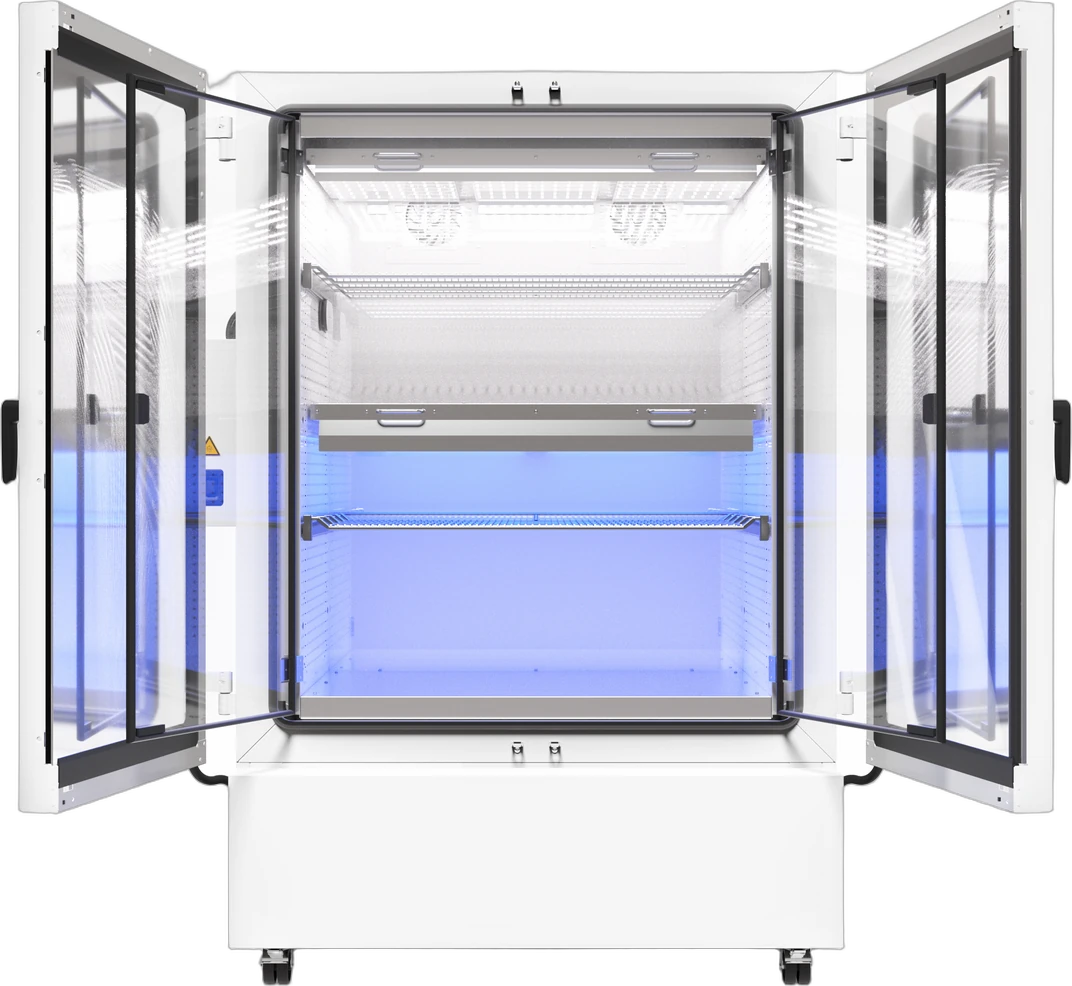
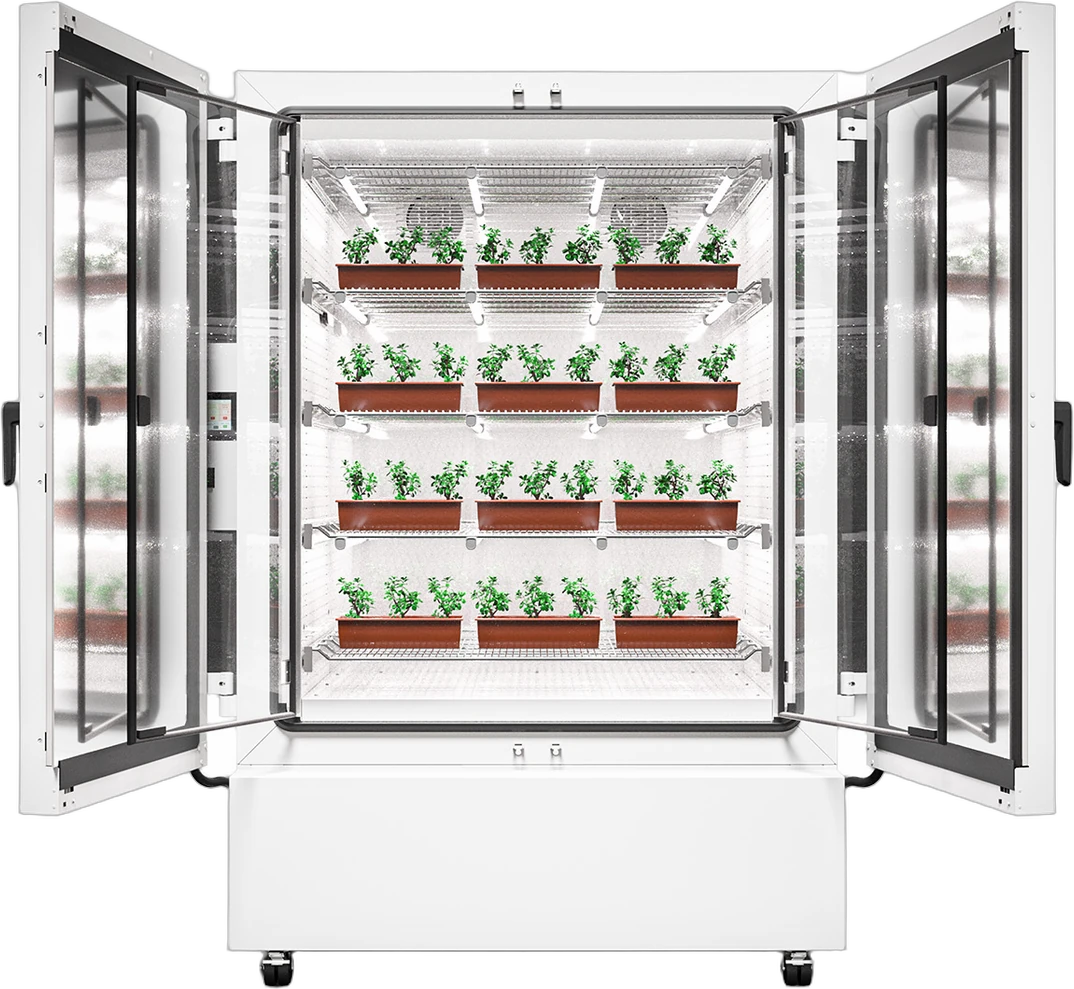
Pictured: KBF PRO 720 with ICH light module (left) and with LED plant light module (right). The modules are accessories.
The KBF 720 can also be extended with three modules: the LED plant light module (8012-2439), the ICH light module (8012-2442, size 720) and the CO2 gassing module (8012-2140 for 0 to 1 vol.%, 8012-2138 for 0 to 20 vol.%). In LED operation, the PAR photon flux density is 1,080 µmol/m²/s at 25 cm, and the control range narrows to 10 °C to 50 °C and 20 to 50 per cent relative humidity. With ICH light, the chamber reaches 42 klx VIS illuminance and 51 W/m² UVA irradiance, an ICH Q1B test takes 33 hours, usable at 20 °C to 50 °C and 20 to 50 per cent relative humidity. The CO2 module covers 0 °C to 70 °C at 20 to 80 per cent relative humidity. A shelf set with U-rails for the LED strips carries item number 8012-2391.
The modules are accessories and not included with the chamber. You will find them with prices under "Matching modules" on this page; more on our Binder page.
Customised requirements & procurement service
A wide range of accessories is available for the Binder KBF 720, such as lighting and LED plant light modules, reinforced or additional insert grids, calibration certificates with varying numbers of measurement points, maintenance contracts with different scopes, and external water supply systems for humidity control. Do you require any of these accessories, a bespoke configuration, or assistance in selecting the right unit for your application? Through our procurement service, LT Laborhandel will be happy to assist you with procurement and configuration.
| Volume: | 727 l |
|---|
Matching modules

A Binder constant-climate cabinet or refrigerated incubator can be converted into a plant growth cabinet using the 8012-2439 LED plant light module, without the need to purchase a separate unit. The module produces lighting conditions that closely resemble natural sunlight and fits into cabinets from the KB, KB PRO, KBF and KBF PRO series with development stage E7. Installation is carried out on site by the customer or a service partner. Design and lighting control The Binder LED plant lighting module consists of 16 LED light strips, which can be positioned individually within the cabinet, and a lighting control box with its own programme controller. Each light strip has three separately controllable colour channels: daylight-like cool white (SunLike, 6,500 K), daylight-like warm white (SunLike, 2,700 K) and dark red phytochrome-controlled light (730 nm), which specifically activates the plant’s phytochrome system. All three channels can be dimmed independently of one another from 0% to 100%. Real-time programming is available for daily routines, either as a cyclical daily programme or individually for each day of the week, supplemented by a twilight function that gently fades the light on and off over a one-hour ramp rather than switching it on or off abruptly. An integrated ventilation function feeds 0 to 500 litres of ambient air per hour into the chamber, thereby maintaining the CO₂ level close to the ambient value required by plants for photosynthesis. The light module is powered by 120 V to 240 V at 50 or 60 Hz, regardless of the mains voltage of the climate cabinet itself. Light output by cabinet size The light intensity depends on the cabinet size and the distance from the light source. With 100 per cent white light and all 16 light strips evenly distributed on a single plane, size 260 achieves a photosynthetically active radiation (PAR) of 1,660 µmol/m²/s at a distance of 25 cm. Size 470 achieves 1,540 µmol/m²/s at a distance of 25 cm, 990 µmol/m²/s at 50 cm and 730 µmol/m²/s at 75 cm. For the 720 size, the figures are 1,080, 740 and 560 µmol/m²/s at the three distances; for the 1060 size, they are 880, 610 and 480 µmol/m²/s respectively. In the largest available size, 1600 – which is only available for the KB PRO and KBF PRO models – the values are 640, 470 and 380 µmol/m²/s. Distributing the 16 light strips across several levels reduces the light output accordingly: to around 50 per cent of the initial value with two levels, and to around 25 per cent with four levels. The maximum temperature during lighting operation is 60 °C for all sizes. Order mounting grids separately The LED plant light module does not include any grids for mounting the light strips. However, LT Laborhandel supplies insert grid sets with telescopic rails (size 260/470: 8012-2384, size 720: 8012-2385, size 1060: 8012-2386, size 1600: 8012-2387) as well as insert grille sets with U-rails, which Binder expressly recommends for mounting the light strips (size 260/470: 8012-2390, size 720: 8012-2391, size 1060: 8012-2392, size 1600: 8012-2393). The number of additional grilles required depends on the desired lighting configuration. For the basic configuration without an additional level, the two standard grids supplied with the cabinet are sufficient; for one or two light levels, at least one additional set is recommended; for full distribution across several levels, up to six sets are required. An additional grid between the light bars and the sample material also creates a gap of around 10 cm, thereby reducing thermal effects on the samples. Typical applications Plant growth experiments with day-night simulation via real-time programming Germination and seedling experiments with reduced light intensity on a single light bar level Photoperiodism and phytochrome studies via the separately dimmable dark red channel Retrofitting existing Binder E7-generation climate chambers and refrigerated incubators to create plant growth chambers, without the need for additional equipment If a higher CO₂ concentration is also required, for example to accelerate plant growth, the LED plant light module can be combined with a CO₂ injection module. According to the operating instructions, both accessories can operate simultaneously within the same cabinet, unlike the ICH light module, which occupies the CO₂ connection. Technical details Configuration16 LED light strips, individually positionable Colour channels per light stripCool white 6,500 K, warm white 2,700 K, dark red 730 nm Dimming range per channel0% to 100% Ventilation function0 to 500 litres of ambient air per hour PFR PAR, size 260 (25 cm)1,660 µmol/m²/s PFR PAR, size 470 (25/50/75 cm)1,540 / 990 / 730 µmol/m²/s PFR PAR, size 720 (25/50/75 cm)1,080 / 740 / 560 µmol/m²/s PFR PAR, size 1060 (25/50/75 cm)880 / 610 / 480 µmol/m²/s PFR PAR, size 1600 (25/50/75 cm)640 / 470 / 380 µmol/m²/s Maximum temperature during operation60 °C Compatible series (development stage E7)KB, KB PRO, KBF, KBF PRO Power supply for light module120 V to 240 V, 50/60 Hz Contents of delivery 16 LED light strips with retaining clips for clipping into standard slotted grilles Lighting control box with programme controller Mains cable Power distribution cable for the LED light strips PU tubing for the air supply Operating instructions Insert grilles for mounting the light strips are not included. These must be ordered as separate accessories; see the section above. Customised requirements & procurement service LT Laborhandel can assist in putting together the right combination of climate chamber, lighting module and insert grilles, for example if the existing size or series is unclear or if multiple lighting levels are planned. The procurement service is also available for other Binder accessories such as CO₂ gas injection modules, water supply systems or sample temperature control sensors. Details can be found on our Services page.

Anyone who needs to carry out photostability tests in accordance with ICH Q1B using a larger sample size will find that the 720 size offers more usable volume than the smaller climate chambers. The Binder ICH light module 8012-2442 is designed specifically for this size and fits into climatic chambers from the KB PRO, KBF and KBF PRO series with development stage E7. Light cassette technology The module consists of a power supply unit for the side panel of the unit, as well as two light cassettes: one for visible light (VIS) and one for UVA radiation. The VIS cassette utilises LED technology and a spectrum similar to sunlight (SunLike Cool White, 6,500 K), whilst the UVA cassette uses a special fluorescent tube (Narva PUVA), as, according to the manufacturer, current LED technology is not yet capable of reproducing this spectrum in an ICH-compliant manner. Together, both cassettes generate the CIE D65 spectrum required by ICH Q1B, which corresponds to daylight grey under overcast skies. Control is via a data cable connected to the climate chamber; the irradiation duration is set as a time-interval programme on the programme controller. The light module is powered by 120 V to 240 V at 50 or 60 Hz. Lighting values and test duration for size 720 In size 720, at full light output, the module achieves a VIS illuminance of 42 klx and a UVA irradiance of 51 W/m², both measured using spherical evaluation at a distance of 12 cm from the light source. These higher values compared with the smaller sizes 260 and 470 reduce the test duration: A complete ICH-Q1B test with the required light doses of 1.2 Mlx·h of visible light and 200 Wh/m² of UVA can be completed in 29 hours for the VIS component and 4 hours for the UVA component, totalling 33 hours. For flat samples, such as printed packaging materials, the test duration is extended by a factor of 1.5 according to the manufacturer, as the spherical evaluation was originally calibrated for three-dimensional test specimens. For pharmaceutical companies with a high sample throughput, this represents a significant time saving compared with the smaller models, without altering the required light doses in any way. Control system without automatic light dose control This version has no light sensors and operates with a conventional timer: the required irradiation time is calculated once on the basis of the known light values and stored as a programme. For automatic switch-off once the target dose has been reached, including continuous measurement, the LQC variant 8012-2444 is available for the same model. In both cases, installation is carried out on site by the customer or a service partner, without the need to return the climate chamber. Typical applications Photostability testing of larger batches or sample series in accordance with ICH Q1B Stability studies for marketing authorisation dossiers of new active substances Light stress tests on primary packaging and packaging materials Combined climate and light testing in a single, larger cabinet According to the operating instructions, a CO₂ gas injection module cannot be operated simultaneously with the ICH light module, as both occupy the same interface on the climatic chamber. An LED plant light module of the same size, however, can be operated without conflict on a second climatic chamber of the same series, provided that a further unit is available. Technical details Compatible size720 Compatible series (development stage E7)KB PRO, KBF, KBF PRO Temperature range for KB PRO 720 with light5 °C to 60 °C, unregulated humidity Temperature range for KBF 720 with light20 °C to 50 °C, 20% to 50% relative humidity Temperature range KBF PRO 720 with light10 °C to 50 °C, 10% to 80% relative humidity VIS illuminance42 klx UVA irradiance51 W/m² ICH Q1B test duration29 + 4 = 33 hours Light spectrum VIS cassetteLED SunLike Cool White, 6,500 K Light spectrum, UVA cassetteNarva PUVA fluorescent tube Power supply for light module120 V to 240 V, 50/60 Hz Contents VIS light cassette with connection cable UVA light cassette with connection cable U-rails for mounting the light cassettes in the climate chamber Power supply box with ballasts/power supplies Profile rails and bolts for securing the power supply box to the climate chamber Data cable Mains cable Operating instructions The light sensors for light dose control are not included in the scope of delivery; these are provided as standard with the ICH-LQC light module 8012-2444. Customised requirements & procurement service LT Laborhandel’s procurement service can advise you on choosing between the ICH light module and the ICH-LQC light module for size 720, as well as on other accessories for constant-climate cabinets. Details can be found on our services page.
In size 720, photostability tests in accordance with ICH Q1B can be carried out with a larger sample volume, and, with the Binder ICH-LQC light module 8012-2444, can also be completed using a measured light dose rather than a calculated one. The module is designed for climate chambers of the KB PRO, KBF and KBF PRO series with development stage E7 in this size. Light dose control via two spherical sensors In addition to the VIS and UVA light cassettes, which together generate the CIE D65 spectrum in accordance with ICH Q1B, the ICH-LQC light module contains two additional spherical light sensors. The VIS sensor measures the illuminance of visible light, whilst the UVA sensor measures the irradiance of the UVA component; both have a spherical response characteristic for three-dimensional test specimens. The light dose to be achieved is stored in the climate chamber’s programme controller – typically 1.2 Mlx·h of visible light and 200 Wh/m² of UVA – and both light cassettes switch off independently of one another as soon as their respective doses have been reached. For flat samples, such as blister packs or printed packaging materials, the light dose must be increased by a factor of 1.5 according to the manufacturer, as the spherical sensors were originally calibrated for three-dimensional test specimens. Higher light output thanks to the larger size In size 720, the module achieves a VIS illuminance of 42 klx and a UVA irradiance of 51 W/m² at full light output, both measured using spherical evaluation at a distance of 12 cm from the light source. These higher values compared with the 260 and 470 sizes reduce the calculated test duration to 29 hours for the VIS component and 4 hours for the UVA component, totalling 33 hours. The LQC sensor system continuously monitors the actual dose achieved, rather than relying solely on this calculated duration. This is particularly relevant for larger sample quantities, where individual areas of the chamber may be illuminated slightly differently. When the LQC version is worthwhile Anyone requiring a documented, measured light dose rather than pure time-based programming – for example, for regulatory testing with a requirement for evidence – is better served by the LQC version than by the simpler ICH light module 8012-2442 for the same size. Both variants are installed on-site by the customer or a service partner and controlled via the climate chamber’s existing programme controller; no additional external control unit is required. Particularly in the case of the 720 size, with its larger usable volume, the LQC sensor system offers the added benefit that several sample batches can be tested simultaneously under a verifiably uniform light dose, rather than having to recalculate the irradiation time for each batch. For a pharmaceutical company with several parallel regulatory approval projects, this significantly reduces the coordination effort required between test series. Typical applications ICH Q1B photostability tests with a documented, measured light dose Regulatory stability testing with a larger sample size Photostability tests on flat samples with an adjusted dose specification Recurring test series with high demands on reproducibility According to the operating instructions, a CO₂ gas injection module cannot be operated simultaneously with the ICH-LQC light module, as both occupy the same interface on the climate chamber. Technical details Compatible model720 Compatible series (development stage E7)KB PRO, KBF, KBF PRO Temperature range for KB PRO 720 with light5 °C to 60 °C, unregulated humidity Temperature range for KBF 720 with light20 °C to 50 °C, 20% to 50% relative humidity Temperature range KBF PRO 720 with light10 °C to 50 °C, 10% to 80% relative humidity VIS illuminance42 klx UVA irradiance51 W/m² ICH Q1B test duration (calculated)29 + 4 = 33 hours Light sensorsSpherical VIS sensor, spherical UVA sensor Dose factor for flat specimens1.5 times the light dose Light spectrum of VIS cassetteSunLike cold white LED, 6,500 K Light spectrum of the UVA cassetteNarva PUVA fluorescent tube Power supply for light module120 V to 240 V, 50/60 Hz Contents VIS light cassette with connection cable UVA light cassette with connection cable U-rails for mounting the light cassettes in the climate chamber Power supply box with ballasts/power supplies Profile rails and bolts for securing the power supply box to the climate chamber Data cable Mains cable Operating instructions Spherical VIS light sensor for light dose control Spherical UVA light sensor for light dose control Customised requirements & procurement service LT Laborhandel’s procurement service can advise you on choosing between the ICH light module and the ICH-LQC light module for the 720 size, as well as on other accessories for constant-climate cabinets. Details can be found on our services page.

In a closed climate chamber, plants consume CO₂ during photosynthesis, which can cause the concentration to fall below the natural ambient level of around 0.04 vol.%. The Binder CO₂ gas supply module 8012-2140, on the other hand, maintains the concentration precisely between 0 and 1 vol.% and is therefore designed for plant growth applications where precise, low CO₂ control is required. It is an accessory for Binder KB PRO series refrigerated incubators and KBF and KBF PRO series constant-climate chambers, all of which are at development stage E7. Measurement and control CO₂ measurement is carried out by an infrared measuring cell with an NDIR sensor (non-dispersive infrared sensor) and continuous control to a reference value. According to the manufacturer, this measurement method offers fast response times and high selectivity for CO₂; interference and ageing effects in the measurement system are largely ruled out, meaning that the system remains virtually drift-free between calibrations. The control process itself is managed entirely via the MB2 controller of the climate chamber; the gas injection module cannot be operated without being connected to the climate chamber. To ensure the CO₂ concentration is displayed correctly in vol.%, the altitude of the installation site must also be entered into the controller. As this control range uses a separate CO₂ sensor to that of the 0–20 vol.% variant, the controller function ‘CO₂ measurement range 0…1 vol.%’ must also be activated to ensure the measured value is converted correctly. Connections and interfaces The CO₂ gas injection unit has a 4 to 20 mA analogue output for the CO₂ concentration, via which the measured value can be transmitted to external data acquisition systems or recording devices. The gas connection is made via a quick-release coupling on the gas cylinder, whilst the data connection to the climate chamber is via a patch cable. A CO₂ gas cylinder is not included in the scope of delivery and must be procured separately. Combination with other accessory modules According to the operating instructions, the CO₂ gas module can be operated simultaneously with the LED plant light module; both accessories complement each other for comprehensive plant growth applications with controlled lighting and CO₂ concentration within the same cabinet. However, simultaneous operation with the ICH light module or the ICH-LQC light module is not possible, as both accessories occupy the same interface on the climate chamber. Anyone requiring both configurations – for example, CO₂ gasation and the ICH photostability test – should plan for two separate climate chambers. For pure plant growth experiments with LED lighting and CO₂ enrichment, however, a single, suitably equipped climate chamber is sufficient. Operation and maintenance A fine gas filter in the gas injection box can be replaced as required to ensure that measurement accuracy is maintained throughout the operational life of the unit. Two CO₂ warning stickers are included in the scope of delivery and must be affixed to a clearly visible position on the climate chamber, as special safety instructions must be observed when handling CO₂ in enclosed spaces. Before initial commissioning, the correct CO₂ outlet pressure of the gas supply and the tightness of the connections must be checked. A connection panel on the rear of the incubator or climate chamber houses the data connection to the gas supply unit, ensuring that the cabling remains neatly organised. Typical applications CO₂ enrichment for accelerated plant growth in combination with the LED plant light module Photosynthesis and growth studies with a defined, low CO₂ concentration Offsetting CO₂ consumption in densely planted, enclosed climate chambers Botanical and agricultural research series with reproducible climatic conditions The CO₂ injection box is installed on the prepared side panel of the climate chamber and connected to the main unit via a data cable, gas hose and sensor cable. Technical details CO₂ control range0 vol.% to 1 vol.% Minimum concentrationAmbient value (approx. 0.04 vol.%) Measuring principleNDIR sensor (non-dispersive infrared sensor) Analogue output4 to 20 mA DC Compatible series (development stage E7)KB PRO, KBF, KBF PRO Compatible sizes260, 470, 720, 1060, 1600 Controlvia MB2 unit controller; operation not possible without a climate cabinet Power supply for fumigation box24 V, via the supplied mains adaptor Scope of supply CO₂ fumigation box CO₂ sensor with cable 2 CO₂ warning stickers 24 V mains adaptor with adaptors Operating instructions 2 mounting rails with screws (4 × M8, 2 × M5) 2 silicone foam plugs for the slotted hole feed-through Patch cable for the data connection between the gas supply box and the device Hose set for the gas connection The CO₂ gas cylinder and pressure regulator are not included; these must be purchased separately. Customised requirements & procurement service LT Laborhandel provides procurement support when choosing between the CO₂ control ranges of 0 to 1 vol.% and 0 to 20 vol.%, as well as when combining the system with an LED plant lighting module or water supply systems. Details can be found on our services page.
Some applications require significantly higher CO₂ concentrations than those found in natural plant growth, such as cell culture work, which traditionally requires a CO₂ incubator. With its control range of 0 to 20 vol.%, the Binder CO₂ gas supply module 8012-2138 covers precisely this broader spectrum and additionally equips a Binder KB PRO series refrigerated incubator or a KBF and KBF PRO series constant-climate chamber (development stage E7) with CO₂ control. Measuring principle and operation Like the version with the narrower control range, this module also measures the CO₂ concentration using an infrared measuring cell with an NDIR sensor and provides continuous control to a reference value. The method has fast response times and, according to the manufacturer, remains virtually drift-free between calibrations, as interference and ageing effects in the measuring system are largely ruled out. The CO₂ control is managed entirely via the MB2 controller of the climate chamber; standalone operation without a connected climate chamber is not intended. To ensure the concentration is displayed correctly in vol.%, the sea-level altitude of the installation site must be entered into the controller so that differences in air pressure do not distort the measurement. Connections and gas supply The CO₂ gas supply box has an analogue output of 4 to 20 mA for the CO₂ concentration, via which the measured value can be transmitted to an external data acquisition system or a recording device. The gas connection is made via a quick-release coupling, connected to a CO₂ gas cylinder, which is not included in the scope of delivery and must be procured separately. The data connection between the gas injection box and the climate chamber is established via a patch cable supplied with the unit; a fine gas filter in the gas injection box can be replaced if necessary. Cannot be combined with the light modules According to the operating instructions, the CO₂ gas injection module, with a control range of 0 to 20 vol.%, cannot be operated simultaneously with the ICH light module or the ICH-LQC light module, as both occupy the same interface on the climate chamber. Simultaneous operation with the LED plant light module, however, is possible, even though the wide control range up to 20 vol.% is rarely utilised in practice for pure plant growth applications and is intended more for other gas injection tasks. Those who require only low, plant-specific concentrations of up to 1 vol.% are generally better served by the more precise control range of the 8012-2140 variant. Operation and maintenance The fine gas filter in the gas supply box can be replaced as required to ensure that measurement accuracy is maintained throughout the operational life of the unit. Two CO₂ warning stickers are included in the scope of delivery and should be affixed to a clearly visible position on the climate chamber, as special safety precautions must be observed when handling CO₂ in enclosed spaces. Before initial commissioning, the correct CO₂ outlet pressure of the gas supply and the tightness of all connections must be checked, particularly given the significantly wider control range of up to 20 vol.% in this case. A connection panel on the rear of the incubator or climate chamber houses the data connection to the gas supply unit, ensuring that the cabling remains neatly organised. Typical applications Upgrading a climate chamber to function as a CO₂ incubator, for example for cell culture work Gassing experiments with higher CO₂ concentrations beyond purely botanical applications Processes that require a documented, constant CO₂ atmosphere to be recorded via an analogue output Research applications with varying CO₂ setpoints across the entire control range Installation takes place on the prepared side panel of the climate chamber, connected via a data cable, gas hose and sensor lead. Technical details CO₂ control range0 vol.% to 20 vol.% (factory setting) Minimum concentrationAmbient value (approx. 0.04 vol.%) Measurement principleNDIR sensor (non-dispersive infrared sensor) Analogue output4 to 20 mA DC Compatible series (development stage E7)KB PRO, KBF, KBF PRO Compatible sizes260, 470, 720, 1060, 1600 Controlvia MB2 unit controller; operation not possible without a climate cabinet Power supply for fumigation box24 V, via the supplied mains adaptor Scope of supply CO₂ fumigation box CO₂ sensor with cable 2 CO₂ warning stickers 24 V mains adaptor with adaptors Operating instructions 2 mounting rails with screws (4 × M8, 2 × M5) 2 silicone foam plugs for the slotted hole feed-through Patch cable for the data connection between the gas supply box and the device Hose set for the gas connection The CO₂ gas cylinder and pressure regulator are not included; these must be purchased separately. Customised requirements & procurement service LT Laborhandel’s procurement service can assist you in choosing between the CO₂ control ranges of 0 to 20 vol.% and 0 to 1 vol.%, as well as with other accessories for constant-climate cabinets and refrigerated incubators. Details can be found on our services page.