
Dangerous Goods Labels
Hazard labels and marks for packages
Hazard labels for Classes 1 to 9 and the marks for limited quantities, environmentally hazardous substances, lithium batteries, orientation and air freight, plus the UN number mark for lettering and the ‘Fragile’ handling symbol. All labels come from Giese-GEF in Offenbach am Main on rolls of 1,000, most of them 100 x 100 mm on self-adhesive film to BS 5609 (manufacturer’s specification). Intended for laboratories, shippers and logistics providers who label the same classes again and again. Framework orders and quotations for public sector clients are handled via the procurement service.

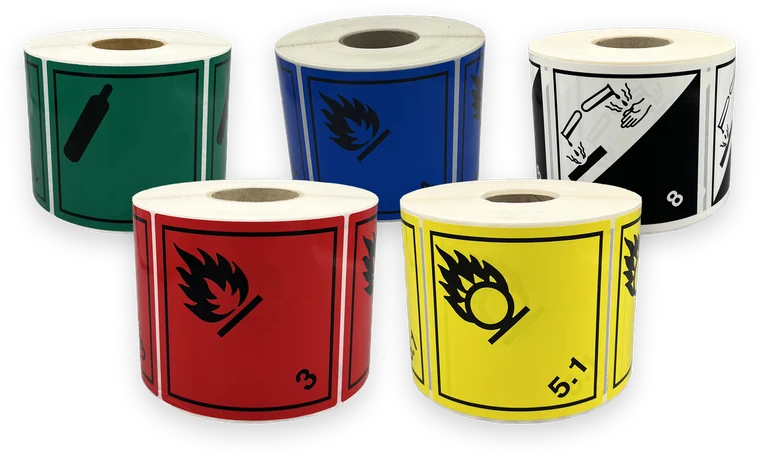
Hazard labels classes 1 to 9
Each class on its own roll of 1,000 labels, class 1 as 1.1 to 1.6 (including 1.1 G), class 7 as 7A, 7B and 7C. Mostly 100 x 100 mm on adhesive film to BS 5609 (manufacturer's specification), the 1.4 label on adhesive paper.
Go to class
Hazard label class 1Hazard label class 1.4Hazard label class 1.5Hazard label class 1.6Hazard label class 2.1Hazard label class 2.2Hazard label class 2.3Hazard label class 3Hazard label class 4.1Hazard label class 4.2Hazard label class 4.3Hazard label class 5.1Hazard label class 5.2Hazard label class 6.1Hazard label class 6.2Hazard label class 7Hazard label class 8Hazard label class 9
LQ, environment, lithium
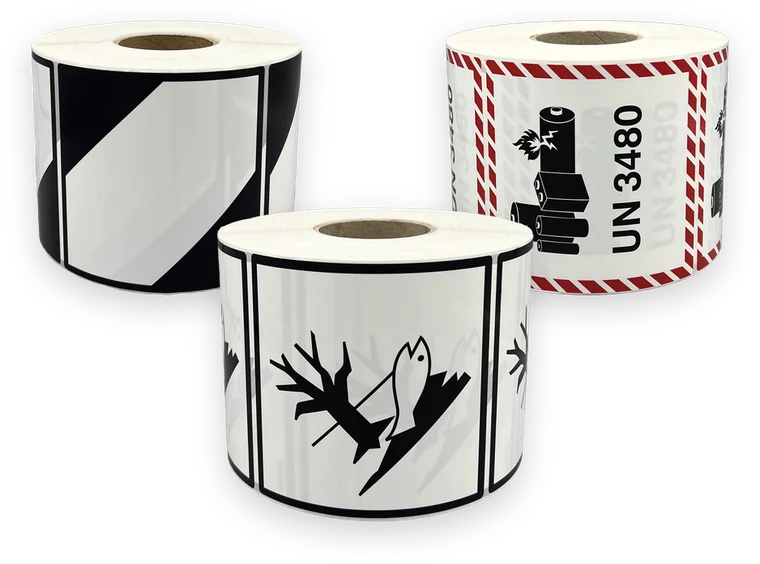
The LQ diamond for limited quantities, also with Y, the fish and tree mark for environmentally hazardous substances and the lithium battery mark for UN 3090, 3091, 3480 and 3481. Plus CAO, orientation arrows, Fragile and the UN mark to fill in.
Go to mark
Mark LQMark LQ with YMark EnvironmentMark LithiumMark CAOMark ArrowsMark FragileMark UN number
Larger quantities
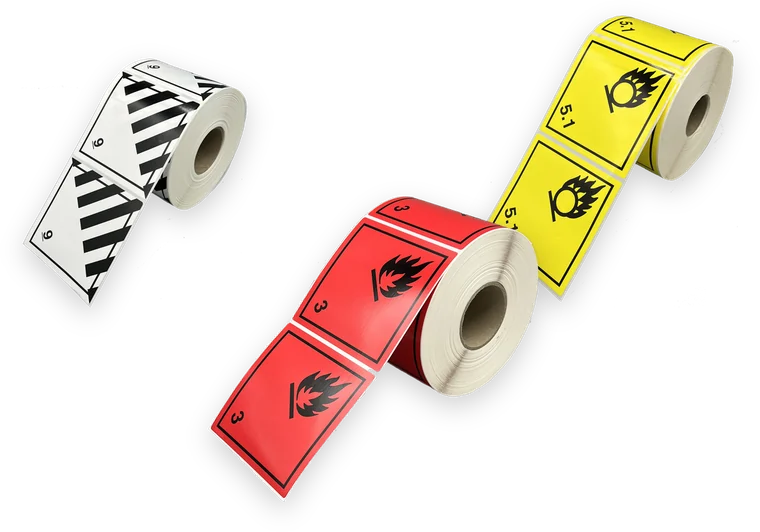
All rolls are in stock and can be reordered. Framework orders, larger quantities and quotations for public sector buyers go through our procurement service.

Giese-GEF Hazard Label Class 3 (Flammable Liquids), 100 x 100 mm, Self-Adhesive Film, Roll of 1,000, 300-10-1
The Class 3 hazard label indicates on packages that they contain flammable liquids. This roll from Giese-GEF (Offenbach am Main) contains 1,000 labels measuring 100 x 100 mm on self-adhesive film in accordance with BS 5609. This labelling is also known commercially as a Class 3 dangerous goods label or sticker.ApplicationsThe label goes on packages and overpacks containing Class 3 substances. Examples include acetone (UN 1090), petrol (UN 1203) and methanol (UN 1230). The manufacturer identifies fire and explosion as the hazards, as vapours can form explosive mixtures with air. The consignor decides which labels a consignment carries.Design of the hazard labelThe diamond is positioned on its point and is red. At the top is a flame, in black or white according to ADR, and at the bottom the number 3. A line runs approximately 5 mm inside the border, in the colour of the symbol at the top and in the colour of the number at the bottom. The minimum size according to ADR is 100 x 100 mm.A special rule applies to self-reactive substances and organic peroxides. They do not require an additional label 3, as label 4.1 or 5.2 already indicates their flammability.Material and finishThe labels are made of self-adhesive film. According to the manufacturer, they are seawater-resistant in accordance with BS 5609 (Section 2). The IMDG Code requires that markings remain legible after at least three months in seawater; BS 5609 is a voluntary means of demonstrating this. According to the manufacturer, the label is UV-resistant, and the adhesive provides a permanent bond, both indoors and outdoors. The roll contains 1,000 labels, each individually mounted on a backing tape.Technical detailsManufacturerGiese-GEF Druck GmbH, Offenbach am MainManufacturer’s number300-10-1Hazard label templateNo. 3, Flammable liquidsFormat100 x 100 mm, diamond shapeMaterialSelf-adhesive film, seawater-resistant to BS 5609, UV-resistant (manufacturer’s specification)Adhesivepermanent, for indoor and outdoor useSupplied asRoll of 1,000 piecesWeight per rollapprox. 1.9 kg according to the manufacturerScope of delivery1 roll containing 1,000 Class 3 hazard labels (flammable liquids), 100 x 100 mm, self-adhesive filmFrequently asked questionsIs label 3 sufficient for methanol? No. According to ADR, methanol (UN 1230) requires labels 3 and 6.1. The second label is available as Class 6.1 hazard label.Does the label replace a large label? No. Large labels measuring at least 250 x 250 mm are required on containers and vehicles; the roll label, measuring 100 x 100 mm, is used to mark the package.Is Class 3 also available on paper? The manufacturer also supplies Class 3 as self-adhesive paper. This item is the film version. Enquiries regarding the paper version should be directed to the procurement service.Individual requirements and procurement serviceNeed more than one roll, a framework order, or other classes, formats and language versions from the Giese range? Quotes are available on request, including for public sector clients. Enquiries should be directed to the procurement service.

Giese-GEF Hazard Label Class 1.1 (Explosives), 100 x 100 mm, Self-Adhesive Film, Roll of 1,000, 100-10-1
Class 1 hazard labels are used to identify packages containing explosive substances and articles containing explosives. Giese-GEF, based in Offenbach am Main, supplies these labels for subclasses 1.1, 1.2 and 1.3, each as a separate roll containing 1,000 labels, measuring 100 x 100 mm, on self-adhesive film in accordance with BS 5609. The subclass is determined by the variant; each subclass is printed separately. A fourth variant is subclass 1.1 with compatibility group G (marked 1.1 G).ApplicationsThe label goes on packages containing substances or articles of subclasses 1.1 to 1.3, next to the proper shipping name in accordance with ADR. The subclasses describe the hazard: 1.1 is capable of mass explosion; for 1.2, the hazard arises from fragments, blast and projectiles without mass explosion; for 1.3, the primary hazard is fire with a low risk of air pressure effects or fragmentation. Examples of 1.1 include trinitrotoluene, dry (UN 0209) and ammonium nitrate containing more than 0.2 % of combustible substances (UN 0222), both with classification code 1.1D.Class 1 occurs as a subsidiary hazard label, for example with Type B organic peroxides. UN 3102, for instance, bears labels 5.2 and 1. As subsidiary hazard labels, the subclass and compatibility group remain blank; rolls with a pre-printed subclass are not suitable for this purpose. There is a separate template for subclass 1.4 (hazard label 1.4). The consignor determines which labels a consignment requires on the basis of the regulations.Design of the hazard labelThe template shows an exploding bomb in black on an orange background, with the number 1 at the bottom. In the lower half, above the number, the ADR provides space for the subclass and the compatibility group letter. Neither is required if the explosive property is only a subsidiary hazard. The minimum size according to ADR is 100 x 100 mm. Whether a letter is pre-printed in addition to the subclass can be clarified via the procurement service before placing an order. Variant 1.1 G already has the letter G printed alongside subclass 1.1.Material and finishThe labels are made of self-adhesive film, which the manufacturer states is seawater-resistant in accordance with BS 5609. The IMDG Code requires legibility after at least three months in seawater; BS 5609 is a voluntary standard for this purpose. According to the manufacturer, the label is UV-resistant and the adhesive provides a permanent bond, both indoors and outdoors. Each roll contains 1,000 labels, individually mounted on a backing tape.Technical detailsManufacturerGiese-GEF Druck GmbH, Offenbach am MainManufacturer’s number100-10-1 for all four variants, printed on the label edge for 1.1 GHazard label templateNo. 1, Explosive substances and articles containing explosivesVariant subclass 1.1capable of mass explosion, example UN 0209 (1.1D)Variant subclass 1.2hazard from fragments, blast and projectiles, not capable of mass explosionVariant subclass 1.3fire hazard with minor blast or fragmentation effect, not capable of mass explosionVariant subclass 1.1 Gsubclass 1.1 with compatibility group G, marked 1.1 GFormat100 x 100 mm, diamondMaterialSelf-adhesive film, seawater-resistant to BS 5609, UV-resistant (manufacturer’s specification)Adhesivepermanent, for indoor and outdoor useSupplied asRoll of 1,000 pieces per variantWeight per rollapprox. 1.8 kg according to the manufacturerScope of delivery1 roll containing 1,000 hazard labels of the selected subclass (1.1, 1.2, 1.3 or 1.1 G), 100 x 100 mm, self-adhesive filmFrequently asked questionsWhich variant do I need? The subclass is determined by the classification of the substance or article, as indicated by the classification code, for example 1.1D. Variant 1.1 G is suitable if the classification results in subclass 1.1 with compatibility group G. For classes 1.4 to 1.6, different labels are required; see Class 1.4 and Class 1.5.Is a single label sufficient for a vehicle or container? No. Large labels of the same design with at least 250 x 250 mm are intended for vehicles and containers. The 100 x 100 mm label belongs on the package.Individual requirements and procurement serviceLarger quantities, framework orders, the other classes and other formats and language versions from the Giese range are available on request. Companies and public sector clients can obtain quotations via the procurement service.

Giese-GEF Hazard Label Class 2.2 (Non-Flammable, Non-Toxic Gases), 100 x 100 mm, Self-Adhesive Film, Roll of 1,000, 220-10-1
A gas cylinder on a green background displays hazard label 2.2, the ADR symbol for non-flammable, non-toxic gases. The roll from Giese-GEF (Offenbach am Main) contains 1,000 labels measuring 100 x 100 mm on self-adhesive film in accordance with BS 5609. The label is also known as a Class 2.2 dangerous goods label.ApplicationsThe label goes on packages and gas cylinders containing gases such as argon, compressed (UN 1006) or carbon dioxide, liquefied under pressure (UN 1013). The manufacturer lists the risks as the danger of suffocation and the pressure within the container; in the case of cryogenic gases, frostbite is also a risk. It is used on packages and overpacks. The consignor checks the regulations to determine whether a consignment requires this label alone or in combination with others.Design of the hazard labelOn a green background is the symbol of a gas cylinder, with the number 2 in the bottom corner. According to ADR, the symbol and number may be black or white. As with all hazard labels, the label is a diamond placed on its point with an inner line approximately 5 mm from the edge. The ADR stipulates a minimum size of 100 x 100 mm; the roll is exactly this size.Material and finishThe label is made of self-adhesive film. The manufacturer specifies BS 5609 Section 2: the material must be able to remain in seawater for three months without peeling off or becoming illegible. This standard is not mandatory; the IMDG Code only requires the label to remain legible after this period. The adhesive is permanent and suitable for both indoor and outdoor use; according to the manufacturer, the film is UV-resistant. Each roll contains 1,000 labels on a backing tape.Technical detailsManufacturerGiese-GEF Druck GmbH, Offenbach am MainManufacturer’s number220-10-1Hazard label templateNo. 2.2, Non-flammable, non-toxic gasesFormat100 x 100 mm, diamond shapeMaterialSelf-adhesive film, seawater-resistant in accordance with BS 5609, UV-resistant (manufacturer’s specification)Adhesivepermanent, for indoor and outdoor useSupplied asRoll of 1,000 piecesWeight per rollapprox. 1.9 kg according to the manufacturerScope of delivery1 roll containing 1,000 Class 2.2 hazard labels (non-flammable, non-toxic gases), 100 x 100 mm, self-adhesive filmFrequently asked questionsWhen does Class 2.2 apply and when does Class 2.1? Label 2.2 is for gases that are neither flammable nor toxic. Flammable gases require the red label with a flame (Class 2.1), whilst toxic gases require the 2.3 label with a skull and crossbones (Class 2.3).Is this label sufficient for a vehicle or a container? No, large labels measuring at least 250 x 250 mm are required for these. This label identifies the individual package.Is there an English version? The manufacturer supplies a version with English lettering (NON-FLAMMABLE, NON-TOXIC GAS) under item number 221-10-1. Enquiries regarding this should be directed to the procurement service.Individual requirements and procurement serviceLarger quantities, framework orders, other classes or formats, and further language versions from the Giese range can be arranged on request. Companies and public sector clients should direct enquiries to the procurement service.

Giese-GEF Limited Quantities (LQ) Mark, 100 x 100 mm, Self-Adhesive Film, Roll of 1,000, LQM-10-1
The LQ mark identifies packages containing dangerous goods in limited quantities. It consists of an upright diamond with black upper and lower points and a white centre, measuring 100 x 100 mm, made of self-adhesive film and available in rolls of 1,000 from Giese-GEF in Offenbach am Main. Legally, it is one of the marks under Chapter 3.4 of the ADR and not a hazard label.ApplicationsThe mark indicates that a package is packed in accordance with the simplifications for limited quantities. The quantity limit per inner packaging is set out in Table A, column 7a. For UN 1350 sulphur and UN 1942 ammonium nitrate, for example, the limit is 5 kg in each case. The package must not weigh more than 30 kg gross mass; for trays wrapped in stretch or shrink film, the limit is 20 kg. This mark does not apply to air transport, where the variant with Y is used (LQ mark with Y). In the case of composite packagings containing liquid substances in inner packagings, the orientation arrows specified in 5.2.1.10 also apply to LQ packages, subject to the exceptions stated there for small inner packagings.Design of the markThe upper and lower sections, as well as the border, are black; the central area is white or a contrasting colour. The mark must measure at least 100 x 100 mm with a border of at least 2 mm. If the size of the package requires it, it may be reduced to 50 x 50 mm with a 1 mm border. It must withstand weathering without significant deterioration. For transport units weighing over 12 t containing more than 8 t of LQ packages, marks are required at the front and rear; for containers, they are required on all four sides, in which case they must measure at least 250 x 250 mm. A roll label measuring 100 x 100 mm does not replace these larger marks.Material and finishThe roll carries 1,000 marks on self-adhesive film, which the manufacturer states to be seawater-resistant in accordance with BS 5609. This standard is voluntary. For maritime transport, the IMDG Code requires that the markings remain legible after three months in seawater. According to the manufacturer, a roll weighs approximately 1.9 kg.Technical detailsManufacturerGiese-GEF Druck GmbH, Offenbach am MainManufacturer’s numberLQM-10-1MarkLimited quantities (LQ) without Y, ADR 3.4.7Format100 x 100 mm, diamond shapeMaterialSelf-adhesive film, seawater-resistant in accordance with BS 5609 (manufacturer’s specification)Supplied asRoll of 1,000 piecesWeight per rollapprox. 1.9 kg according to the manufacturerScope of delivery1 roll containing 1,000 LQ marks (without Y), 100 x 100 mm, self-adhesive filmFrequently asked questionsDo I need a different mark for air transport? This mark does not apply to air transport. There, the LQ mark with Y applies in accordance with the ICAO Technical Instructions.Is the mark with Y also sufficient on the road? The ADR recognises it. Packages bearing the Y mark are deemed to comply with 3.4.1 to 3.4.4 and do not require the mark without Y. The mark without Y remains the option for consignments not transported by air.Individual requirements and procurement serviceThe procurement service handles requests for quantities exceeding one roll, framework orders and additional marks, formats or language versions from the Giese-GEF range. Companies and public sector clients will receive a quotation on request. The consignor checks against the regulations whether a consignment may be dispatched as a limited quantity.

Giese-GEF Lithium Battery Mark UN 3090, 100 x 100 mm, Self-Adhesive Film, Roll of 1,000, LIT-10-1-3090
The lithium battery mark has a red hatched border, a battery symbol and the UN number. It is available here in four versions for UN 3090, 3091, 3480 and 3481, each measuring 100 x 100 mm, on self-adhesive film and available in rolls of 1,000. The manufacturer is Giese-GEF in Offenbach am Main, where the label is marketed under the name ‘IATA Lithium Battery Sticker’.ApplicationsThe mark goes on packages containing cells or batteries prepared in accordance with Special Provision 188 or 400. The four numbers denote: UN 3090 lithium metal cells or batteries, UN 3091 lithium metal cells or batteries contained in or packed with equipment, UN 3480 lithium-ion cells or batteries, and UN 3481 lithium-ion cells or batteries contained in or packed with equipment. If a package contains several of these numbers, all applicable ones appear on one or more marks. It therefore covers loose cells and batteries as well as equipment in which they are installed or with which they are packed.Design of the markThe mark is a rectangle or square with a hatched border; the hatching is at least 5 mm wide and red. It measures at least 100 x 100 mm and may, if the package so requires, be reduced to 100 mm in width and 70 mm in height. The ADR specifies, as the symbol, a cluster of batteries, one of which is damaged and ignited, positioned above the UN number. The lithium battery mark is not hazard label 9A. Which of the two a package requires is determined, for road transport, by Table A and Special Provision 188, and for air transport by the IATA regulations.Material and finishSelf-adhesive film, which, according to the manufacturer, is seawater-resistant in accordance with BS 5609. This standard is voluntary; the IMDG Code requires legibility after three months in seawater. A roll of 1,000 marks weighs approx. 1.6 kg according to the manufacturer.Technical detailsManufacturerGiese-GEF Druck GmbH, Offenbach am MainUN 3090Lithium metal cells or batteries, manufacturer’s number LIT-10-1-3090UN 3091Lithium metal, contained in or packed with equipment, manufacturer’s number LIT-10-1-3091UN 3480Lithium-ion cells or batteries, manufacturer’s number LIT-10-1-3480UN 3481Lithium-ion, contained in or packed with equipment, manufacturer’s number LIT-10-1-3481Format100 x 100 mmMaterialSelf-adhesive film, seawater-resistant in accordance with BS 5609 (manufacturer’s specification)Supplied asRoll of 1,000 piecesWeight per rollapprox. 1.6 kg according to the manufacturerScope of delivery1 roll containing 1,000 lithium battery marks with the selected UN number, 100 x 100 mm, self-adhesive filmFrequently asked questionsIs this hazard label 9A? No. Design 9A is a Class 9 hazard label with a battery symbol; this is a lithium battery mark, which the ADR regulates separately in 5.2.1.9. The standard Class 9 hazard label is available as a separate item.Is the mark also available for sodium-ion batteries? The ADR 2025 also specifies it for sodium-ion batteries (UN 3551, 3552). In air transport, Addendum 1 to IATA DGR 67 (valid from 1 January 2026) removes the reference to UN 3551 from the requirements for the battery mark; the regulations for road and air transport therefore differ in this respect. The range includes only the four lithium numbers.Individual requirements and procurement serviceLarger quantities, framework orders and other marks, formats or language versions from the Giese-GEF range, such as the environmentally hazardous substance mark, are available via the procurement service. Quotations for businesses and public sector clients are available on request. The consignor determines which marking the consignment requires.

Giese-GEF Hazard Label Class 2.1 (Flammable Gases), 100 x 100 mm, Self-Adhesive Film, Roll of 1,000, 210-10-1
Class 2 flammable gases are indicated by hazard label 2.1, which features a flame on a red background. Giese-GEF, based in Offenbach am Main, supplies it in rolls of 1,000 labels, measuring 100 x 100 mm, on self-adhesive film in accordance with BS 5609. In the trade, this label is also known as a Class 2.1 dangerous goods label or sticker.ApplicationsThe label is applied to packages and overpacks containing flammable gases, for example aerosols, flammable (UN 1950), hydrogen, compressed (UN 1049) or isobutane, liquefied under pressure (UN 1969). The manufacturer describes the warning as indicating a risk of fire and explosion, as the gases are under pressure within their containers. The consignor determines the labelling requirements for a consignment in accordance with the regulations.Design of the hazard labelThe symbol is a flame in black or white, with the number 2 in the bottom corner; this may also be black or white. Visually, the label resembles that for flammable liquids (Class 3); the number distinguishes the two. On cylinders and gas cartridges for liquefied petroleum gas, the symbol, text and number may appear in the colour of the container, provided there is sufficient contrast. The ADR specifies 100 x 100 mm as the minimum size and permits a proportional reduction only if the size of the package requires it and all elements remain clearly visible.Material and finishPrinting is carried out on self-adhesive film, which the manufacturer describes as seawater-resistant in accordance with BS 5609. This is in line with the IMDG Code’s requirement that markings remain legible after three months in seawater. BS 5609 is a voluntary standard and is not mandatory. According to the manufacturer, the film is UV-resistant and the adhesive provides a permanent bond, suitable for both indoor and outdoor use. The labels are supplied individually on a backing tape.Technical detailsManufacturerGiese-GEF Druck GmbH, Offenbach am MainManufacturer’s number210-10-1Hazard label templateNo. 2.1, Flammable gasesFormat100 x 100 mm, diamond shapeMaterialSelf-adhesive film, seawater-resistant to BS 5609, UV-resistant (manufacturer’s specification)Adhesivepermanent, for indoor and outdoor useSupplied asRoll of 1,000 piecesWeight per rollapprox. 1.9 kg according to the manufacturerScope of delivery1 roll containing 1,000 Class 2.1 hazard labels (flammable gases), 100 x 100 mm, self-adhesive filmFrequently asked questionsWill the label fit on gas cylinders? For gas cylinders, the ADR specifies specific dimensions in accordance with ISO 7225:2005, tailored to the cylinder shoulder. 100 x 100 mm is the minimum size for packages in general; for cylinders, the dimensions should be checked before ordering.Does it replace the large label on the vehicle? No. Large labels for containers and vehicles must be at least 250 x 250 mm; the roll label is intended for the package itself.What is the difference between 2.1, 2.2 and 2.3? 2.1 refers to flammable gases. Non-flammable, non-toxic gases are marked with a green label (Class 2.2), whilst toxic gases are marked with a white label featuring a skull and crossbones (Class 2.3).Individual requirements and procurement serviceAnyone requiring larger quantities, a framework order or additional classes, formats and language versions from the Giese range can request a quotation. For businesses and public sector clients, the procurement service is responsible for this.

Giese-GEF Hazard Label Class 7, Design 7B (Radioactive Substances), 100 x 100 mm, Self-Adhesive Film, Roll of 1,000, 720-10-1
Class 7 hazard labels for radioactive substances are available here in three designs: 7A (Category I-WHITE), 7B (Category II-YELLOW) and 7C (Category III-YELLOW). All three measure 100 x 100 mm, are made of self-adhesive film and are supplied in rolls of 1,000 from Giese-GEF in Offenbach am Main. The person labelling the package chooses which variant to use. The applicable category is determined by the nature of the package.ApplicationsThe labels go on packages and overpacks containing radioactive substances, specifically on two opposite sides. On containers and tanks, all four sides must be labelled. The category depends on the transport index and dose rate, and not on the UN number. Part 2 of the ADR lists, for example, UN 2915 (Type A package), UN 2916 (Type B(U) package) and UN 3332 (Type A package of special form). Depending on the category, the same substance bears label 7A, 7B or 7C.Design of the hazard labelAll three designs feature the radiation symbol in black and the number 7 in the bottom corner. They differ in terms of background and stripes:7A: white background, one vertical red stripe7B: upper half yellow with a white border, lower half white, two red stripes7C: designed like 7B, but with three red stripesThe ADR template specifies the text ‘RADIOACTIVE’, ‘CONTENTS’ and ‘ACTIVITY’; from 7B onwards, it also includes the ‘TRANSPORT INDEX’ field. According to ADR, the radionuclide and activity must be entered in Bq; for 7B and 7C, the transport index must also be included. Fissile materials also require label 7E, which is not covered in this article. Large labels on containers and vehicles must measure at least 250 x 250 mm; for Class 7, label 7D applies. They do not replace the roll labels.Material and finishThe rolls are supplied by the manufacturer on self-adhesive film in accordance with BS 5609. The standard is voluntary; the IMDG Code requires legibility after three months in seawater. Each roll contains 1,000 labels of a single design.Technical detailsManufacturerGiese-GEF Druck GmbH, Offenbach am MainDesign 7ACategory I-WHITE, one red stripe, manufacturer’s number 710-10-1Design 7BCategory II-YELLOW, two red stripes, manufacturer’s number 720-10-1Design 7CCategory III-YELLOW, three red stripesFormat100 x 100 mm, diamond shapeMaterialSelf-adhesive film in accordance with BS 5609Supplied asRoll of 1,000 piecesScope of delivery1 roll containing 1,000 hazard labels in the selected design (7A, 7B or 7C), 100 x 100 mm, self-adhesive filmFrequently asked questionsWhich design do I need? This is determined by the category of the package, i.e. the transport index and dose rate. It cannot be deduced from the UN number; the consignor carries out the classification in accordance with the regulations.Is the label sufficient for a container? No. Containers, tanks and vehicles usually carry large labels in accordance with design 7D, which the roll labels do not replace. However, according to ADR, hazard labels in accordance with designs 7A, 7B or 7C must also be affixed to containers and tanks, on all four sides.Individual requirements and procurement serviceAnyone requiring additional classes, such as Class 6.1 or Class 8, will find them in the same range. The procurement service also handles larger quantities, framework orders, other formats and language versions from the Giese-GEF range. Quotations for businesses and public sector clients are available on request. The consignor decides which labelling a consignment requires.

Giese-GEF Hazard Label Class 6.2 (Infectious Substances), 100 x 100 mm, Self-Adhesive Film, Roll of 1,000, 620-10-1
The Class 6.2 hazard label features the biohazard symbol, three crescents around a circle, in black on a white background, and identifies infectious substances. Giese-GEF, based in Offenbach am Main, supplies it on a roll of 1,000 labels, measuring 100 x 100 mm, on self-adhesive film in accordance with BS 5609. The number 6 is positioned in the bottom corner.ApplicationsAccording to the manufacturer, the label is used to identify infectious substances during transport and to warn of the risk of infection. Class 6.2, according to the ADR, includes, among others, infectious substances hazardous to humans (UN 2814), those hazardous only to animals (UN 2900), and clinical waste, unspecified, n.o.s. (UN 3291).In addition to label 6.2, all other labels that the properties of the contents require are added (ADR 5.2.2.1.10). Containers and vehicles must be fitted with large labels measuring at least 250 x 250 mm. The choice of labels is at the discretion of the consignor.Design of the hazard labelThe label is white with a black biohazard symbol. In the lower half, black text is permitted in accordance with the ADR template: ‘INFECTIOUS SUBSTANCES’ and the instruction to notify the health authorities immediately in the event of damage or release. The class number at the bottom is 6, as on label 6.1.Material and finishSelf-adhesive film, seawater-resistant to BS 5609 according to the manufacturer, permanently adhesive and suitable for both indoor and outdoor use. The film is UV-resistant. Supplied as a roll of 1,000 labels. According to the manufacturer’s specifications, it is intended for use on packages and overpacks.Technical detailsManufacturerGiese-GEF Druck GmbH, Offenbach am MainManufacturer’s number620-10-1Hazard label templateNo. 6.2, Infectious substancesFormat100 x 100 mmMaterialSelf-adhesive film, seawater-resistant in accordance with BS 5609, UV-resistant (manufacturer’s specification)Adhesivepermanent adhesion, suitable for indoor and outdoor useSupplied asRoll of 1,000 piecesWeight per rollapprox. 1.9 kg according to the manufacturerScope of delivery1 roll containing 1,000 Class 6.2 hazard labels, 100 x 100 mmFrequently asked questionsIs label 6.2 sufficient on its own? That depends on the contents. The ADR also requires all hazard labels that correspond to the properties of the contents. This could be label 6.1 or label 8, for example, depending on the substance.How does 6.2 differ from 6.1? Label 6.1 features a skull and crossbones, whilst 6.2 features the biohazard symbol consisting of three crescents around a circle. The number 6 at the bottom is the same for both.Who affixes the label? The ADR assigns responsibility for compliance with the regulations on marking and labelling to the packer (1.4.3.2 b); the consignor ensures that packaging bearing the prescribed markings is used.Individual requirements and procurement serviceFramework orders, larger quantities and other classes, formats or language versions from the Giese range can be requested via the procurement service. Companies and public sector clients will receive a quotation on request.

Giese-GEF Hazard Label Class 1.6 (Extremely Insensitive Articles), 100 x 100 mm, Self-Adhesive Film, Roll of 1,000
This Class 1.6 hazard label goes on packages containing extremely insensitive articles that are not capable of mass explosion. Giese-GEF, based in Offenbach am Main, supplies it on a roll of 1,000 labels, measuring 100 x 100 mm, on self-adhesive film in accordance with BS 5609.ApplicationsSubclass 1.6 covers articles containing explosives where the risk is limited to the explosion of a single article. This distinguishes them from subclass 1.5, which covers very insensitive substances capable of mass explosion. One example is UN 0486, articles containing explosives, extremely insensitive, classification code 1.6N.The label is intended for packages. For containers and vehicles, large labels measuring at least 250 x 250 mm are required; these do not replace a 100 x 100 mm label. The choice of marking is at the discretion of the consignor.Design of the hazard labelOrange background, the numerals 1.6 in black, without a pictogram. The characters are approximately 30 mm high at 100 x 100 mm, with lines around 5 mm thick. The class number 1 appears in the lower half; above this, the ADR template provides space for the letter of the compatibility group. Hazard labels must be affixed to a background of contrasting colour or have an outer border.Material and finishThe roll contains 1,000 labels on self-adhesive film. The manufacturer describes the film as seawater-resistant in accordance with BS 5609. This is relevant for maritime transport, where the IMDG Code requires that labels remain legible after three months in seawater. BS 5609 is a common standard used to demonstrate this, but it is not a mandatory standard.Technical detailsManufacturerGiese-GEF Druck GmbH, Offenbach am MainHazard label templateNo. 1.6, subclass 1.6Format100 x 100 mmMaterialSelf-adhesive film in accordance with BS 5609, seawater-resistant (manufacturer’s specification)Supplied asRoll of 1,000 piecesScope of delivery1 roll containing 1,000 Class 1.6 hazard labels, 100 x 100 mmFrequently asked questionsWhat is the difference between 1.5 and 1.6? Both labels look almost identical; only the numerals at the top differ. Class 1.5 refers to very insensitive substances capable of mass explosion, whilst Class 1.6 refers to extremely insensitive articles not capable of mass explosion.Can the label be reduced in size? If the size of the package requires it, the dimensions may be reduced proportionally, provided that the symbols and other elements remain clearly visible (ADR 5.2.2.2.1.1.3). The roll itself has the minimum size of 100 x 100 mm.Are there any other Class 1 labels? Yes, the shop lists subclass 1.4 as hazard label 1.4 and template No. 1 for 1.1 to 1.3 as Class 1 hazard labels.Individual requirements and procurement serviceAnyone requiring larger quantities, framework orders or additional classes, formats and language versions from the Giese range can receive a quotation on request, including businesses and public sector clients. Enquiries are handled via the procurement service.

Giese-GEF Environmentally Hazardous Substance Mark, 100 x 100 mm, Self-Adhesive Film, Roll of 1,000, UMW-10-1
Fish and tree in black on white: the environmentally hazardous substance mark goes on packages whose contents meet the criteria in 2.2.9.1.10 ADR. Giese-GEF, based in Offenbach am Main, supplies it as a roll of 1,000 pieces, 100 x 100 mm, on self-adhesive film.ApplicationsThe mark sits next to the UN number on the package. Examples include UN 3077 (environmentally hazardous substance, solid, n.o.s.) and UN 1203 (petrol). It applies in addition to the hazard labels; for UN 3077, this means alongside the hazard label Class 9, and for petrol, alongside the hazard label Class 3. IBCs over 450 l and large packagings carry it on two opposite sides. The UN number itself is not part of this mark and is applied separately, for example using the UN number mark for lettering, with a character height of at least 12 mm; for packages up to 30 l or 30 kg net mass, the character height must be at least 6 mm.Design of the markThe manufacturer depicts a dead fish and a dead tree in black on a white background. The ADR requires a diamond measuring at least 100 x 100 mm with a border of at least 2 mm. A smaller size is permitted provided that everything remains clearly visible. Legally, it is a distinct mark in accordance with 5.2.1.8 and not a hazard label.Material and finishThe material is self-adhesive film. According to the manufacturer, it is seawater-resistant in accordance with BS 5609, a voluntary standard not required by the IMDG Code. One roll contains 1,000 pieces and, according to the manufacturer, weighs approx. 1.9 kg.Technical detailsManufacturerGiese-GEF Druck GmbH, Offenbach am MainManufacturer’s numberUMW-10-1MarkEnvironmentally hazardous substances, fish and tree, ADR 5.2.1.8Format100 x 100 mm, diamond shapeMaterialSelf-adhesive film, seawater-resistant in accordance with BS 5609 (manufacturer’s specification)Supplied asRoll of 1,000 piecesWeight per rollapprox. 1.9 kg according to the manufacturerScope of delivery1 roll containing 1,000 environmentally hazardous substance marks, 100 x 100 mm, self-adhesive filmFrequently asked questionsIs this a hazard label? No, it is a mark and does not replace a hazard label. The hazard labels for the relevant classes on the package must remain in place.When can it be omitted? For single or combination packagings with no more than 5 l (liquid) or 5 kg (solid) per single or inner packaging (5.2.1.8.1).Does this also apply to maritime transport? In maritime transport, the equivalent mark is called Marine Pollutant. The IMDG Code requires that marks remain legible after three months in seawater. According to the manufacturer, the film is seawater-resistant in accordance with BS 5609, a voluntary standard.Individual requirements and procurement serviceAnyone planning to order larger quantities or placing framework orders can obtain a quotation via the procurement service; this also applies to other marks, formats and language versions from the Giese-GEF range. This applies to both businesses and public sector clients. The consignor checks against the regulations which marks must appear on the package.

Giese-GEF Hazard Label Class 4.3 (Substances Which, in Contact with Water, Emit Flammable Gases), 100 x 100 mm, Self-Adhesive Film, Roll of 1,000, 430-10-1
Blue background, black or white flame: this is what the Class 4.3 hazard label looks like. It warns of substances that, on contact with water, give off flammable gases. Giese-GEF (Offenbach am Main) supplies it on self-adhesive film in accordance with BS 5609, 100 x 100 mm, in rolls of 1,000.ApplicationsThe label goes on packages containing water-reactive substances. The dangerous goods list cites sodium (UN 1428) and solid lithium hydride (UN 1414) as examples, both with classification code W2.For containers and vehicles, large labels (diamond-shaped, at least 250 x 250 mm) apply. The roll labels do not replace these. The consignor decides whether a consignment requires labels and, if so, which ones.Design of the hazard labelThe background is blue throughout. According to the ADR, the symbol and number may be black or white; this option is not available for 4.1 and 4.2. The number in the bottom corner is a 4, not 4.3. A line runs along the edge at a distance of approximately 5 mm, the upper half of which is the same colour as the symbol.Material and finishThe roll material is self-adhesive film, which the manufacturer states to be seawater-resistant in accordance with BS 5609. Section 2 of the standard tests the unprinted material with adhesive, including by subjecting it to three months’ exposure to seawater. Print durability is covered in Section 3 and is assessed separately. The adhesive is permanent; the label is designed for both indoor and outdoor use and is UV-resistant. There are 1,000 labels per roll.Technical detailsManufacturerGiese-GEF Druck GmbH, Offenbach am MainManufacturer’s number430-10-1Hazard label templateNo. 4.3, Water-reactive substancesFormat100 x 100 mmMaterialSelf-adhesive film, seawater-resistant in accordance with BS 5609, UV-resistant (manufacturer’s specification)Adhesivepermanent adhesion, suitable for indoor and outdoor useSupplied asRoll of 1,000 piecesWeight per rollapprox. 1.9 kg according to the manufacturerScope of delivery1 roll containing 1,000 Class 4.3 hazard labels, 100 x 100 mmFrequently asked questionsAre the flame and the number black or white? The ADR permits both. The manufacturer’s description states ‘in black or white’; if you require a specific colour, please clarify this before placing your order.Where does the label go on large containers? For IBCs over 450 l and for large packaging, hazard labels go on two opposite sides (ADR 5.2.2.1.7).What do 4.1, 4.2 and 4.3 have in common? They are three separate classes under ADR; their hazard labels all feature the number 4 at the bottom. The labels differ in their background colour: 4.1 is white with red stripes, 4.2 is white at the top and red at the bottom, and 4.3 is blue.Individual requirements and procurement serviceAdditional rolls, bulk orders or framework agreements can be requested via the procurement service, as can other classes, formats and language versions from the Giese range. Non-binding quotations are available for businesses and public sector clients.

Giese-GEF Hazard Label Class 6.1 (Toxic Substances), 100 x 100 mm, Self-Adhesive Film, Roll of 1,000, 610-10-1
A skull and crossbones in black on a white background, with the number 6 at the bottom: this is the Class 6.1 hazard label for toxic substances. It is supplied by Giese-GEF in Offenbach am Main on a roll of 1,000 labels on self-adhesive film in accordance with BS 5609, size 100 x 100 mm.ApplicationsThe label warns of the risk of poisoning through inhalation, ingestion or skin contact. It is used on packages and overpacks containing toxic substances and is frequently used as a subsidiary hazard label, for example with methanol (UN 1230), which carries labels 3 and 6.1. Hazard label 3 is suitable for this purpose. Examples of primary hazard labels in the list of dangerous goods include trichloroethylene (UN 1710) and toxic organic liquid, n.o.s. (UN 2810).Containers and vehicles require large labels measuring at least 250 x 250 mm, which the roll label does not replace. The choice is made by the consignor.Design of the hazard labelThe symbol and number are black on white; the number at the bottom is a 6 (ADR 5.2.2.2.1.3 c). Visually, the label closely resembles hazard label 2.3 for toxic gases; the design differs from it only in the number. The minimum size of 100 x 100 mm applies to both.Material and finishAccording to the manufacturer’s specifications, the film is seawater-resistant in accordance with BS 5609 and UV-resistant. The adhesive provides a permanent bond and is suitable for both indoor and outdoor use. The ADR also permits indelible hazard marks in place of hazard labels, provided they correspond exactly to the specified designs. One roll contains 1,000 labels.Technical detailsManufacturerGiese-GEF Druck GmbH, Offenbach am MainManufacturer’s number610-10-1Hazard label templateNo. 6.1, Toxic substancesFormat100 x 100 mmMaterialSelf-adhesive film, seawater-resistant in accordance with BS 5609, UV-resistant (manufacturer’s specification)Adhesivepermanent adhesion, suitable for indoor and outdoor useSupplied asRoll of 1,000 piecesWeight per rollapprox. 1.9 kg according to the manufacturerScope of delivery1 roll containing 1,000 Class 6.1 hazard labels, 100 x 100 mmFrequently asked questionsIs the 6.1 label sufficient on its own if the substance is also flammable? Not always. Methanol (UN 1230), for example, carries both 3 and 6.1. The ADR’s list of dangerous goods specifies which labels apply to a substance.Who is responsible for affixing the labels? The ADR requires the consignor to use packaging that is marked in accordance with the regulations and the packer to comply with the regulations on marking and labelling. In Germany, Section 22 of the GGVSEB explicitly names the packer.How can I tell the difference between 2.3 and 6.2? For 2.3, simply by the number (6 instead of 2). The hazard label 6.2 for infectious substances features three crescents around a circle instead of the skull and crossbones.Individual requirements and procurement serviceLarger quantities, framework orders and other classes, formats or language versions from the Giese range can be requested via the procurement service. Companies and public sector clients will receive a quotation on request.

Giese-GEF Fragile Handling Label (Glass Symbol), 74 x 105 mm, PE Self-Adhesive Film, Roll of 1,000, 12-07-1
The ‘Fragile’ sticker shows a wine glass symbol and identifies packages with fragile contents. It measures 74 x 105 mm, is made of PE self-adhesive film and is supplied in rolls of 1,000 by Giese-GEF in Offenbach am Main. As a handling symbol for dispatch, it is not a dangerous goods mark.ApplicationsAs a handling symbol, it supplements the dangerous goods labelling and does not replace it. If the consignment also contains dangerous goods, the relevant marks are added, such as the orientation arrows for certain packages containing liquid dangerous goods or a Class 3 hazard label for flammable liquids.Design of the labelThe graphic is a wine glass symbol; the manufacturer’s designation is ‘Shipping Label, Fragile Glass Symbol’. The dimensions are 74 x 105 mm. The manufacturer does not specify a standard for this item.Material and finishThe label is made of PE self-adhesive film. According to the manufacturer, the label adheres permanently, both indoors and outdoors, and is UV-resistant. There are 1,000 labels on the roll; the roll weighs approximately 1.6 kg, according to the manufacturer.Technical detailsManufacturerGiese-GEF Druck GmbH, Offenbach am MainManufacturer’s number12-07-1SymbolFragile, glass (wine glass)Format74 x 105 mmMaterialPE self-adhesive film, UV-resistant according to the manufacturerAdhesivepermanent adhesion, indoors and outdoorsSupplied asRoll of 1,000 piecesWeight per rollapprox. 1.6 kg according to the manufacturerScope of delivery1 roll containing 1,000 ‘Fragile’ (glass symbol) stickers, 74 x 105 mm, PE self-adhesive filmFrequently asked questionsIs the sticker a dangerous goods mark? No. It is a handling symbol for dispatch. For dangerous goods, the hazard labels and marks of the relevant class apply.What is the difference between this and the orientation arrows? The glass symbol warns of breakage. The orientation arrows indicate the position of the package; the ADR requires them for certain packages containing liquid dangerous goods.Will the sticker last outdoors? The manufacturer describes the label as permanently adhesive for indoor and outdoor use and UV-resistant. It does not provide any information regarding seawater for this product.When does the ADR require the orientation arrows? For composite packaging containing liquid substances in inner packagings, for single packagings with ventilation devices, for cryogenic containers and for machinery containing liquid dangerous goods, in each case on two opposite vertical sides (5.2.1.10.1). Exceptions apply, among other things, to inner packagings of up to 120 ml containing absorbent material and to tightly sealed inner packagings of up to 500 ml. The ‘Fragile’ sticker does not indicate orientation and therefore does not replace the orientation arrows.How big is the label? It measures 74 x 105 mm, i.e. 7.4 x 10.5 cm. A roll contains 1,000 labels.Individual requirements and procurement serviceThe procurement service handles orders for more than one roll, bulk orders or other handling symbols and formats from the Giese-GEF range. It provides quotations on request for businesses and public sector clients.

Giese-GEF Limited Quantities Mark with Y (Air Transport), 100 x 100 mm, Self-Adhesive Film, Roll of 1,000, LQY-10-1
This mark carries a black Y in the white centre of the LQ diamond. It confirms that a package containing limited quantities has been packed in accordance with the ICAO Technical Instructions for Air Transport. The label measures 100 x 100 mm, is made of self-adhesive film and is supplied by Giese-GEF (Offenbach am Main) in rolls of 1,000.ApplicationsIt is used for packages that are transported by air as limited quantities. A special feature is set out in 3.4.9 ADR: on the road, the Y mark is recognised. Packages bearing this mark are deemed to be packed in accordance with 3.4.1 to 3.4.4 and do not additionally need the LQ mark without Y. For composite packaging containing liquids in inner packagings, orientation arrows are generally required under ADR. The quantities permitted per inner packaging are governed by the regulations of the respective mode of transport; for the Y mark, they are governed by the ICAO Technical Instructions.Design of the markThe diamond has the same shape as the standard LQ mark. The upper and lower sections, the border and the Y are black; the central area is white or of a sufficiently contrasting colour. In the ADR, the illustration is numbered 3.4.8.1.Material and finishSelf-adhesive film with the manufacturer’s declaration of seawater resistance in accordance with BS 5609. This is voluntary proof and not a requirement of the IMDG Code, which stipulates legibility after three months in seawater. Giese-GEF supplies 1,000 labels per roll; according to the manufacturer, the roll weighs approximately 1.9 kg.Technical detailsManufacturerGiese-GEF Druck GmbH, Offenbach am MainManufacturer’s numberLQY-10-1MarkLimited quantities with Y, ADR 3.4.8Format100 x 100 mm, diamond shapeMaterialSelf-adhesive film, seawater-resistant in accordance with BS 5609 (manufacturer’s specification)Supplied asRoll of 1,000 piecesWeight per rollapprox. 1.9 kg according to the manufacturerScope of delivery1 roll containing 1,000 LQ marks with Y, 100 x 100 mm, self-adhesive filmFrequently asked questionsDoes the Y mark apply only to air transport? No. It is the air transport mark, but the ADR expressly recognises it for road transport (3.4.9).What is the difference from the LQ mark without Y? The diamond is the same; the air transport mark also has a Y in the centre field. The mark without Y is not intended for air transport.How big must the mark be? At least 100 x 100 mm with a border of at least 2 mm. For small packages, a reduction to 50 x 50 mm with a 1 mm border is permitted (3.4.8.1, 3.4.8.2). The roll provides the standard size.Individual requirements and procurement serviceLarger quantities, framework orders and other marks, formats or language versions from the Giese-GEF range are handled via the procurement service. Quotations for businesses and public sector clients are available on request. The consignor chooses the mark in accordance with the regulations of the relevant modes of transport.

Giese-GEF Hazard Label Class 4.2 (Spontaneously Combustible Substances), 100 x 100 mm, Self-Adhesive Film, Roll of 1,000, 420-10-1
The Class 4.2 hazard label goes on packages containing spontaneously combustible substances. The upper half is white, the lower half red, and it features a black flame. The roll from Giese-GEF in Offenbach am Main contains 1,000 labels, measuring 100 x 100 mm, on self-adhesive film in accordance with BS 5609.ApplicationsTitanium powder, dry (UN 2546, Code S4): Label 4.2Phosphorus, white, dry (UN 1381, Code ST4): Labels 4.2 and 6.1These are two examples from the list of dangerous goods. Anyone shipping phosphorus requires label 6.1 in addition to this label. A 100 x 100 mm label does not replace a large label (at least 250 x 250 mm) on containers and vehicles. The choice of labels is made by the consignor.Design of the hazard labelTwo coloured areas divide the label horizontally: white at the top, red at the bottom. The flame is black, as is the number. At the bottom is a ‘4’, not ‘4.2’ (ADR 5.2.2.2.1.3 b). This two-part design distinguishes the label from the white label with red stripes for Class 4.1 and from the solid blue label for 4.3.Material and finishThe backing material is self-adhesive film, which, according to the manufacturer’s specifications, is seawater-resistant in accordance with BS 5609. The IMDG Code requires that markings on packages remain legible after at least three months in seawater. It does not specify a standard; BS 5609 is used as evidence, but is voluntary. The adhesive is permanent; the film is designed for both indoor and outdoor use and is UV-resistant. The roll contains 1,000 labels.Technical detailsManufacturerGiese-GEF Druck GmbH, Offenbach am MainManufacturer’s number420-10-1Hazard label templateNo. 4.2, Spontaneously combustible substancesFormat100 x 100 mmMaterialSelf-adhesive film, seawater-resistant in accordance with BS 5609, UV-resistant (manufacturer’s specification)Adhesivepermanent adhesion, suitable for indoor and outdoor useSupplied asRoll of 1,000 piecesWeight per rollapprox. 1.9 kg according to the manufacturerScope of delivery1 roll containing 1,000 Class 4.2 hazard labels, 100 x 100 mmFrequently asked questionsHow do I tell the difference between 4.2, 4.1 and 4.3? By the background: 4.1 is white with seven red stripes (see hazard label 4.1), 4.2 is white at the top and red at the bottom, and 4.3 is blue (see hazard label 4.3). The symbol is a flame in all cases.How weather-resistant must a hazard label be? The ADR requires that hazard labels withstand the weather without any significant impairment to their effectiveness, and that symbols, text and numbers are clearly legible and indelible (5.2.2.2.1.6, 5.2.2.2.1.7). It does not specify a test method or a minimum duration.Is the label also suitable for maritime transport? The manufacturer states that the film is seawater-resistant in accordance with BS 5609. Whether a package meets the requirements of the IMDG Code as a whole depends on the packaging and labelling and is the responsibility of the consignor.Individual requirements and procurement serviceEnquiries can be made regarding quantities exceeding one roll, bulk orders or other classes, formats and language versions from the Giese range. The procurement service accepts enquiries from businesses and public sector clients.

Giese-GEF Hazard Label Class 2.3 (Toxic Gases), 100 x 100 mm, Self-Adhesive Film, Roll of 1,000
The Class 2.3 hazard label warns of toxic gases. It features a black skull and crossbones on a white background, with the number 2 in the bottom corner. The roll from Giese-GEF (Offenbach am Main) contains 1,000 labels measuring 100 x 100 mm; the material is self-adhesive film in accordance with BS 5609.ApplicationsThe label goes on packages and gas cylinders containing toxic gases of Class 2. It is rarely used on its own. According to the dangerous goods list, ammonia, anhydrous, liquefied under pressure (UN 1005) bears 2.3 together with 8, and chlorine, liquefied under pressure (UN 1017) bears 2.3, 5.1 and 8. The templates for oxidising and corrosive substances are available as hazard label 5.1 and hazard label 8.Gas cylinders are subject to specific dimensions in accordance with ISO 7225:2005 in the area of the cylinder shoulder (ADR 5.2.2.2.1.2). Whether the roll label fits there must be checked on the container. Large labels of at least 250 x 250 mm are required on containers and vehicles. The consignor decides which labels a consignment requires in total.Design of the hazard labelThe symbol and number are black, with a white background. The number 2 at the bottom refers to the class of gases. The design is strikingly similar to hazard label 6.1 for toxic substances; the only difference lies in this number, 2 instead of 6. Hazard labels must be affixed to a contrasting background or be surrounded by an outer border.Material and finishSelf-adhesive film, specified by the manufacturer as seawater-resistant in accordance with BS 5609. The ADR requires weather resistance but does not specify either a test method or a minimum duration. For maritime transport, the IMDG Code requires legibility after three months in seawater. The roll contains 1,000 labels.Technical detailsManufacturerGiese-GEF Druck GmbH, Offenbach am MainHazard label templateNo. 2.3, Toxic gasesFormat100 x 100 mmMaterialSelf-adhesive film, seawater-resistant in accordance with BS 5609 (manufacturer’s specification)ColoursSkull and number in black on a white backgroundSupplied asRoll of 1,000 piecesScope of delivery1 roll containing 1,000 Class 2.3 hazard labels, 100 x 100 mmFrequently asked questionsHow does Class 2.3 differ from Class 6.1? There is no difference in the symbols or colours. Only the number in the bottom corner is different: 2 for toxic gases, 6 for toxic substances.Does a consignment containing toxic gas need to carry several labels? Often, yes. Several hazard labels must be placed close together on the same surface and must not obscure one another (ADR 5.2.2.1.6). For chlorine, the dangerous goods list specifies three different designs.Are there labels for other types of gas? Flammable gases have the red hazard label 2.1, whilst non-flammable and non-toxic gases have the green hazard label 2.2.Individual requirements and procurement serviceRequests for larger quantities, framework orders or additional classes, formats and language versions from the Giese range can be made via the procurement service. Companies and public sector clients can request a quote there.

Giese-GEF Hazard Label Class 5.2 (Organic Peroxides), 100 x 100 mm, Self-Adhesive Film, Roll of 1,000, 520-10-1
The Class 5.2 hazard label identifies organic peroxides. The upper half is red, the lower half yellow; it also features a flame and the number 5.2 at the bottom. Giese-GEF, based in Offenbach am Main, supplies the label on a roll of 1,000 pieces, measuring 100 x 100 mm, on self-adhesive film in accordance with BS 5609.ApplicationsIt goes on packages containing organic peroxides. According to the manufacturer’s specifications, it warns of the risk of fire and explosion due to decomposition at elevated temperatures or on contact with other substances; the label also indicates that the product may be flammable. Examples from the list of dangerous goods include dibenzoyl peroxide (UN 3106, Type D, solid, label 5.2) and di-(2,4-dichlorobenzoyl) peroxide (UN 3102, Type B, solid, labels 5.2 and 1).A 100 x 100 mm label does not replace a large label on containers or vehicles. The consignor determines what a consignment requires in accordance with the regulations.Design of the hazard labelHalf red, half yellow, with the division running horizontally. The flame may be black or white in accordance with ADR (5.2.2.2.1.6 c); the number 5.2 remains black. As the design already indicates flammability, no additional hazard label 3 for flammable liquids is required.Material and finishSelf-adhesive film with the manufacturer’s BS 5609 specification, permanently adhesive and suitable for use both indoors and outdoors. The film is UV-resistant. The ADR stipulates that hazard labels must withstand weathering, without specifying a method. In this case, it is the manufacturer’s specification in accordance with BS 5609 that provides the reference to seawater. There are 1,000 labels per roll.Technical detailsManufacturerGiese-GEF Druck GmbH, Offenbach am MainManufacturer’s number520-10-1Hazard label templateNo. 5.2, Organic peroxidesFormat100 x 100 mmMaterialSelf-adhesive film, seawater-resistant in accordance with BS 5609, UV-resistant (manufacturer’s specification)Adhesivepermanent adhesion, suitable for indoor and outdoor useSupplied asRoll of 1,000 piecesWeight per rollapprox. 1.9 kg according to the manufacturerScope of delivery1 roll containing 1,000 Class 5.2 hazard labels, 100 x 100 mmFrequently asked questionsWhen are additional labels required alongside label 5.2? For Type B organic peroxides, an additional label 1 is required as a subsidiary hazard label, i.e. without a subclass or compatibility group, unless the competent authority waives this requirement. In addition, a label 8 is required if the criteria for packing group I or II of Class 8 are met (ADR 5.2.2.1.9).Can a UN number appear on the label? Yes, the ADR permits text such as the UN number, provided it does not obscure the prescribed elements. Additional text is excluded only on design 9A.How does 5.2 differ from 5.1? Both have a yellow background and the number 5.x at the bottom. The hazard label 5.1 is entirely yellow with a flame above a circle, whilst the 5.2 label has red at the top.Individual requirements and procurement serviceFurther quantities, framework orders, other classes, formats and language versions from the Giese range can be requested via the procurement service. Companies and public sector clients can receive a no-obligation quotation on request.

Giese-GEF Hazard Label Class 8 (Corrosive Substances), 100 x 100 mm, Self-Adhesive Film, Roll of 1,000, 800-10-1
The Class 8 hazard label is used to mark packages containing corrosive substances. The diamond-shaped label measures 100 x 100 mm, is printed on self-adhesive film and is supplied in rolls of 1,000 by Giese-GEF in Offenbach am Main.ApplicationsClass 8 comprises corrosive substances according to ADR. The label goes on packages containing such substances and is often applied as a subsidiary hazard label alongside the label for the primary hazard. Examples include UN 1830 sulphuric acid, UN 1789 hydrochloric acid and UN 1824 sodium hydroxide solution. If other hazards are present, such as flammability or toxicity, the relevant labels are added, for example Class 3 or Class 6.1.Design of the hazard labelThe upper half is white and depicts liquids being poured from two test tubes, corroding a hand and a piece of metal. The lower half is black with a white border; the number 8 appears in white in the lower corner. Class 8 is the only hazard label where the text and class number must be white. The ADR describes hazard labels as a diamond standing on its point measuring at least 100 x 100 mm, with an inner line approximately 5 mm from the edge. A label of this size belongs on the package. Containers and vehicles require large labels measuring at least 250 x 250 mm; this label does not replace them.Material and finishThe material is self-adhesive film, which the manufacturer states is seawater-resistant in accordance with BS 5609. This standard is voluntary. The IMDG Code requires that labels remain legible after at least three months in seawater, but does not specify a particular standard. One roll contains 1,000 labels and, according to the manufacturer, weighs approximately 1.9 kg.Technical detailsManufacturerGiese-GEF Druck GmbH, Offenbach am MainManufacturer’s number800-10-1Hazard label templateNo. 8, Corrosive substancesFormat100 x 100 mm, diamond shapeMaterialSelf-adhesive film, seawater-resistant in accordance with BS 5609 (manufacturer’s specification)Supplied asRoll of 1,000 piecesWeight per rollapprox. 1.9 kg according to the manufacturerScope of delivery1 roll containing 1,000 Class 8 hazard labels, 100 x 100 mm, self-adhesive filmFrequently asked questionsWhen is the self-adhesive film recommended? For packages transported by sea, as the IMDG Code requires the labels to remain legible after three months in seawater. For road transport, the ADR requires the label to withstand the elements, but does not specify a test procedure for this.Does the label go on the package on its own? Not always. If the substance poses additional hazards, the relevant labels are applied close together on the same surface, without one obscuring the other.Individual requirements and procurement serviceThe procurement service supplies larger quantities, framework orders and additional classes, formats or language versions from the Giese-GEF range on request, including as quotations for businesses and public sector clients. The consignor determines which labelling a consignment requires in accordance with the applicable regulations.

Giese-GEF Hazard Label Class 4.1 (Flammable Solids), 100 x 100 mm, Self-Adhesive Film, Roll of 1,000, 410-10-1
This Class 4.1 hazard label features a black flame on a white background with seven vertical red stripes. It identifies flammable solids, self-reactive substances, polymerising substances and desensitised explosive solids. Giese-GEF, based in Offenbach am Main, supplies it on a roll of 1,000 labels, measuring 100 x 100 mm, on self-adhesive film in accordance with BS 5609.ApplicationsThe label is intended for packages and overpacks containing substances of Class 4.1. The list of dangerous goods cites, as examples, sulphur as a fine-grained powder (UN 1350, Code F3) and flammable organic solid, n.o.s. (UN 1325, Code F1). Both carry only the 4.1 label.The roll does not replace a large label: containers and vehicles must be fitted with large labels measuring at least 250 x 250 mm. The consignor determines which labelling applies to a consignment in accordance with the regulations.Design of the hazard labelThe flame is black, as is the number in the bottom corner. The white background features seven vertical red stripes, which immediately distinguishes this label from those for 4.2 and 4.3. The number 4 appears at the bottom, as prescribed by the ADR for Classes 4.1, 4.2 and 4.3 (5.2.2.2.1.3 b). The minimum dimensions are 100 x 100 mm; a line in the colour of the symbol runs around the edge at a distance of approximately 5 mm.Material and finishThe adhesive is permanent; according to the manufacturer’s specifications, the film is suitable for both indoor and outdoor use and is UV-resistant. Giese also states that it is seawater-resistant in accordance with BS 5609. BS 5609 is a voluntary standard. The 1,000 labels are supplied on a roll.Technical detailsManufacturerGiese-GEF Druck GmbH, Offenbach am MainManufacturer’s number410-10-1Hazard label templateNo. 4.1, Flammable solidsFormat100 x 100 mmMaterialSelf-adhesive film, seawater-resistant in accordance with BS 5609, UV-resistant (manufacturer’s specification)Adhesivepermanent adhesion, suitable for indoor and outdoor useSupplied asRoll of 1,000 piecesWeight per rollapprox. 1.9 kg according to the manufacturerScope of delivery1 roll containing 1,000 Class 4.1 hazard labels, 100 x 100 mmFrequently asked questionsWhy does the label say 4 and not 4.1? The ADR prescribes the number 4 in the bottom corner for classes 4.1, 4.2 and 4.3 alike. The colour scheme indicates which of these classes is meant: the red stripes on a white background correspond to Class 4.1.When is a Class 4.1 substance also required to carry a Class 1 label? Self-reactive substances of Type B also require a label 1 as a subsidiary hazard label, i.e. without a subclass or compatibility group, unless the competent authority waives this requirement (ADR 5.2.2.1.9).What do labels 4.2 and 4.3 look like? Label 4.2 is white at the top and red at the bottom; label 4.3 is blue.Individual requirements and procurement serviceLarger quantities, framework orders or other classes, formats and language versions from the Giese range can be requested via the procurement service. Companies and public sector clients can obtain a non-binding quote there.

Giese-GEF Cargo Aircraft Only Handling Label, 120 x 110 mm, Self-Adhesive Paper, Roll of 1,000, CAO-12-0
The ‘Cargo Aircraft Only’ (CAO) handling label indicates that a package may only be carried on cargo aircraft. It is orange with black printing, measures 120 x 110 mm and is made of self-adhesive paper. Giese-GEF in Offenbach am Main supplies it in rolls of 1,000.ApplicationsThe label comes from air transport under IATA rules. It goes on packages where the goods are authorised for carriage only on cargo aircraft or where the quantity exceeds the limit for passenger aircraft. If the packing instructions and maximum quantity are the same for both passenger and cargo aircraft, the label is not required. It is applied to the same surface as the hazard labels, close to them. It is not mandatory for road transport and is not an ADR mark. For air freight consignments, the range also includes the LQ mark with Y and the lithium battery mark.Design of the labelThe manufacturer prints in two colours, with the symbol and text in black on an orange background. It features an aeroplane and a cargo door, as well as the text ‘CARGO AIRCRAFT ONLY’ and ‘FORBIDDEN IN PASSENGER AIRCRAFT’. The format is 120 x 110 mm.Material and finishThe label is made of self-adhesive paper and is permanently adhesive. One roll contains 1,000 labels and, according to the manufacturer, weighs approximately 2.1 kg.Technical detailsManufacturerGiese-GEF Druck GmbH, Offenbach am MainManufacturer’s numberCAO-12-0MarkCargo Aircraft Only, IATA handling labelFormat120 x 110 mmMaterialSelf-adhesive paper, permanent adhesionPrinttwo-colour: orange and blackSupplied asRoll of 1,000 piecesWeight per rollapprox. 2.1 kg according to the manufacturerScope of delivery1 roll containing 1,000 ‘Cargo Aircraft Only’ handling labels, 120 x 110 mm, self-adhesive paperFrequently asked questionsIs this a hazard label? No. It is a handling label for air freight, which is placed alongside the hazard labels and is not required for road transport.How do I know if my package requires one? This depends on the packing instructions and maximum quantities for passenger and cargo aircraft. The decision rests with the consignor, who must refer to the IATA regulations.Is there an older version? Yes, the earlier version bearing the word ‘DANGER’ is no longer permitted. The current design bears the inscriptions ‘CARGO AIRCRAFT ONLY’ and ‘FORBIDDEN IN PASSENGER AIRCRAFT’.What do the wordings on the label mean? ‘CARGO AIRCRAFT ONLY’ means that the package may be carried on cargo aircraft only, and ‘FORBIDDEN IN PASSENGER AIRCRAFT’ means that carriage in passenger aircraft is prohibited. Both lines express the same restriction: the package may only be carried on a cargo aircraft.How does the CAO label differ from the LQ mark with Y? The limited quantities mark with Y confirms that a package is packed in accordance with the ICAO Technical Instructions for Limited Quantities in Air Transport. The CAO label, by contrast, concerns the type of aircraft in which the package may be carried. The consignor decides which marking a consignment requires on the basis of the regulations.Individual requirements and procurement serviceThe procurement service handles larger quantities, framework orders and additional labels from the Giese-GEF range, including those in other formats or languages. Companies and public sector clients receive quotations on request.

Giese-GEF Hazard Label Class 9 (Miscellaneous Dangerous Substances and Articles), 100 x 100 mm, Self-Adhesive Film, Roll of 1,000, 900-10-1
Seven vertical black stripes in the upper half of a white diamond: this is what the Class 9 hazard label looks like, the standard design used for various hazardous substances and articles. Giese-GEF, based in Offenbach am Main, supplies it on a roll of 1,000 labels, measuring 100 x 100 mm, on self-adhesive film in accordance with BS 5609.ApplicationsClass 9, as defined by ADR, covers various dangerous substances and articles. Typical examples include UN 3082, environmentally hazardous substance, liquid, n.o.s., and UN 3077, environmentally hazardous substance, solid, n.o.s. The label is affixed to packages and overpacks. The consignor determines the overall labelling requirements for a consignment in accordance with the regulations.Design of the hazard labelThe background is white, the seven stripes are black, and the number 9 appears in the bottom corner, in black and underlined. The underline is part of the design. The diamond is positioned on its point; the ADR specifies 100 x 100 mm as the minimum size. Inside, a line runs approximately 5 mm from the edge.Material and finishThe roll contains labels on self-adhesive film; according to the manufacturer’s specifications, these are seawater-resistant in accordance with BS 5609. The IMDG Code requires that labels remain legible after three months’ exposure to seawater; the standard itself is voluntary. According to the manufacturer, the label is UV-resistant, the adhesive is permanent, and it can be used both indoors and outdoors. Each roll contains 1,000 labels, individually mounted on a backing tape.Technical detailsManufacturerGiese-GEF Druck GmbH, Offenbach am MainManufacturer’s number900-10-1Hazard label templateNo. 9, Miscellaneous dangerous substances and articlesFormat100 x 100 mm, diamond shapeMaterialSelf-adhesive film, seawater-resistant to BS 5609, UV-resistant (manufacturer’s specification)Adhesivepermanent, for indoor and outdoor useSupplied asRoll of 1,000 piecesWeight per rollapprox. 1.9 kg according to the manufacturerScope of delivery1 roll containing 1,000 Class 9 hazard labels (various dangerous substances and articles), 100 x 100 mm, self-adhesive filmFrequently asked questionsIs this the label for lithium batteries? No. For lithium batteries, Table A of the ADR assigns label 9A, which features a battery symbol at the bottom, depending on the UN number, such as 3480 and 3481. In addition, there is a separate lithium battery mark with a UN number.Do I need an additional mark for environmentally hazardous substances? The environmentally hazardous substance mark (fish and tree) applies in addition to the hazard labels. There is an exception for single and composite packagings up to 5 l or 5 kg per individual or inner packaging.Can the label be used as a large label? No. Large labels on vehicles and containers are larger (at least 250 x 250 mm) and, for Class 9, always follow design 9, even for lithium batteries.Individual requirements and procurement serviceEnquiries can be made regarding larger quantities, framework orders and other classes, formats or language versions from the Giese range. Companies and public sector clients can obtain a quotation for this via the procurement service.

Giese-GEF Orientation Arrows (Symbol Above), 74 x 105 mm, Self-Adhesive Film, Roll of 1,000, 11-07-1
Two arrows pointing upwards indicate how a package must stand. This label with the double arrow (symbol at the top) measures 74 x 105 mm, is printed in black and is made of self-adhesive film. Giese-GEF, based in Offenbach am Main, supplies it in rolls of 1,000.ApplicationsThe ADR requires orientation arrows on packages containing liquid dangerous goods, specifically for composite packaging with liquid substances in inner packagings, for single packagings with ventilation devices, for cryogenic containers and for machinery containing liquid dangerous goods (5.2.1.10.1). The arrows belong on two opposite vertical sides and point upwards. LQ packages with liquid contents are also covered by this requirement (3.4.1 e). Exceptions apply, among other things, to inner packagings of up to 120 ml containing sufficient absorbent material and to tightly sealed inner packagings of up to 500 ml. Arrows must not be used on the package for any other purpose.Design of the labelThe ADR shows two parallel arrows pointing upwards above a bar; a rectangular frame is optional. The colour is black or red on a white or contrasting background. The Giese label is plain black. The ADR refers to ISO 780 for this; the current edition is ISO 780:2015. The standard itself contains no instructions regarding dangerous goods. The manufacturer assigns the label to the orientation arrows under the ADR.Material and finishThe label is printed on self-adhesive film, is permanently adhesive for indoor and outdoor use and, according to the manufacturer, is UV-resistant and seawater-resistant. There are 1,000 labels on the roll, which weighs approximately 1.6 kg according to the manufacturer.Technical detailsManufacturerGiese-GEF Druck GmbH, Offenbach am MainManufacturer’s number11-07-1MarkOrientation arrows, symbol at the top (double arrow)Format74 x 105 mmMaterialSelf-adhesive film, UV-resistant and seawater-resistant according to the manufacturerPrintsingle-colour blackAdhesivepermanent adhesion, indoors and outdoorsSupplied asRoll of 1,000 piecesWeight per rollapprox. 1.6 kg according to the manufacturerScope of delivery1 roll containing 1,000 orientation arrows (symbol shown above), 74 x 105 mm, self-adhesive filmFrequently asked questionsHow many labels do I need per package? Two, on opposite vertical sides, with the arrows pointing upwards.Does the label replace the hazard label? No. The hazard label indicates the hazard; the arrows indicate the orientation. For liquids in limited quantities, they are used in addition to the LQ mark.Can I also use the arrows for other purposes? No arrows indicating anything other than orientation may be displayed on a package containing dangerous goods (5.2.1.10.3). If you also wish to warn of breakage, use the Fragile symbol for this purpose.Individual requirements and procurement serviceAnyone requiring more than one roll, planning framework orders or looking for other formats and language versions from the Giese-GEF range should contact the procurement service. Upon request, the service will provide quotations for businesses and public sector clients. It is the consignor who decides whether arrows are required on a consignment.

Giese-GEF Hazard Label Class 1.4 (Explosive Substances and Articles), 100 x 100 mm, Self-Adhesive Paper, Roll of 1,000, 140-10-0
Instead of a pictogram, hazard label 1.4 bears the numerals 1.4 in the upper half of the orange diamond. It is used to mark packages in subclass 1.4 and is supplied by Giese-GEF in Offenbach am Main on a roll of 1,000 labels, measuring 100 x 100 mm, on self-adhesive paper.ApplicationsSubclass 1.4 covers substances and articles which, if ignited or set alight during carriage, present only a minor risk of explosion. The effects are essentially confined to the package. The manufacturer intends the label for packages and overpacks.For goods in compatibility group S, no large labels are required on vehicles. Subclasses 1.1 to 1.3 have a different design featuring a bomb symbol (Class 1 hazard label). Subclasses 1.5 and 1.6 have their own designs featuring the numerals 1.5 and 1.6 respectively, instead of a pictogram. The consignor selects the appropriate design in accordance with the regulations.Design of the hazard labelBlack numerals 1.4 on an orange background; the character height is approximately 30 mm and the line thickness approximately 5 mm, based on a size of 100 x 100 mm. The class number 1 appears in the lower half; above it, the ADR provides for the letter of the compatibility group. The label meets the minimum size of 100 x 100 mm. The diamond is positioned on its point, with an inner line running approximately 5 mm from the edge.Material and finishThe label is made of self-adhesive paper which, according to the manufacturer, offers permanent adhesion, achieves high final strength and is conditionally water-repellent. It adheres to both interior and exterior surfaces. The labels are individually mounted on a backing tape; one roll contains 1,000 labels.Technical detailsManufacturerGiese-GEF Druck GmbH, Offenbach am MainManufacturer’s number140-10-0Hazard label templateNo. 1.4, subclass 1.4Format100 x 100 mm, diamond shapeMaterialSelf-adhesive paperAdhesivepermanent adhesion, indoors and outdoorsSupplied asRoll of 1,000 piecesWeight per rollapprox. 1.8 kg according to the manufacturerScope of delivery1 roll containing 1,000 Class 1.4 hazard labels, 100 x 100 mm, self-adhesive paperFrequently asked questionsIs the compatibility group letter missing from the label? The ADR provides for the letter in the lower half. The manufacturer’s description does not list it as a printed detail. If you wish to check this before ordering, please enquire via the procurement service.Is paper or film the right choice? This product is made of self-adhesive paper. For maritime transport, the IMDG Code requires that markings remain legible after three months in seawater. The consignor must assess whether a material meets this requirement for their chosen mode of transport. Giese supplies hazard labels for other classes on self-adhesive film in accordance with BS 5609, for example Class 2.1.Individual requirements and procurement serviceEnquiries can be made regarding larger quantities, framework orders, additional classes and other formats from the Giese range. Quotations for businesses and public sector clients are handled via the procurement service.

Giese-GEF UN Number Mark for Lettering, 100 x 100 mm, Self-Adhesive Film, Roll of 1,000, UN-10-1
The UN number mark is a white, square label with a black border. The letters UN are printed large at the top left; the field for the number is left blank. Giese-GEF from Offenbach am Main supplies the label in the size 100 x 100 mm on self-adhesive film in rolls of 1,000.ApplicationsThe ADR provides for the UN number on each package, i.e. the letters UN followed by the four-digit number of the substance. It must be applied clearly and permanently unless the ADR provides otherwise. The label supplies the printed UN; the number of the respective goods goes into the blank field.The UN number is not a hazard label. The hazard labels on the package remain in place; for flammable liquids, for example, the Class 3 hazard label. Under the ADR, the environmentally hazardous substance mark is placed next to the UN number mark. The consignor determines which labelling a consignment requires on the basis of the regulations.Design of the markThe label is white, has a black border and measures 100 x 100 mm. It is a square and not a diamond shape like the hazard labels. The letters ‘UN’ appear in the top left-hand corner; the remaining space is left blank for the number. The ADR specifies a character height of at least 12 mm for the number entered. For packages up to 30 l or 30 kg net mass and for bottles with a water-holding capacity of up to 60 l, the minimum is 6 mm; for those up to a maximum of 5 l or 5 kg, an appropriate size is sufficient. The labelling must also be clearly visible and legible, and must withstand the effects of the weather (ADR 5.2.1.2). It is up to the consignor to assess whether this is achieved in each specific case.Material and finishThe label consists of self-adhesive film and is supplied on a roll of 1,000 pieces. The dimensions are 10 x 10 cm.Technical detailsManufacturerGiese-GEF Druck GmbH, Offenbach am MainManufacturer’s numberUN-10-1MarkUN number mark for lettering, UN printed on it, field for the number left blankFormat100 x 100 mm, squareDesignwhite with a black borderMaterialSelf-adhesive filmSupplied asRoll of 1,000 piecesScope of delivery1 roll containing 1,000 UN number marks for lettering, 100 x 100 mm, self-adhesive filmFrequently asked questionsIs the label a hazard label? No. The UN number is a separate identification mark on the package. A hazard label may also carry the UN number as text, with the exception of design 9A. This label, however, is a separate, square identification mark.Is it the limited quantities mark? No. The LQ mark is a diamond with black upper and lower sections (ADR 3.4.7.1). This label, however, is a white square with a border and the printed text UN. The range lists the LQ mark as the limited quantities mark.Individual requirements and procurement serviceLarger quantities, framework orders and other labels from the Giese-GEF range, including in other formats, can be requested via the procurement service. Quotations for businesses and public sector clients are available on request.
What each label and mark is for
Hazard labels are the diamonds set on their point, with a symbol and a class number. They go on packages and, under ADR, must be at least 100 x 100 mm. Placards on containers, tanks and vehicles measure at least 250 x 250 mm; roll labels are not intended for these. Marks are the other indications that are added depending on the goods. The consignor decides which combination a consignment needs in accordance with the regulations of the relevant mode of transport.
Hazard labels by class
- Class 1: explosive substances, template No. 1 for 1.1 to 1.3, plus labels 1.4, 1.5 and 1.6
- Class 2: gases, 2.1 flammable, 2.2 non-flammable and non-toxic, 2.3 toxic
- Class 3: flammable liquids
- Class 4: 4.1 flammable solids, 4.2 self-heating substances, 4.3 substances which, in contact with water, emit flammable gases
- Class 5: 5.1 oxidising substances, 5.2 organic peroxides
- Class 6: 6.1 toxic substances, 6.2 infectious substances
- Class 7: radioactive substances, designs 7A, 7B and 7C depending on the category of the package
- Class 8: corrosive substances
- Class 9: miscellaneous dangerous substances and articles
Marks and handling symbols
- LQ mark for limited quantities, not for air freight; with Y as the air transport mark, recognised in the ADR
- Fish and tree for environmentally hazardous substances, in addition to the hazard label
- Lithium battery mark with red hatching, for UN 3090, 3091, 3480 and 3481
- Cargo Aircraft Only for air cargo that may only be carried on cargo aircraft
- Orientation arrows for liquid goods, UN number mark for entering the number, ‘Fragile’ symbol
Material and form of supply
Hazard labels and most marks from Giese-GEF (Offenbach am Main) measure 100 x 100 mm and, according to the manufacturer, are printed on self-adhesive film to BS 5609, with a permanent adhesive and UV resistance, on rolls of 1,000. BS 5609 is a British standard for seawater resistance; it is not mandatory. The IMDG Code only requires that markings remain legible after three months in seawater. For sea shipping and outdoor storage, choose the film; for dry indoor shipping, self-adhesive paper is sufficient, as with label 1.4 and the CAO label.
Frequently asked questions
Hazard label 9 or lithium battery mark?
The lithium battery mark is not a hazard label. It applies to cells and batteries prepared in accordance with Special Provision 188 or 400. Design 9 is the general Class 9 label, which also serves as the placard. We do not currently stock design 9A.
Other formats or larger quantities?
Giese-GEF also prints the labels in 50 x 50 mm, with a UN imprint and in English. If you cannot find what you need here, enquire via the procurement service, which also handles framework orders and quotations for public sector clients.